





Emerson Hancock’s professional baseball career has been a bit of a bumpy ride. Full transparency, I’ve never had a lot of faith in him. Even when he was a top prospect rising through the Mariners’ farm system, I didn’t see much of anything in his profile that suggested he would be great at the major league level, or even had the potential to be.
I consider myself an optimist when it comes to pitcher evaluation, usually envisioning their best form and working backward to try to find a more realistic outcome. It isn’t common that I look at a pitcher and think: “There’s not much here.” That is where I was with Hancock after the 2024 season. It was at this point that he made a change that I didn’t think he was capable of.
What’s Old is New
We saw some slight improvements to his process in 2025, even if his results were largely the same. He switched to throwing the sinker as his primary fastball, but the changes to his stuff were the real story. He was throwing harder with 1.5 mph increases to his fastballs, and their spin profiles had changed. Gone were the super-high active spin percentages.
I can’t say for certain if his intent had previously been to get as far behind his fastball as he could to maximize active spin, but intentional or not, his fastballs were holding him back. Hancock changed so many things at once that I’m not sure what specifically he did that has led to the reinvented fastballs. It’s very odd to see a pitcher who previously had such heavily pronated fastballs start throwing supinator’s fastballs with success instead. That’s usually something that gets ironed out before pitchers reach the majors now, but credit to the Mariners’ development staff is due for getting Hancock on the right track. This season, he’s leading with the 4-seamer like he used to, but now it actually stands a chance of successfully shouldering that load.
His 4-seam has gone from being firmly in the dead zone for his release to just barely out of it, but with the backing of increased velocity and movement separation that is somewhat abnormal for his new near-sidearm slot. He’s cutting his 4-seam now, that much is clear, but managing to lower his arm slot while increasing his IVB is about as perfect as upgrades to a pitch can get. No drawbacks, just pure stuff gain.
Just as important, he’s continued with the change he made in 2025, when he increased his 4-seam hiLoc% from 55.7% to 61.7%. It’s even higher this year, which is exactly what we want to see from a 4-seamer with a flat approach angle like his.
Lowering the arm slot has affected his other fastball as well. It’s sending the sinker out on a lower spin axis, and with similar SSW to last season, he’s added 4” of depth to this pitch. Ordinarily, it would be at a disadvantage for inducing ground balls due to his low release point creating a slightly shallower than average +0.7° HAVAA. However, the 11.1” of IVB separation between his fastballs should keep hitters swinging on top of the sinker, and whiffing under the 4-seam. Furthermore, his fastballs come out of his hand without giving anything away, with spin directions just 9 minutes apart and very similar active spin percentage.
For the first time in his career, Hancock has an MLB-caliber fastball. Going from having zero of them to two immediately improves his odds of becoming a rotation mainstay. While we’re here, we should cover how the rest of his arsenal has changed and fits into his new look.
After throwing just 47 sweepers total last season, it has leapfrogged everything but his 4-seam to become his secondary offering of choice. This is an odd decision to me, given that his command of it doesn’t seem to be special, and neither is its stuff. The 17 mph separation between his fastball and sweeper is a bit of a rarity in today’s game and can throw off timing, but it does make the pitch more identifiable to hitters.
It’s working so far, but I’m not sure that I trust his current deployment of this pitch. I’d like to see him ease back on it a bit. It has a pitiful 20.7% CSW%, stemming from its 16th-percentile zone% and 17th-percentile O-Sw%. However, when hitters are getting the bat on this pitch, they haven’t been able to do anything with it. It is built for weak contact, but I don’t know how long that will hold if he can’t put it in higher-quality locations more consistently.
He threw just one cutter last season, but it’s featuring more prominently in his mix this season. This is a gyro cutter*, and due to its depth, it’s more akin to a slider than what most people visualize when they think of a cutter. It does, however, serve a cutter’s role in his arsenal. It functions as a bridge between his fastballs and his sweeper against righties, hopefully disguising the other pitches at least a bit while also having the potential to serve as a whiff pitch in its own right.
Meanwhile, against lefties, he seems more content to try to spot it backdoor. When he’s tried that, he has regrettably just missed the zone more than he’s clipped it. Regardless, the logic for that strategy is sound, and he’s been close enough for me to believe he’ll get the hang of that with more practice.
Last on the docket is his changeup. He used it as his second-most common offering last year, but it’s been relegated to the backseat this season. He might be struggling with his feel for this pitch, given the mechanical changes he’s made, but it’s also possible he’s just shelving this one for right now. It was hit hard last season without enough whiffs to make up for it. It is a theoretically decent pitch due to how its shape plays off of his 4-seam, though I wonder if the spin changes its seen over the last few seasons have hurt its deception. Not much point dwelling on a pitch he only throws 5% of the time, it’s mostly a non-factor until he throws it more anyway.
Crossing Ts and Dotting Is
Given the changes he’s made and what we’ve covered so far, it’s clear I had previously misjudged Hancock’s potential as a pitcher. I’m happy to have been wrong in this case; it makes for a good learning experience. Making the necessary adjustments based on the new information, let’s look at how he can continue to develop and build on what he’s done so far.
I covered it earlier, but I’d like to see fewer sweepers from him because I don’t fully trust that pitch in the role he has it in. Its success is probably not sustainable given the locations he’s been throwing it. It isn’t getting strikes, just weak contact. I worry that that will eventually run out. Luckily, his cutter should fill that gap nicely.
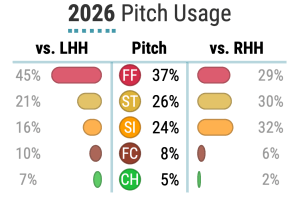
I’d also like to see him specialize a bit more. He’s got a revamped arsenal, but he’s throwing everything to both handednesses of hitters. Usually, after a change like what we saw with him, pitchers will specialize based on the platoon advantages of each pitch. Hancock has done so slightly, as we see fewer sweepers and sinkers to lefties with more 4-seamers to fill that space, but I wouldn’t call it a huge difference.
(Image courtesy of BaseballSavant)
Further optimization could be useful here. His 4-seam is the best it has ever been, but I don’t know that it warrants 45% usage against lefties. If he doesn’t trust the changeup right now, that’s fine, work in more cutters. As for righties, I don’t mind the three pitch mix he’s bringing right now, but I wonder if the extreme zone% disparity between his fastballs and his sweeper will get him into trouble eventually. For the millionth time in this article, I will suggest more cutters to help spread the burden and keep hitters guessing.
Hancock has repeated in multiple interviews that he likes to prioritize getting ahead in counts, throwing strikes, and being aggressive, and that’s been working for him so far this year. His fastballs are both in the 96th percentile among their pitch types for zone rate. I’m not sure he needs to be throwing them there quite that often, but I wouldn’t adjust it unless it starts biting him.
There’s something about Hancock’s development journey that’s a little bit funny to me. He came up leading with his 4-seamer as his primary. He then realized that it wasn’t going to work at the highest level in that state, so he dropped his slot and became a sinker guy for a year. Then he came back the next year pitching nearly sidearm and leading with a new and improved 4-seam while retaining the new sinker. He serves as a great example of how pitcher development is an inexact science that must be evaluated on a case-by-case basis. He’s still got a lot of work to do to clean up his process, and there are further improvements he could make beyond shoring up weaknesses. That said, in reinventing himself, he has substantially raised both his floor and ceiling as a pitcher.
*In this (linked) interview with Ryan Rowland-Smith, there’s a segment in which he breaks down the pitches of a specific at-bat, and he refers to a pitch marked as a cutter as his slider, which makes more sense anyway. I would not be surprised to see this be relabeled at some point in the future. I call it a cutter in this article because that is what it is labeled as on every website that offers pitch data and statistics, and I wanted to avoid confusion.
