





Potential doesn’t come across much more obviously than in a pitcher like Eury Pérez. He looks like a created player out there, standing at 6’8” and throwing fastballs that are more or less an upgraded version of what Gerrit Cole was throwing in Houston. Now, since coming back from his thigh strain in June, he’s been on fire, pitching as well as he ever has. Let’s establish what he offers so we can better understand how what he works with shapes his ideal form.
Tower of Power
As mentioned, Eury’s 4-seam is a monster of a pitch. He throws pure fuel, usually working 96-99 and running it up to 101. Perhaps more notably, he’s a pronator with exceptionally high spin rates. As such, he makes the most of this spin, getting well above-average rise and run on this pitch. Cole Ragans is the only starter with a 4-seam that moves more, but Eury’s is 3 ticks harder and has a better shape with more rise from a lower release point and arm angle. This also results in a fastball that is far removed from its expected dead zone.
Perez has started throwing a sinker this season, and it immediately became a staple in his arsenal, getting about equal usage amongst a trio of secondary pitches. While it looks like the 4-seam out of his hand, with only 4” of separation on both movement planes, this pitch has just barely enough to work with. Its shape isn’t great in a vacuum, with too much rise to get ground balls ordinarily. To do its job, it has to work contextually within his process and execution.
Eury’s slider reverted this season to something closer to what it was when he debuted. It’s a good, straight gyro slider in the high-80s that makes up for its somewhat limited depth by being well separated from his rising 4-seam, and also by virtue of being a hard gyro slider.
Eury’s sweeper is even weirder than it was last year when he introduced it. There are so few pitches that do anything like what this one does. Sweepers don’t normally rise like this. Usually when people talk about a rising sweeper, it has maybe 4-8” of IVB. Eury’s has 11.1”, and it rises more than it sweeps!
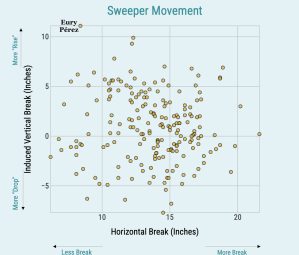
(Chart courtesy of BaseballSavant)
There’s nothing else like it, so it’s difficult to project how it will perform. So far, hitters have largely been overmatched by it, as it’s gotten above-average swinging strike rates while returning mostly unimpressive contact. His bad habit of leaving it down the middle has gotten it tagged for a few barrels, but it’s usually too much for hitters to do anything against.
Eury’s changeup has been a prospective offering used sparingly across his major league career. This has been especially true in the wake of his Tommy John surgery. It’s been documented that offspeed pitches are frequently the last thing pitchers regain feel for in the recovery process. This was evidently the case for Eury, as just seven (7) of the 131 changeups he threw after returning last season were in the zone. I am fairly confident that I have never seen a percentage that low in any sample for any pitch. Back on the topic of stuff, this pitch is theoretically solid. Not special, but he does repeat his delivery on it well enough, it spins on an axis close to his fastballs, and it has 8 mph of velocity separation with 8” of IVB separation as well.
As I commented on when I wrote about Eury last year, his old gyro curve is gone, and his current curveball is a slurvy offering that doesn’t have a ton of movement or elite velocity but does serve as a pitch that offers a different look. It can steal some strikes and induce some bad swings with its velocity gap. In a vacuum, it’s mediocre, but it has a place at the back of his mix.
Getting Vertical
Our own Nate Schwartz wrote about the troubles plaguing Eury right before he went down with the injury, and I highly recommend you read that article before continuing to get a fuller idea of where he was a few months ago. I’m covering the changes he’s made in this section, and I’ll be making reference to it, but the previous issues are outlined more completely in the article that was dedicated to them.
Eury’s re-breakout is not being driven by modifications to his stuff; a change in strategy has been the catalyst. Nate pointed out how Eury, like other Marlins starters, had 4-seam fastballs settling low in the zone, with hiLoc% far below the league average. This is quite simply not where a fastball like his belongs. I referenced Cole’s fastball earlier. Remember when he was in Pittsburgh throwing low fastballs and striking out 22% of hitters instead of 32%? This was a big reason why. Thankfully, it isn’t taking until the sixth year in Eury’s career for him to start making this adjustment.
Eury Pérez 4-Seam Locations
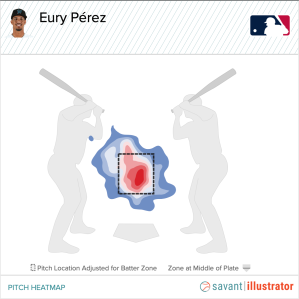
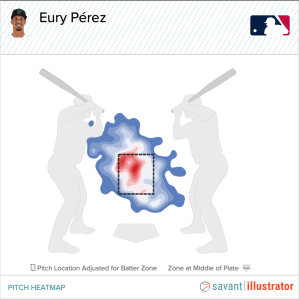
(Pre-injury left, post-injury right)
While the hiLoc% in this time frame still isn’t quite league average, 53.6% is noticeably better than the 45.3% (just 36.9% to righties) it was at before his thigh injury in May. It is also miles better than the abysmal 37.0% it was at last year. Oddly, this has not led to improved whiff numbers in this time frame. It’s getting more whiffs out of the zone, but not inside of it. Part of my theory is that the lower fastballs were getting confused for sliders, causing hitters to be late on it. His sinker usage is probably a big part of this as well, more on that later. There’s also likely some small-sample variance going on here. This slight drop-off in whiff rate while he learns to elevate the fastball properly is worth it because the contact against this pitch has absolutely cratered in the meantime. I can accept a drop in whiffs if this is what the non-whiffs look like.
Another thing Nate pointed out was that Eury wasn’t locating his slider well. “The in-zone location is poor, and the chase location is slightly too far from the zone. The spread of the pitch also shows how little feel there is, with so many pitches being non-competitive.” He was 100% correct about this! Then, as if Eury read Nate’s article while he was on the injured list, he made significant progress in this regard upon returning.
Eury Pérez Slider Locations
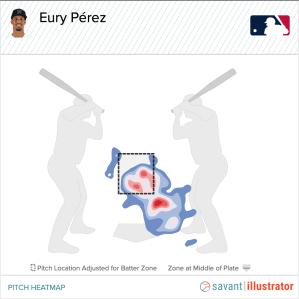
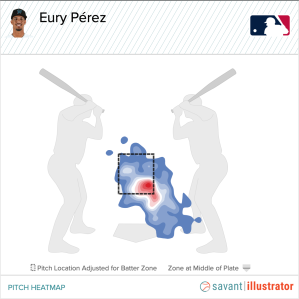
(Pre-injury left, post-injury right)
While it’s not perfect, it is at least consistently in a decent spot that plays well with where he’s been throwing his 4-seam as of late. Ideally, that deep red bubble would be a few inches further down and toward the lefty batter’s box, but we will take progress where we can get it. Also, I think the gravity of this change is illustrated well enough in the before-and-after splits.
Yeah, that tracks. It’s almost like high 4-seams and low glove-side gyro sliders are a tried-and-tested duo that works well together. This improvement has been the main catalyst behind his excellent summer. His ability to induce weak contact and whiffs with his 4-seam and slider has become an indispensable trait he did not have full access to earlier because of how he was using them. “The foundational change of being able to elevate the fastball should make it a pitch that can overcome problems with the rest of the arsenal.” You know, I think Nate may have been onto something.
Another big change he’s made is that his sinker is seeing a ton of use, including a stretch where it inexplicably became his primary fastball against lefties. I think this pitch is likely acting as a boon for the 4-seam. It could be part of the reason the results against it in this stretch have seen so much poor contact without a rise in whiffs.
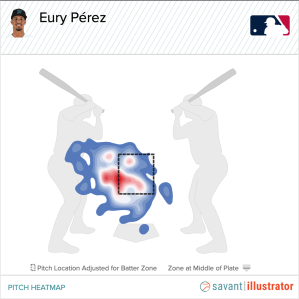
He’s pretty consistently throwing this pitch on the arm-side edge, usually around the middle or bottom third of the zone vertically. This spot does tunnel well with his 4-seam, but the limited movement separation is probably pushing those results in the odd direction they’ve taken. Regrettably, it’s taking on the issue we frequently see other “boon” pitches such as bridge cutters suffer, where they absorb all the damage and get clobbered.
It’s not quite that bad; it’s a diminished version of this type of problem. It also doesn’t get called strikes because he zones it at one of the lowest rates in the league. Presently, this pitch is functioning as a bulwark. It takes some damage while “protecting” (setting up) the other pitches so they can do what they do best. You can accept the low strike rate and lack of ground balls because it’s causing other pitches to play at higher levels. It also isn’t getting hammered or anything; it just gets taken for balls and hit for singles and the occasional double. It’s one of those things where you take the bad with the good for as long as the good is around, and then adjust as needed.
Reaching New Heights
Despite the recent success, Eury still has room to grow. Tall as the young pitcher may be and as well as he’s performed, he has yet to reach his rather altitudinous ceiling. He’s made progress, but his overall pitch execution could still use some sharpening. Building on the strides he’s already made, I’d love to see the sliders and 4-seamers pushed further in the directions we’ve seen them move this year. His sweeper and changeup command are still fringy at best, though he’s been making slow improvements on both. The sweeper’s weirdness is also helping it play well despite the mixed bag of location quality pitch to pitch.
One slightly out-of-the-box suggestion I don’t think we’ll actually see (even though I stand by it being a good idea) is that I’d love to see Eury’s sinker replaced by a splinker or 1-seam sinker if he’s capable of throwing one. Increased movement separation could do wonders for both pitches, driving up whiff rates while maintaining the effect of hitters being unable to discern which fastball they’re getting and having to hope for the best. You don’t need a ton of movement separation between a 4-seam and a sinker to get them both working, but Eury’s are toeing the line of being too close.
Beyond that, I think it’s going to be a lot of just waiting and seeing. At 23, Eury’s younger than most of the pitchers we see getting called up to make their debuts. Just five days separate him and Painter. His quick ascent to the majors was astonishing, but he’s still absolutely an unfinished project, developing as he learns. The progress we’ve seen this year shows clear growth both in skill and understanding of what works for him. It’s not a stretch to assume he’ll continue to make these kinds of positive adjustments.
Adapted by Kurt Wasemiller (@kurt_player02 on Instagram & Threads
@kuwasemiller.bksy.social on BlueSky)
