





After returning from Tommy John surgery last year, Eury Pérez looked poised to take another step forward in 2026.
In his age-22 season last year, Perez posted a 4.25 ERA, 3.67 FIP, and 19.0% K-BB%. His 1.9 fWAR was the best among any pitcher 22-years-old or younger. This put him into a grouping with other young pitchers poised to break out this year: Cam Schlittler, Nolan McLean, Chase Burns, Jacob Misiorowski, Trey Yesavage, and Bubba Chandler. As Eno Sarris deemed this group the “Hype Seven”, it was a collection of pitchers who all had top ten potential coming into this year. With Perez’s strong 2025, he stood out as one of the favorites among the group.
Just 52.1 innings into this year, Perez is doing anything but competing with the others. His 5.33 ERA and 5.20 FIP show poor topline results, and a 13.0% K-BB% is a big step backward from where he was in 2025 and 2023. His WHIP jumped up to 1.41 after a 1.05 and 1.13 previously. Perez’s 0.1 fWAR is second-worst of the group, only ahead of Chandler, but there were considerably fewer questions about Perez coming into this season.
Perez’s season has been confounding, despite the clear struggles. What made him part of that “Hype Seven” was the absurd stuff, and that has only improved in 2026.
His Stuff+ ranks third in baseball, with all the names around him being incredible company. Luzardo’s struggles have been well documented (link), and Woo had a home run problem that has since been corrected. Perez stands alone in outlier peripherals: his ERA, WHIP, and walk rate are all the highest of the group, while his strikeout rate is second-lowest. Compared to all starting pitchers (min. 100 innings in prior seasons) with at least a 110 Stuff+, it stands out even more.
Of the 61 player-seasons in this sample, there are more sub-2.20 ERA seasons than above-4.00. Perez’s poor 2026 stands out here too: highest ERA, second-highest WHIP, highest walk rate, and eighth-lowest strikeout rate. Clearly, something has gone drastically wrong, given the skill set.
While a handful of stats might’ve been the tell already, it’s command. Of the 660 starting pitchers since 2021 with either at least 100 innings or qualified this year, Perez’s 91 Location+ ranks eighth lowest.
Perez is the most “min-maxxed” pitcher in baseball right now, and definitely one of the biggest in recent memory. Only 2023 Shohei Ohtani and 2022 Spencer Strider are in Perez’s ballpark when it comes to high Stuff+ and low Location+ (2021 Corbin Burnes and 2026 Misiorowski are higher, but exhibited near league-average command).
All Stuff, No Command
His fastball is the loudest tool, a 98 mph offering that has the ability to overpower hitters. It has good vertical movement with a 1.3 height-adjusted VAA, setting up for whiffs up in the zone.
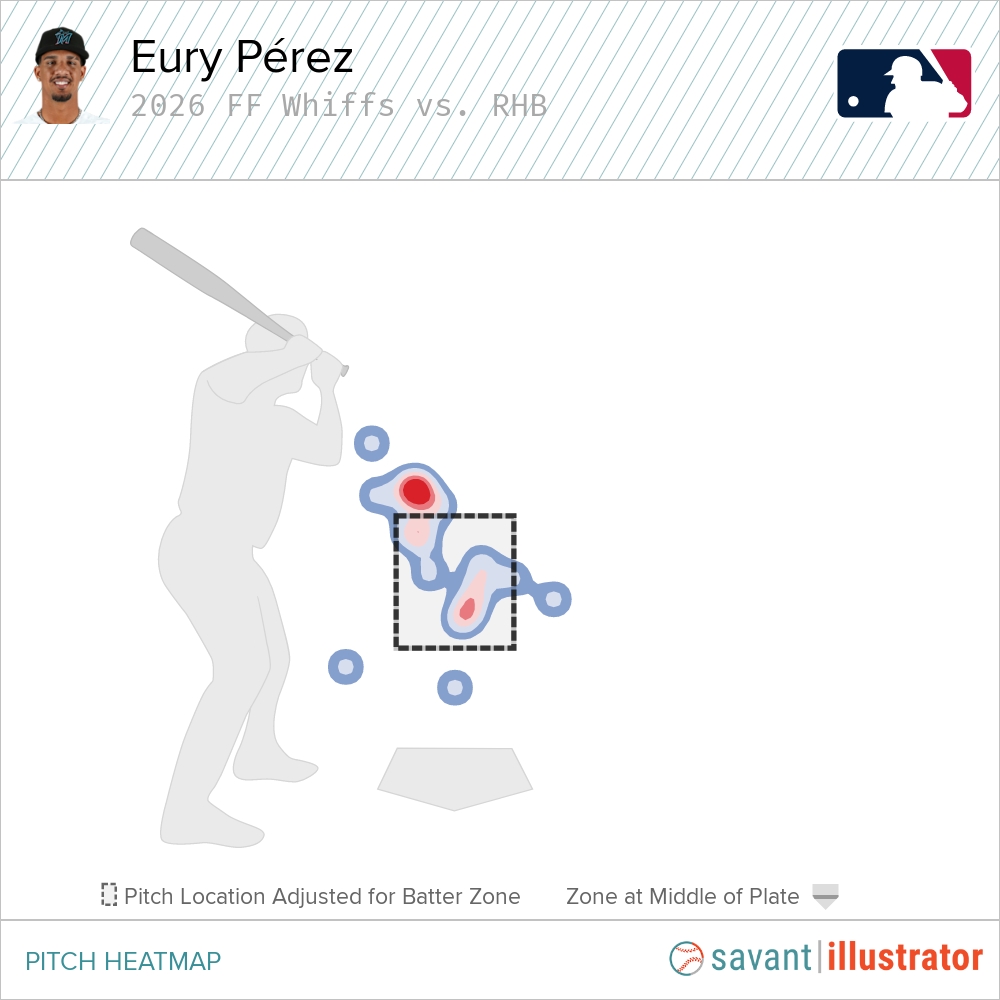
However, he elevates the fastball against right-handed hitters 33.7% of the time — a sixth percentile mark. He’s able to get chases on the pitch, but hitters are swinging more at the pitch despite a similar amount of pitches in the zone. Compared to 2023, he’s elevating the fastball 13.0% less, putting more in hittable locations. His swinging strike rate has remained above average, but the increased swing rate has turfed the overall CSW% down to a poor 24.9%.
Against lefties, Perez’s location is even worse: the majority of pitches are right in their wheelhouse.
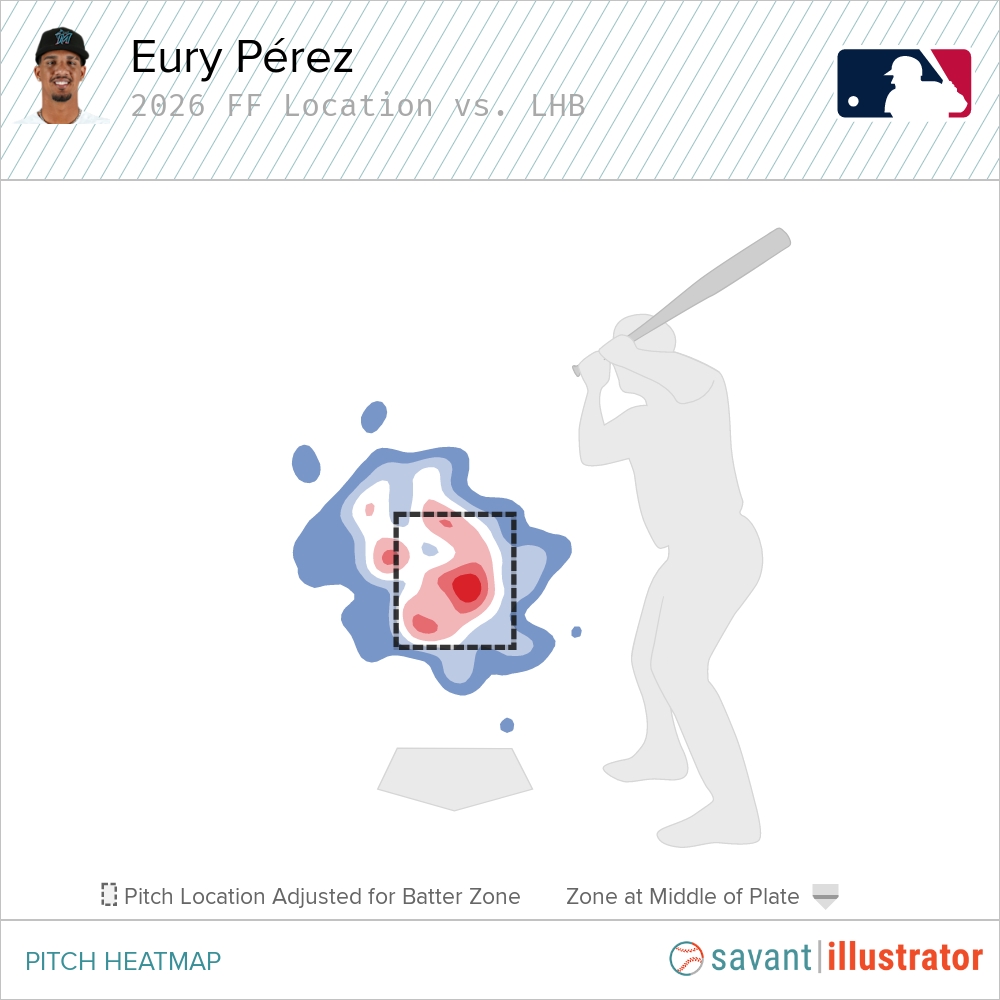
While he does elevate it slightly more, it’s still going right to where lefties do their damage. So even when he’s cruising, all it takes is one of many fastballs to be hit for damage.
The results against all hitters have been right around average. Decent amount of whiffs, poor amount of called strikes, and average contact. Including a home run problem driven by poor location, the results aren’t horrendous. This shouldn’t be an average pitch, though — it has the pure ability to be one of the best fastballs in the game, and his inability to elevate holds him back.
Perez also has one of the best sliders in the game by pure stuff, but again, it’s the command that holds it back. He’s throwing the pitch 1.5 mph harder this year, giving it more gloveside break and making it less of a true gyro slider.
He’s used it less than in past seasons, but it’s still his most frequently thrown breaking pitch against all hitters. His mistake rate on the pitch has nearly doubled, going from 6.1% last year to 11.0% this year. Mistake rate accounts for poor pitches in the zone, meaning that even a great pitch is suffering from poor location. The strike zone plot makes it easy to see why.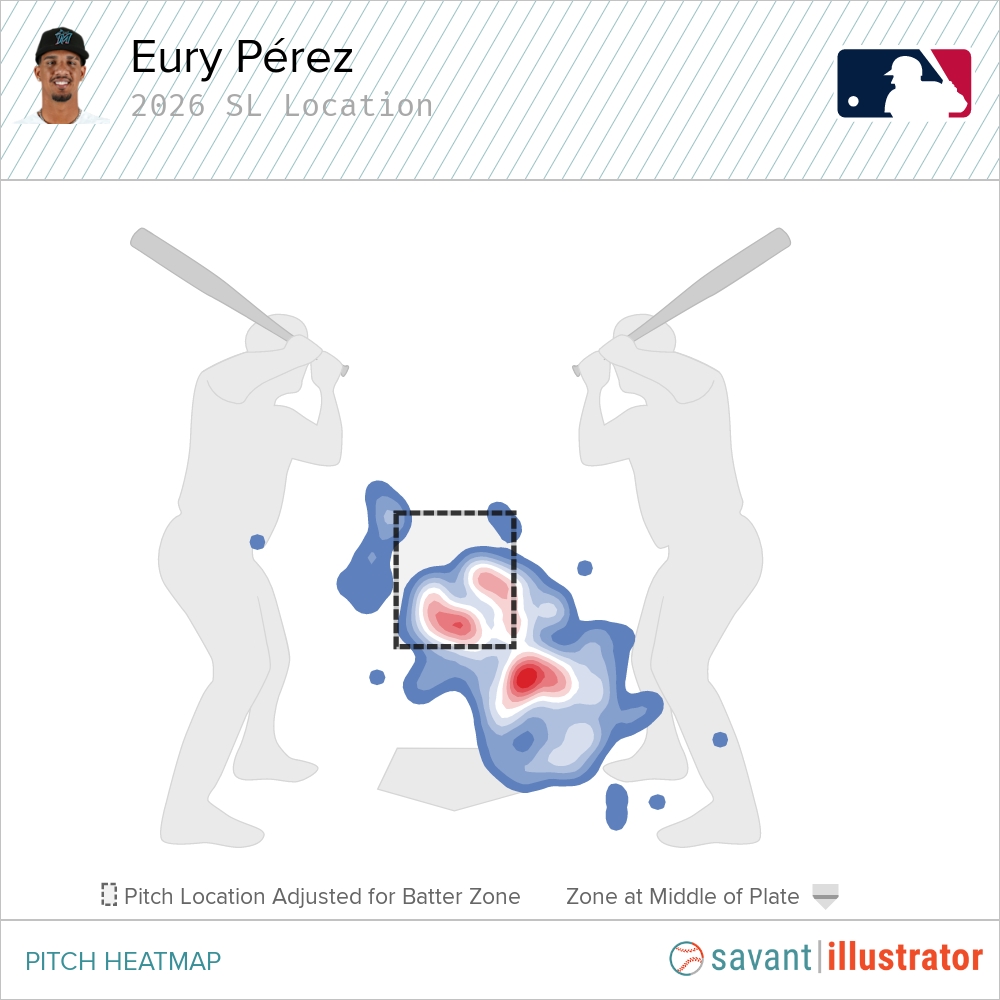
The in-zone location is poor and the chase location is slightly too far from the zone. The spread of the pitch also shows how little feel there is, with so many pitches being non-competitive. While the pitch is still capable of getting whiffs, the locations have led to increased damage on contact and a lower chase rate. Perez has never fully had a great feel for the pitch, but it’s taken a significant step backward this year.
Perez doesn’t need it to be a strike pitch; he just needs to get it to one spot and let the pitch do the rest of the work.
He runs into the same issue with his sweeper, which gets located middle-up to most hitters, setting him up for failure.
The curveball is the one breaking pitch that has arguably taken a step forward, becoming an effective called-strike pitch for lefties. Almost 75% of his curveballs are early in the count, and a 24.5% Called Strike% is a very strong figure.
The curveball makes up for the changeup, which is his main secondary to lefties. Once again, while the pitch can miss bats, it can’t find good locations. Perez’s changeup has a paltry 15.8% zone rate right now, which is arguably the most untenable part of the profile. This puts him in a tough position constantly, where he falls behind and hitters just know that something good is coming.
Where Does He Go From Here?
It’s been a tough start, but this is far from determining Perez’s outlook.
The foundational change of being able to elevate the fastball should make it a pitch that can overcome problems with the rest of the arsenal. However, that currently doesn’t seem to be in the cards for any of the Marlins pitchers. They rank last in elevated fastballs, despite Perez, Janson Junk, and Max Meyer all having fastballs that should be up in the zone. With coaches calling the pitches in Miami, this feels deliberate. Instead, Perez has recently added a sinker to mitigate the fastball troubles, which has been an intriguing but uninspiring addition so far (like most things, it’s not in the zone enough).
If Perez isn’t going to elevate the fastball, he needs to find stronger locations for the secondaries. It’s okay if it’s one location for each, because it’s a wide enough arsenal that sequencing can overcome that. But the number of meatballs he’s throwing drives the 1.72 HR/9, which is well above the 1.30 HR/9 he had coming into the year.
The home run problem also occurs once he gets deeper into games. Through the first three innings, Perez has a 2.70 ERA, 1.03 WHIP, 33.3% K%, and 11.4% BB%. All of those marks are in line with or better than his previous seasons. At the fourth inning and beyond, those numbers jump catastrophically to an 8.87 ERA, 1.93 WHIP, 15.9% K%, and 13.1% BB%. As Perez needs to go deeper into the arsenal, the results plummet.
Perez has the skills to pitch to where his ERA was last year, if not further. There’s a sub-3.00 ERA in there waiting to happen — it just might take time for one of the youngest pitchers in baseball to get there. The 5.33 ERA is tough to stomach now, and the lack of command is a current problem, but the ability to get whiffs across the board brings confidence. The struggles should turn into learning moments that allow him to adjust later in the season.
