





As fantasy baseball becomes more popular, a growing number of fantasy leagues are shifting away from the standard 5×5 scoring toward a scoring option with which fantasy football fans are comfortable with: points scoring.
Many people prefer the simplicity of points leagues when it comes to roster building and scoring. Others like it for its complexity and ability to capture stats far beyond that of a traditional 5×5 league. However, unlike fantasy football leagues, there is no universal standard fantasy baseball scoring system. This makes any column giving advice for points scoring inherently flawed, but we’ll do our best.
In points leagues, unlike standard leagues, you’re not trying to get home runs, RBI, saves, etc. Your goal is to maximize overall points. Therefore, in this article, we’ll discuss strategies for winning your points league, take a look at the standard scoring systems for each of the major platforms for those wanting to start their own points league, and evaluate potential scoring variations. As for my pedigree, I’m the reigning champion of my home points keeper league and have never finished below third in any of 10 points leagues over the past five years.
How to Win
The most important thing to do when joining a points league is to study the scoring system. The importance of this tip cannot be overstated.
Your league could have strange aberrations from standard scoring, allowing you to find value where there otherwise might be none. If your league’s scoring places a high value on starting pitching, it may be worthwhile to take a bunch at the beginning, settling for mediocre hitters. You might be in a league that gives 4 points for a stolen base (versus 1 on ESPN), for example, which would push players such as Trea Turner far up the rankings. If you take only one thing away from this article, it should be this: Know your scoring system. Keep this rule in mind as you read the following tips.
If you need an anecdote to prove the point, check out this one from our own Austin Bristow II:
“This past season, a friend of mine approach me with a proposal. She had read a few of my articles and wanted me to help draft and run a fantasy baseball team for her. She knew nearly nothing about baseball, but she was excited to try this out. Prior to her draft, she and I reviewed the points settings for the league she had joined and put them into a draft software I’d been working with to try to find excess value. Long story short, the points settings were very odd, heavily favoring starting pitchers that throw lots of innings. Knowing this, we planned for her to grab aces early, taking Corey Kluber with her first pick, soon followed by Justin Verlander. We also grabbed SP/RP eligible players, like Joe Musgrove, to fill out her RP slots because closers had nearly no value under these settings. She updated me periodically throughout the season, asking for a bit of advice only occasionally. She didn’t really need much advice because she was undefeated halfway through the season, easily making the playoffs despite her interest petering out a bit in the second half of the year. She wound up placing second in the league, due mostly to poor roster management in the playoffs. That being said, it was a very successful rookie season, due largely to the fantastic draft strategy she and I incorporated based on the league’s points settings.”
As you can see, taking advantage of an odd scoring system can put you in an excellent position to win your fantasy league.
The next tip is one that should be familiar to fantasy baseball veterans, and that is streaming. In categories leagues, streaming starting pitchers is a risky proposition that can result in a hit to your ratios that is impossible to overcome. However, in points scoring, streaming is far less risky.
A start from a starting pitcher usually results in positive points, with an elite start doing more to help your week than a similar start in categories, as the latter can only help you in three of 10 categories. Granted, this comes with the caveat that your scoring system supports this logic. If your league, like most, offers multiple points for each inning and only 1 point lost for wins, hits, and earned runs, then this should hold up.
Another important consideration for points leagues is roster construction. As discussed above, the goal in points leagues is to maximize overall points. To accomplish this, you want to maximize the number of players playing each day. In a standard format, careful consideration must be made to ensure that you play hitters with the highest upside so as not to tank your batting average, and you must carefully weigh all your pitching plays so as not to tank ERA and WHIP.
In points, ERA and WHIP mean nothing. Overall average means nothing, which means you can feel comfortable starting far more starting pitchers than you would in categories leagues — and thus, if your scoring system supports this idea, it would behoove you to have your roster feature far more pitchers than hitters, even to the point where you have no bench bats.
Some like carrying bench bats because of fear of injury or to maximize points because that bench bat has unique position eligibility. That is fair, but keep in mind that every day you have hitters sitting on your bench, you’re losing the opportunity for starters or closers to earn you points with that roster spot. In many points leagues, I will leave the catcher position empty, as the spot only gains me 10 or so points per week, whereas a starting pitcher has the potential for far more. Again, this tip depends on your scoring system, as it must be enough in favor of SPs to promote these roster construction methods.
Ultimately, this is tied to the first tip. If you know your scoring system, you can take advantage of it to construct your roster in the best way possible.
Basic Points Scoring
Although they differ, the major formats tend to follow a similar theme. Below, you can see the ESPN standard scoring system:
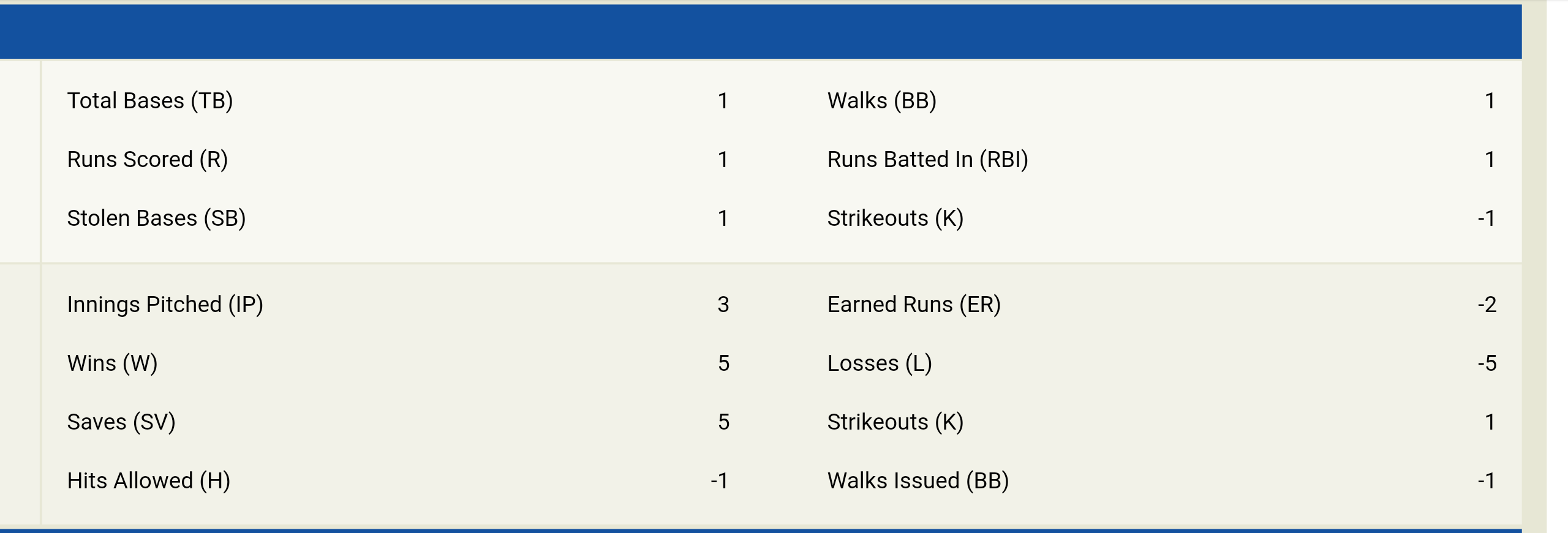
And here are the default Yahoo scoring settings:

And finally Fantrax:
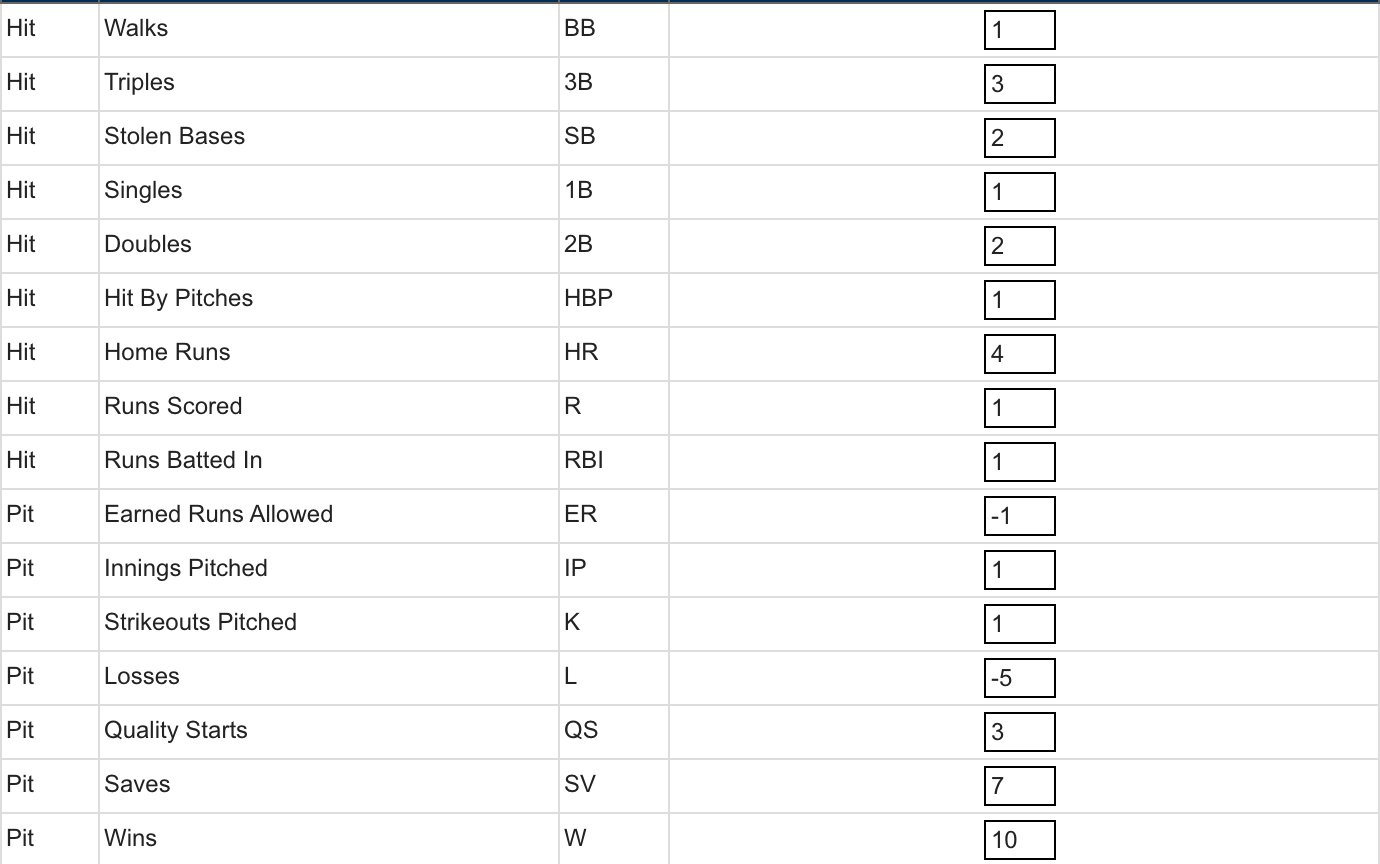
If you don’t want to customize your scoring system for fear of creating imbalance, I suggest Fantrax, as it is the most comprehensive. Each of these systems covers a number of different categories, but none is exhaustive. Each of the categories you see in each format is available in each scoring system, so if your league is in Yahoo but you like the Fantrax scoring system, you’re able to copy it over.
Ultimately, this is merely to demonstrate different approaches. Your league will choose whichever fantasy site is preferred. Where the fun comes in is where you feel that you want to add value to certain statistics or devalue others or maybe introduce new stats.
Customizing Your Keeper League
There are dozens of options for scoring categories in each of these formats that help keep the league fun. My home keeper league gives points for grand slams, no-hitters, and hitting for the cycle while taking points away for things such as errors.
The most important thing to keep in mind when playing with scoring categories or values of each category is balance. My first points league was back in 2014, and I realized only after Opening Day that pitchers were virtually meaningless because of the scoring system. While I was able to adjust to this and abuse the system to my advantage, it really wasn’t fun at the end of the day for Jonathan Lucroy (granted, he was an elite catcher that year) to be worth more than a combination of Jose Fernandez and Clayton Kershaw.
I highly recommend going to Fangraphs and exporting its standard data table for both pitchers and hitters into Microsoft Excel. From there, you can add multiplier values for each category you want to value and determine each player’s total point value for the preceding season to assess how balanced your league is. Maybe you want to make strikeouts more valuable, but in doing so, you realize that hitting would be negatively impacted, thus resulting in a corresponding increase in some category for hitters. Excel allows you to play around with the stat values very easily without much disruption and helps to visualize balance on a leaguewide scale.
The most important thing though is to have fun. If you and your friends love homers and want home-run hitters to be crazy valuable, then go for it. Just make sure you know how to take advantage of it and find value.
Graphic by Justin Paradis (@freshmeatcommr on Twitter)
