





I wrote some articles earlier this season pertaining to a couple of current buzzwords- spin rate and Bauer Units. Discussions abound concerning pitcher’s spin rate (and/or axis) and how it applies to pitch effectiveness. Sometimes fanatically so, velocity is deemed ‘king metric’ which can cloud other downplayed factors. Make no mistake, velocity has its value but to imply a pitcher fails or succeeds due to velocity increase/decrease is ignoring many variables (sequencing, location, etc). Bauer Units come in to try to encompass all of this in order to better understand how a four-seam fastball should be used (its applied to other pitches as well). BU’s are reached by dividing (average) spin rate by (average) velocity. The average four-seam velocity is 92 MPH with 2200 RPMs considered the median spin rate. When calculating a BU score using those metrics, you come up with a mean of 24. The creators of BUs, Driveline Baseball, uses it in the following way:
League average Bauer Units -> look into developing a 2-seam
Above average Bauer Units -> try to throw middle/up in the zone
Below average Bauer Units -> try to throw middle/down in the zone
One important thing to mention is BUs are more useful for pitchers in high school, college, and perhaps the low-level minor leagues. However, this does not mean we can’t apply it to and evaluate Major League pitchers. I found a good example of how this measurement, and some thoughts on spin rate itself, can be flawed.
The 2018 Milwaukee Brewers had one of the best relief pitchers in baseball with Josh Hader. He was the third-ranked reliever in WAR, struck out an incredible 47% of batters faced, was second overall by a fair margin in SIERA (1.70), and had the lowest rate of contact in the strike zone (67.8%). Hader was an incredibly valuable weapon for the Brewers in the postseason, mainly due to his elite fastball and how he supplemented it with a slider. Of pitchers who threw at least 50 innings in 2018, Hader’s four-seam fastball ranked seventh overall in Pitch Value (19.7 wFA) and third when the pitch is scaled to 100 (1.89 wFA/C).
A brief explanation of pitch values are provided by Fangraphs:
The first category is the total runs above average that a hitter has contributed against that pitch or total runs saved by a pitcher using that pitch. However, it is tough to compare these total numbers since hitters see different amounts of each pitch. The second category corrects for this, standardizing the values on a “per 100 pitch” basis. In other words, when you see wFB/C, that represents the average amount of runs that (pitcher saved) against 100 fastballs thrown.
Hader’s average fastball velocity is 95.1 MPH and his spin rate is 2043 RPMs. That scores a 21.5 on the BU scale. Since the average BU score on four-seam fastballs is 24, and Hader’s BU is considered below average, Hader should probably be throwing his pitch lower in the zone. Again, its hard to say how iron clad this metric is, but let’s roll with the BU premise.
Generally speaking, with some regard to velocity, if you have a high spin rate on your fastball, conventional wisdom would say you’d want to keep it up in the zone. Reason being is Magnus Force is affected by spin rate, especially the backspin on four-seam fastballs. The high spin keeps the ball on a (somewhat) even trajectory and can even appear to rise in a hitter’s mind’s eye. I’ve gone down this road before and more information can be found on Driveline’s site.
So what does Hader do with his four-seam? What happens in certain locations? Chart 1 breaks down each section of the strike zone.
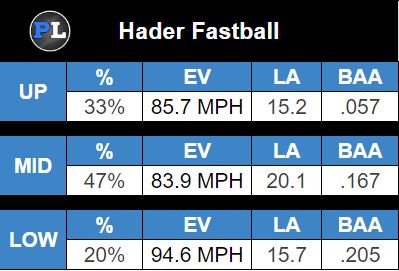
CHART 1
We can see that Hader is much more successful up in the zone. In fact, the exit velocity difference is nearly 10 MPH while keeping in mind sub-90 MPH EVs produce next to no home runs. Yet BUs would suggest he keep his fastball down.
Charts 2 and 3 display Hader’s batting average allowed and whiff rates, respectively (minimum 5 swings).
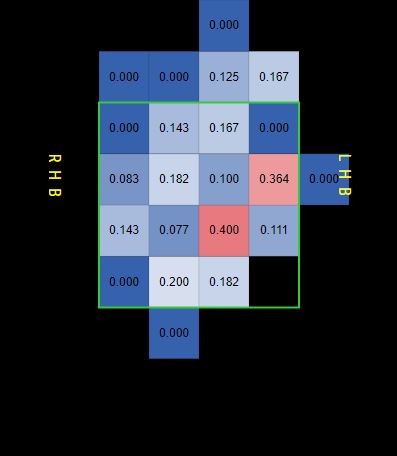
CHART 2
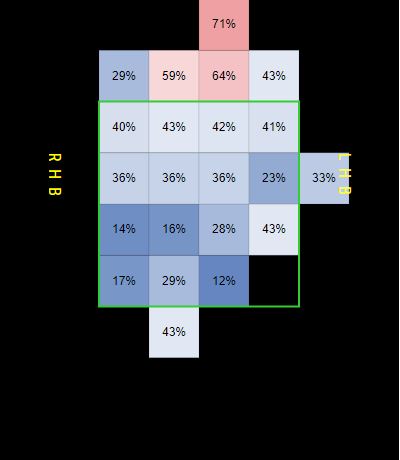
CHART 3
Again, we see Hader gets the best results up in the zone with his fastball. And this is in spite of his below-average spin rate and BU.
For reference, Chart 4 displays the top ten and bottom five wFB scores with the ratio of high fastballs, average spin rate, and BU score.
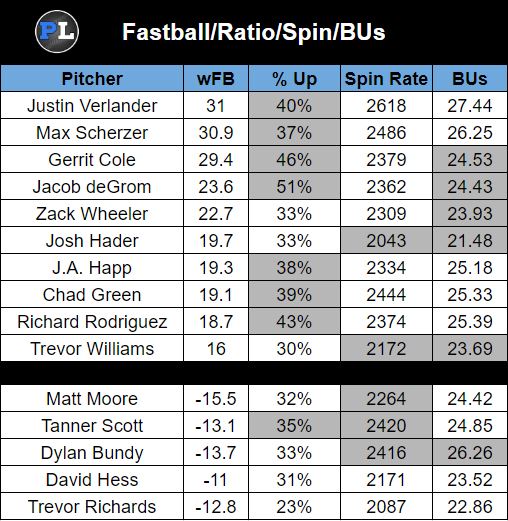
CHART 4
We see that only Zack Wheeler, Trevor Williams, and Hader all throw their fastballs up less than the league average of 34%. The bottom five’s Tanner Scott is above average. Only two pitchers (Hader and Williams) have a below average spin rate, while the bottom three in wFB have above average spin rates. Gerrit Cole, Jacob deGrom, Wheeler, Hader, and Williams have average or below BU scores, along with Dylan Bundy among the bottom five.
But we can’t rely on spin rate and Bauer Units alone. We have to take movement into consideration, right? Let’s look at Brooks Baseball’s Pitch IQ evaluation of fastball movement. To summarize, Pitch IQ normalizes movement in the same way that stats like ERA+ or FIP- do. A score of 100 would be considered league average, with anything above or below being above average movement and vice versa. To attempt to rank movement, I averaged out the movement scores. For context, the more overall movement, the better; a pitcher with great horizontal movement would be balanced out by weak vertical movement.
Of the top 20 wFB scores of 2018, Chart 5 shows the top ten average Pitch IQ scores.
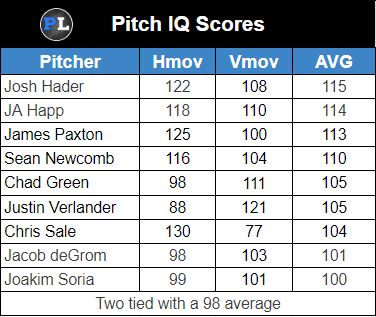
CHART 5
You’ll notice that there are several top-tier pitchers present in Chart 5. Can we assume that the movement they get on their fastballs makes the difference? Not exactly. When looking at the five worst wFB scores, four out of the five pitchers have above average overall movement on their pitches. Even pitchers with average fastball value don’t provide any conclusive evidence when reviewing their average movement score.
So where does that leave us? We can reasonably say that high spin doesn’t always make the difference, nor high velocity in tandem with spin (BUs). And movement can’t exactly be pointed to either. That doesn’t mean they are mutually exclusive metrics, either. Overall, location tends to matter more than anything else. Its great to have high velocity, an applicable spin rate, and movement. If you don’t locate, it’s all moot. In this case, looking at four-seam fastballs, its a clear advantage to throw up in the zone instead of down. Charts 6 and 7 display league-wide whiff rate and batting average against, respectively.
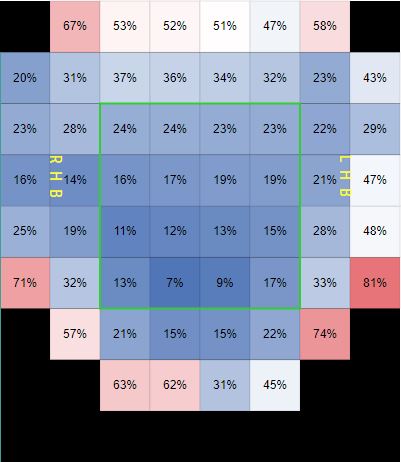
CHART 6
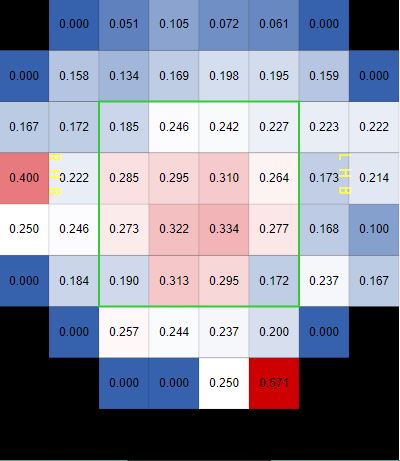
CHART 7
Placing a fastball high(er) in the zone, mainly up and in to hitters a la Effective Velocity standards, sets up breaking or off-speed pitch tunnels. Sequencing and tools such as creating pitch tunnels also factor in. According to Ev developer Perry Husband, Throwing up and in to a hitter can add as much as 4-5 MPH to a fastball in relation to reaction time to make positive contact. Anything down and/or away can actually subtract velocity thereby creating a spread larger than the radar gun is telling you in a hitter’s mind’s eye. An up (and in) fastball at 90 MPH can register up to 95 EvMPH depending on location and a curve (for example) down and away at 80 MPH can actually drop to 75 EvMPH. While both spreads are large, the further apart they get, the more the hitter’s attention zone has to account for. What’s more is if these pitches are tunneled properly, the hitter stands very little chance to be successful during their at-bat.
Its important for a pitcher to be aware of velocity spreads that can be created by putting a ball in certain locations. You can throw a fastball as hard as you want or create movement with spin rate (and axis), but if you can’t locate properly, you’re not going to last long. The aforementioned lowest-tier fastballs (Matt Moore, Scott, Bundy, Jordan Zimmerman, etc) have above average velocity, spin rate, and BU scores, yet they aren’t successful. And I have to reiterate that those things do have their place; knowing how your spin works with your velocity can be valuable information.
As an example, a query I ran on fastball value scaled to 100 (FA) pitches (wFA/C) in relation to velocity, just over a third of the top-30 performers had fastball speeds that were at or below average (92 MPH). You can’t expect that just because you throw 100 MPH, you can regularly blow hitters away. Or that you create a ton of movement, therefore you’ll always be able to throw a hitter off no matter how or when it’s used.
What’s the ‘x’ factor? Proper pitch location in conjunction with Ev tunneling (e.g.- high fastballs, away breaking pitches, down off-speed,) should always be given priority over velocity, spin, etc. Knowing this frees you from the stigma of needing high velocity and good movement to succeed. They make your weapons better but it won’t matter if you don’t use them properly.
Photo by Jimmy Simmons/Icon Sportswire
