





For the first time since his rookie season in 2021, Griffin Jax is starting games again. A lot’s changed for him since then, more than can fit into an article of reasonable length. Let’s instead focus on how this year is going for him; there’s a lot to get into.
An Appealing Hypothetical
Since his breakout in 2022, Jax’s arsenal has been defined by his sweeper, and it’s still his primary pitch as a starter. It is unquestionably one of the nastiest pitches in the majors. A full foot of horizontal movement in the high 80s is absurd power and break. Only Will Klein has a breaking ball that is thrown harder with more movement, and he’s a reliever who regularly pushes triple digits with his fastball. Jax’s sweeper has proven difficult for hitters to do anything with since his initial move to the bullpen, routinely returning above-average whiff rates and contact suppression.
Jax’s changeup leaped from conceptual to legitimate offering in 2024 when he started using it more. The Rays have been the beneficiaries of this growth, as he’s used it even more since being traded to Tampa. It is a devastating pitch with strong spin deception, more than an hour of seam-shifted wake, and tremendous movement separation from his fastballs. It’s arguably been his best pitch this year.
Jax’s sinker has taken on a more prominent role in recent times, becoming his primary fastball against right-handed hitters. Its shape is somewhat weak in a vacuum, as it lacks significant depth or steep approach angle. It does have tremendous run for his arm slot, and good velocity, but that’s most of what it has going for it on its own. In theory, it works within the context of his arsenal as it fits nicely with all of his other pitches, especially the 4-seam, sweeper, and changeup. He also commands it well. In more limited use, it has been a ground-ball machine for him.
Despite being a supinator, this is the first year in which Jax has thrown more sinkers than 4-seamers. His spin traits and delivery have previously made his 4-seam the superior fastball. He creates solid movement due to high spin rates that offset the relatively low active spin percentage. This, coupled with his mechanics, produces a fastball with above-average ride for a lower-than-average release. This has been amplified since his move to Tampa, as the domed environment and near sea-level elevation are known to slightly boost the movement of 4-seam fastballs.
Unsurprisingly given his aptitude for the sweeper, his curveball is a similarly ridiculous pitch. At present, nobody throws a curveball with more negative IVB than Jax’s at a higher velocity. This pitch is an absolute hammer, capable of racking up whiffs at will.
Like most cutters, grading its stuff is more context-dependent than straightforward. He throws it hard and gets it over the horizontal neutral line pretty consistently. It has fairly generic movement, without significant rise or depth compared to average, but it does serve as a bridge pitch for his fastballs and sweeper.
Contact Sport
It all sounds great in theory. It’s a phenomenal arsenal, with four plus pitches, including three that comfortably push a half step further in their grading. Unfortunately, Jax has one significant flaw. When the ball has been put in play this season, there haven’t been many pitchers with worse expected numbers than him. His pitches, for all their stuff quality, seem to be getting crushed on contact. Or, have they? The numbers don’t seem to be definitive on their own.
Now why is this? Sure, maybe you expect that for a 4-seamer, but the changeup and sweeper? Those pitches should be suppressing contact with no issue. Also, if his contact metrics are this odd, how is he pitching so well as a starter while his K rate has dropped so much? Looking at his run since moving to the rotation, he has the 31st-ranked ERA out of a group of 123 pitchers with as many innings as he has in that time. None of this makes sense. Don’t worry, I was confused too. Let’s look at his pitches individually and figure out what’s going on.
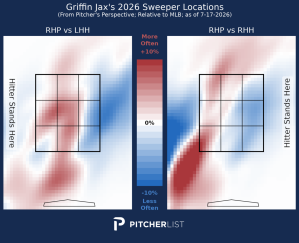
You can see part of the problem here. While the batted balls haven’t been falling much, hitters have been pouncing on his sweeper when he leaves it vulnerable. Too many of these pitches are finding the middle of the plate.
He hasn’t been burying it or pulling it to the glove side as much as he usually does, and the barrel rate and expected numbers on contact have skyrocketed. At the same time, when it’s been located well, it’s been good. The barrel rate is up, but the ICR% is down significantly as he’s seen far fewer flares and burners against this pitch this year. Furthermore, most of this contact hasn’t been pulled, lessening the potential for damage. He’s gotten into trouble when he’s hanging this pitch, but when it’s where it belongs, it’s as good as it’s always been.
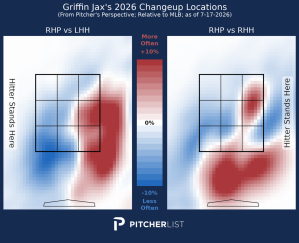
His changeup locations are exceptional. Posting a 49.5% O-Sw% on any pitch is absurd, but even more so when you’re only zoning it 32.4% of the time. Why the contact numbers on this pitch were poor isn’t going to be found here, even if he has occasionally left the odd pitch in the upper-inner quadrant to a righty. No, we have to dig a bit further into the batted ball data.
There’s the culprit. If you look at the individual batted balls against his changeup this season, you’ll notice an inordinate number of balls hit reasonably hard with launch angles between -5° and 10° or so. While they don’t represent huge threats, they do frequently become singles and doubles if they find the right space. They are also inflating the heck out of his batted ball numbers on this pitch because he’s only given up two barrels on it all season. When it’s not a ball with a decent chance of being a single, it’s a mediocre ground ball. That is the majority of contact allowed on this pitch. It is nothing to be worried about.
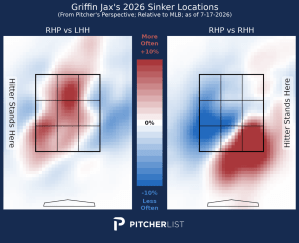
Somehow, someway, his worst pitch stuffwise by a mile is the one suppressing contact the best. It’s functioning as a slightly better-than-average sinker, due in large part to his ability to bury it down and in against righties. We could talk about how the way his sinker fits between his 4-seam and changeup allows him to use all three in tandem, but he hasn’t done that all that much. He hasn’t needed to.
This pitch is doing everything it needs to mostly on its own. He’s throwing it early and often, especially to righties, and it’s been playing better than expected.
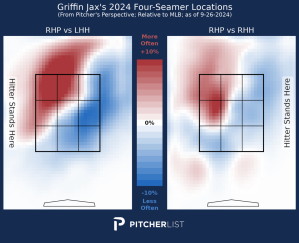
I hate to be the bearer of bad news, but the damage must come from somewhere. We’ve determined the numbers on his sweeper and changeup to be at least somewhat flukey, but there’s no getting around this set. It’s weird though, in some ways it’s actually doing better. The full-season stats for this pitch look dramatically worse due to his early-season blowups as a reliever. This pitch is still getting hit, but it’s not as bad as it could be, and the problem is identifiable. While I do love the location frequency heatmaps, they aren’t universally useful; sometimes the raw pitch location plot helps us better spot trends:
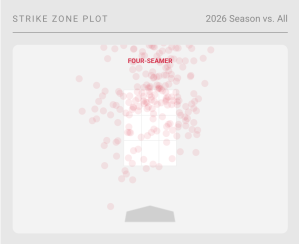
While his rate of 4-seamers at the top of the zone is not particularly noteworthy, the problem is that they aren’t directly above the zone as often as I’d like. He is consistently putting them in a spot where they are still hittable, and that’s where it’s hurt him. Also, while we’re here, we should talk about how his locations are affecting pitches that aren’t put in play. He has the fourth-highest 4-seam waste zone rate among starters this season, and in general he’s just missing by too much for them to be tempting. The misses on the sides of the zone aren’t doing him any favors either.
It’s very strange to say, but his 4-seam command is the weakest of the pitches we’ve looked at so far. It’s worth noting this wasn’t an issue for him in 2023 or 2024, though. He did make a slight mechanical change in 2025, but it wasn’t anything huge; I’m not sure it would’ve thrown off his command enough to affect his results this much. I’m hoping he can regain his 2024 form of the pitch.
He hasn’t thrown his other two pitches enough to say anything definitive about their batted ball numbers, which is why they weren’t included in the tables. With how he’s spread out his usage, he’s barely thrown enough to cover the others with any certainty. Grand totals of 9 and 13 of his curves and cutters have been put in play this year, respectively. I am not wasting your time or mine on in-depth analysis for that. On the whole, his curveball execution has been decent, returning an above-average CSW% despite an exceptionally low zone rate. The cutter has been bad in limited use. He has not located it well, and he should consider shelving it until such a time comes that it can be helpful.
Further Oddities and a Muddled Outlook
So, what do we make of this? His ERA as a starter this season after his solid outing against Texas this past Wednesday sits at 3.24. We’ve established that a lot of his ugly batted ball numbers are noise and can be somewhat ignored. His season numbers are skewed by his awful first month of the season when he was still coming out of the bullpen. Yes, the Rays saw Jax flounder his way through April and decided to go forward with the plan to stretch him out for starts anyway. Bold move, but it’s been working.
Jax is in an interesting spot. There are clear areas to improve, but he’s also pitching rather well. I think he’s been favored by the baseball gods a bit at times this season, and he’s probably earned an ERA that’s a touch higher than it currently is, but not nearly what some estimators would suggest. A lot of his stats read really well:
The drop in strikeout rate isn’t anything to worry about either. His putaway rate is still phenomenal; the falloff has been due to an explainable decrease in two-strike counts.
His early BIP% is the highest it’s ever been, and it seems to be something of a conscious choice. He has very much enjoyed throwing early sinkers to try to induce contact quickly to help him pitch efficiently and extend his outings while being on a pitch limit. 37 times*, a whopping 14.8% of all of his sinkers, have resulted in balls in play on an 0-0, 1-0, or 0-1 count. It’s the fourth-highest rate among starters that have thrown at least 250 sinkers. 25.5% of his sinkers in those counts were put in play, the fifth-highest rate among starters who have thrown at least 150 sinkers in those counts. It’s happened with 11.1% of all of the batters he’s faced. To put it into further context, in the previous three seasons combined, his sinker did that 39 times, or in 4.7% of matchups. The increased sinker usage is a major reason for the diminished K rate, not stuff loss.
He’s reworked his usage to round out his mix for starting, as it’s difficult to beat hitters multiple times with a two-pitch mix like he had gotten used to pitching one inning at a time in relief. I’m not entirely convinced his current usage is optimal, but it’s been successful. Looking at how he’s going after hitters, I can’t help but wonder what it looks like when he uses his fastballs and changeup to work off of each other; those pitches should play so nicely together. At the same time, I can’t exactly advocate for him to throw more 4-seamers when it’s been his by far the worst pitch of the main five this year.
I’m not even sure what to watch for in his case right now outside of: “Is he pitching well?” He has a lot of directions he could go in because his stuff is so good that he can try several different approaches and probably expect some level of success. That start he just had against Texas, he used the sinker as his primary fastball against both righties and lefties and relegated the 4-seam to minimal usage. But he located it well and got five chases on seven 4-seams above the zone, with four total whiffs on just eight pitches.
There is so much weirdness in his profile right now that it’s hard to get a confident read on him. I think I believe in him as a good short outing starter now? Probably? When I started digging into his numbers after noticing them, I wasn’t really sure what I’d find. I wound up coming out of it feeling more positive and reassured than I did upon first seeing them. Take that as you will, I suppose.
*Stats are up to date through his start vs Texas on July 28th, except for this paragraph specifically, which does not include that last start due to when Savant adds numbers from the previous day to the database.
