






As I see it, the Most Valuable Player award should go to the best player in either league. We often get into semantic debates about what makes up the MVP, which is tough, because we already have enough trouble trying to come to a consensus even if we agree on the operational definition of MVP. Last year, Shane Bieber raised the MVP hardware over his head, but it was in the All-Star Game. This year, though, I’m going to state the case for Bieber as the clear-cut AL Cy Young winner, but also as a player with a case for winning the MVP award too.
For AL pitchers, it’s not even close. Even in a shorter season, Bieber has distanced himself by 1.1 WAR from the next player (Zack Greinke). For reference, the difference between Bieber and Greinke (1.1 WAR) is equal to the difference between Greinke and Mike Minor, who ranks 25th in starter WAR. Bieber has been out of his mind this year.
Here’s how he ranks by various metrics, for AL starters:
- K%: 1st
- K-BB%: 1st
- ERA: 1st
- FIP: 1st
- xFIP: 1st
- xwOBAcon: 29th (46th percentile)
Limiting hard contact has never been Bieber’s strong suit—in fact, it was previously the one flaw in his game that made him mortal—but he’s hovering close enough to league average that his ability to garner called strikes and whiffs outweigh his batted ball quality significantly, hence his 95th percentile xwOBA.
Bieber’s dominance goes even further than this, though, as he’s captured more conventionally prized accolades:
.@ShaneBieber19 is the first pitcher to complete the triple crown since Johan Santana in 2006. pic.twitter.com/70AGIB97AC
— MLB Stats (@MLBStats) September 27, 2020
The obvious caveat here is that Bieber is operating under the auspices of a dramatically shortened season, so there’s something of an asterisk here as it pertains to the pitching triple crown, but it’s impressive nonetheless. In any case, the MVP doesn’t only include pitchers! We should consider hitters!
On the hitting side, it gets more complicated. Bieber and José Ramírez are tied in WAR, at 3.2, to end the year. Already, Bieber may be at a disadvantage, but it should also be considered that a pitcher hasn’t won the MVP since Clayton Kershaw in 2014. For AL pitchers, Justin Verlander in 2011. Before that? Dennis Eckersley in 1992. It simply doesn’t happen—but I think the arguments for it happening this year are strong.
In any given season, WAR is often a pretty good measure for the most valuable player. In general, it’s an approximation of a player’s value, and it has error bars on either side for every player. That makes it pretty messy over a full season! In a 60-game season? We’ve descended into madness. Fortunately, on the pitching side, there isn’t really an argument to be had that there’s been a more valuable pitcher than Bieber.
| WAR | |
|---|---|
| Shane Bieber | 3.2 |
| José Ramírez | 3.2 |
| Anthony Rendon | 2.8 |
| José Abreu | 2.7 |
| Mike Trout | 2.6 |
| DJ LeMahieu | 2.6 |
| Brandon Lowe | 2.4 |
| Tim Anderson | 2.2 |
| Zack Greinke | 2.1 |
| Kenta Maeda | 2.1 |
As mentioned, WAR has its limitations, but it’s generally pretty strong at capturing the broad strokes. With that said, I would be remiss if I let it guide the entire conversation here—especially given the tie for first. Given that there aren’t many overlapping statistics between hitters and pitchers, the best that I think we can do here is to consider WPA/LI and REW. Those don’t exactly roll off the tongue — and they’re not cited very often, either — but they should give us additional insight paired with what we already know with WAR. WPA/LI is essentially the win expectancy version of WAR, whereas REW is RE24 (similar to WPA, but doesn’t account for inning or score, and thus is more context-neutral), converted to a wins scale. All three of them serve the purpose of counting stats on similar scales to WAR, coming from different perspectives.
Let’s start with a scatterplot, plotted by WAR and WPA/LI, considering AL hitters and pitchers:
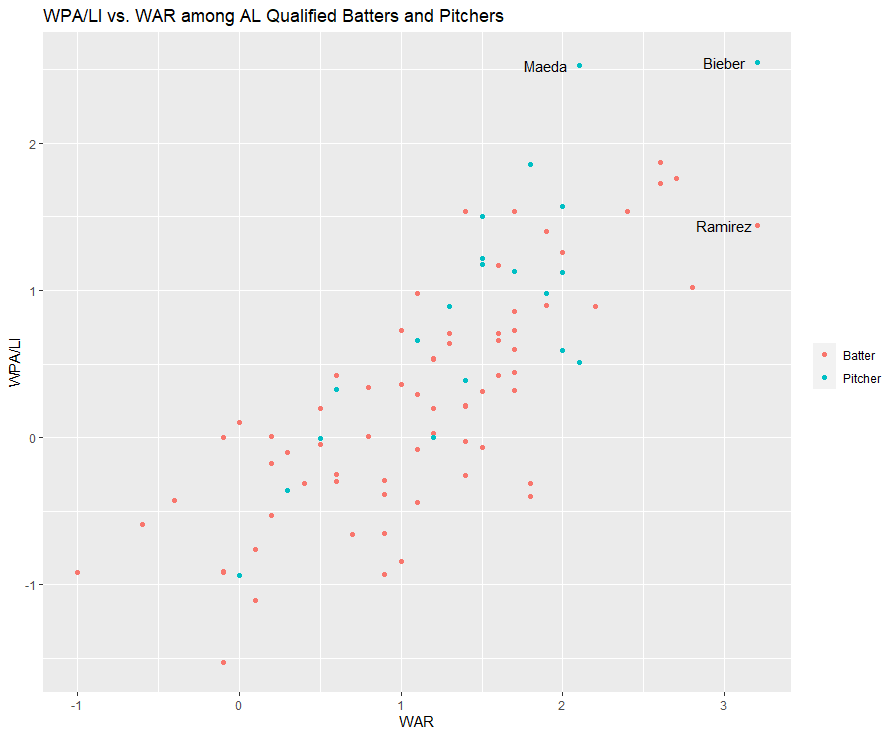
Here, you can see that Bieber is in a league of his own. Ramírez matches him by WAR, but falls well short by WPA/LI. Conversely, Maeda measures up by WPA/LI, but is 1.1 WAR behind Bieber. And so, not only did Bieber demolish other pitchers, but he also sets himself apart from hitters, which feels fairly uncommon.
And then another scatterplot, this time plotted by WAR and REW, looking at AL hitters and pitchers, once again:
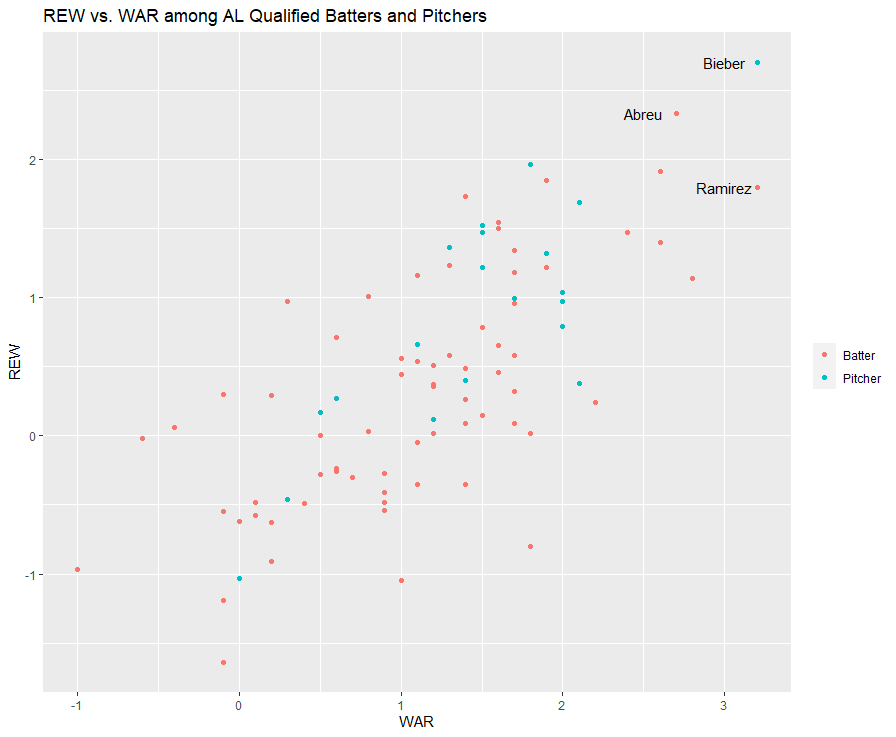
Again, Ramírez matches Bieber in WAR, but he falls well short in REW. This time, José Abreu is equally close to Ramírez here: the sum of Abreu’s WAR and REW is 5.03, while Ramírez’s is 5.0 and Bieber’s is 5.9. Bieber can’t be touched.
By plain ol’ WPA, Bieber’s 3.05 bests the next-best player, Brandon Lowe, who checks in at 2.50. Bieber’s 28.89 RE24 leads the league. By rWAR, Bieber, once again, leads the league, at 3.3. Unless I’m misapplying these statistics—and I don’t think I am—then perhaps Bieber should be the favorite for the AL MVP. The only thing left to do, in my mind, is to consider MVP pitchers from the past decade. It hardly happens, so we have 2014 Clayton Kershaw, and then we have 2011 Justin Verlander. Let’s consider these two years from the same perspective we’re considering Bieber.
A leaderboard, showing WAR, REW, WPA/LI, and their sum (which we’ll call COM) for 2011 AL players:
| WAR | REW | WPA/LI | WAR + REW | WAR + WPA/LI | COM | |
|---|---|---|---|---|---|---|
| Verlander | 6.5 | 5.28 | 6.37 | 11.78 | 11.78 | 18.15 |
| Ellsbury | 9.5 | 5.86 | 4.55 | 15.36 | 14.05 | 19.91 |
| Bautista | 8.1 | 6.91 | 7.04 | 15.01 | 15.14 | 22.05 |
| Pedroia | 7.9 | 2.95 | 2.86 | 10.85 | 10.76 | 13.71 |
| Kinsler | 7.3 | 1.86 | 2.54 | 9.16 | 9.84 | 11.7 |
And then another leaderboard, showing the same statistics, but this time, for 2014 NL players:
| WAR | REW | WPA/LI | WAR + REW | WAR + WPA/LI | COM | |
|---|---|---|---|---|---|---|
| Kershaw | 7.9 | 4.92 | 4.97 | 12.82 | 12.87 | 17.79 |
| Posey | 7.6 | 3.99 | 5.70 | 11.59 | 13.30 | 17.29 |
| Lucroy | 8.2 | 2.86 | 2.35 | 11.06 | 10.55 | 13.41 |
| McCutchen | 7.4 | 4.93 | 5.38 | 12.33 | 12.78 | 17.71 |
Verlander? He shouldn’t have won. But he did! This is, to me, proof (albeit anecdotal) that pitchers don’t necessarily have to have the best case to win. It can happen! Although, I will mention that this is more so a function of voters not being as savvy in 2011. I wouldn’t think this same mistake would happen today. For Kershaw, he had a much more compelling case relative to his peers, but given something of a toss-up between him and a catcher (Posey or Lucroy, depending on how you look at it), the voters are going to go with Kershaw. Although these are six and nine years ago, they serve as precedents for Bieber, and I think Bieber states a better case than either of them did.
Regardless of who wins the AL MVP award, both Bieber and Ramírez are deserving. If I were a betting man—and I am not a betting man!—I imagine Ramírez will come home with the hardware. That Bieber has kept up a pace like this over a 60-game stretch is awfully impressive, and if he were in the NL (which is packed with competition for NL Cy Young), he would still likely win the Cy Young. Nonetheless, Cleveland has two MVP candidates on their team. If Bieber wins, it would be nearly unprecedented. That’s how good his 2020 has been. I’ve talked myself into Bieber as MVP. I hope I’ve talked you into it too.
Photos by Frank Jansky/Icon Sportswire | Adapted by Justin Paradis (@freshmeatcomm on Twitter)
Scatterplots by Paul Brendel (@brendalizer on Twitter)
