





If you happen to be a fan of a team other than the Padres who consumes baseball highlights primarily through social media, you might think everything’s just fine with Jackson Merrill. This past Monday, he robbed Alec Burleson of a home run, and that wasn’t even his first larcenous act on a would-be-home-run this season. He’s just a couple of years removed from a 5-WAR rookie season and has an envious combination of speed and defense. He was already fast before, but he added a couple of ticks to his sprint speed over the winter and is on pace to steal 25 bases.
Despite all that, his .612 OPS is 11th-worst among qualified hitters in the big leagues. The Padres’ inability to hit this year has caught up to them. There has been plenty of talk about Fernando Tatis Jr., who didn’t go yard for the first time until the end of May, and Manny Machado, whose .180 BABIP suggests he was hexed by an evil spirit. Merrill has been less productive than both. This is a guy who hit .292 with 24 homers and 31 doubles at just 21 years old. If it weren’t for Paul Skenes, he would’ve easily won Rookie of the Year. That first season got him a 9-year extension that kicked in a few months ago, and while his sophomore year wasn’t quite as impressive, he was still firmly above-average with the bat and glove, as well as on the bases.
He hasn’t been completely healthy the entire time, as a concussion sent him to the IL for a week last June. However, a nagging injury is an unlikely story here unless the Padres are great at being secretive; Merrill’s 2nd-best month of 2025 came in September after he recovered. His average bat speed is up to 73.5 MPH, a 1.5-MPH increase from last year, so between that and the outstanding foot speed, he continues to trend upward physically. The reasons for his 71 OPS+ lie further beneath the surface.
I should note that while Merrill is using his quickness to his advantage on the bases, we’ve yet to see the bat speed increase pay off with respect to his power numbers. The hardest ball he has ever hit in the majors came off the bat at 111.6 MPH in 2024, a mark he has yet to top. His barrel rate is also down to 9.9%, and while that’s the lowest of his young career, it’s still in the 63rd percentile. His steep swing is geared for flyballs and he’s still hitting a lot of those while continuing to make his hardest contact in the air.
Merrill has long been aggressive, with chase rates in the mid-30s ever since he first donned a Padres uniform. However, he’s been more disciplined in 2026, and it hasn’t come at any cost to the frequency with which he swings at pitches in the zone. His numbers are a slight byproduct of the fact that pitchers know by now that he’s a swing-happy guy, as the rate of pitches he has seen in the zone is 45.2%, which is both the lowest of his career and one of the lowest in baseball. No one is a better hitter when they aren’t seeing pitches to drive, but Merrill has done a good job adapting to where he’s being pitched.
A look at pitch type splits is where things start to get weird. Merrill teed off on four-seam fastballs in his first two seasons, hitting 18 of his first 40 career regular-season home runs against them. This year, they’ve become his Achilles’ heel. Ironically, his hard-hit rate against them is the highest it’s ever been, but he’s coming up empty on a lot more of them. For that matter, his contact rates in general are squarely below-average for the second year in a row after they were excellent in his rookie year. Admittedly, I have no idea what to make of this. He didn’t post a strikeout rate higher than 20% at any level since his age-18 season in the Arizona Complex League. Either way, the swings and misses are here now, and they’re happening a lot on fastballs.
To me, the reason this is happening lies primarily within his batted ball distribution and swing path. When he took the league by storm, Merrill could hit for average and power to all fields. Two years ago, especially, he did a terrific job of using the middle of the field, hitting plenty of flyballs and line drives and keeping the ball off the ground. Below is a side-by-side comparison of his spray chart for every big-league season he has played. 2024 was a brilliant act of symmetry. He pulled the ball a tad more in 2025, but we still see a variety of hits all around the diamond. This year, he’s gotten away from that.
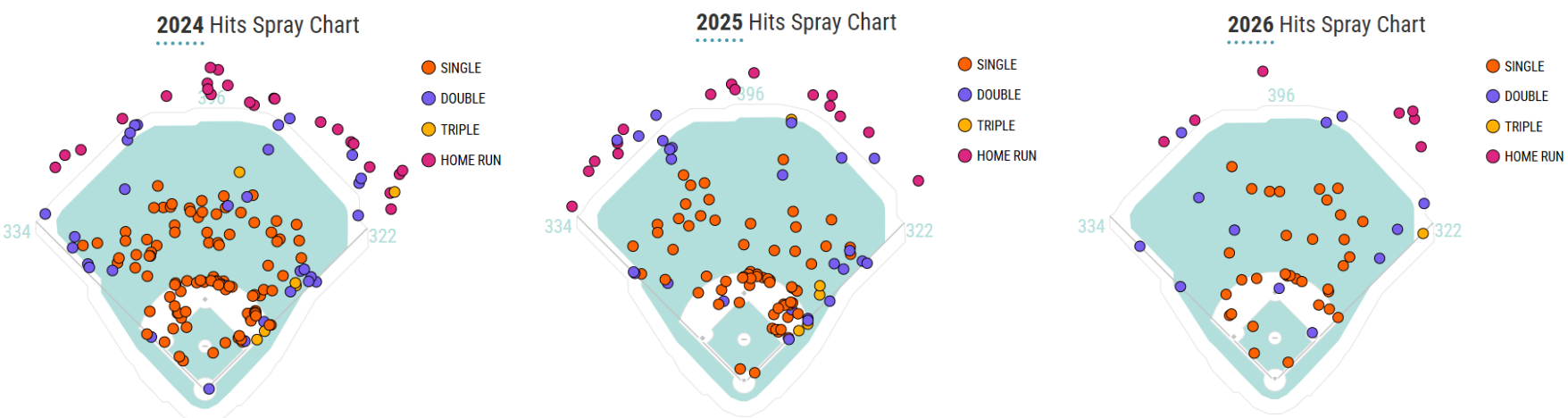
Jackson Merrill Hits Spray Chart, 2024-26 (Baseball Savant)
His bat tracking stats show a classic secondaries-out-front, fastballs-let-it-travel profile. He didn’t pull the ball that much in years past and his average point of contact was deeper toward the plate than most, but that was all fine and well because he has above-average power and an uppercut swing. Not many players who come to the big leagues with contact-ability like his can claim to also have a bat path that naturally lends itself to power production without the need to manipulate stance or position in the box. For him, it makes sense to lean into that unique skill set and shoot hard-hit balls all over the field.
This year, though, he has the highest attack angle and shallowest intercept point against fastballs of his career. I have a hard time believing that isn’t at least partially related to his recent swing-and-miss issues against them. In a vacuum, it’s better to maximize pulled contact in the air to see better results on batted balls. Merrill proved he could make it work without doing that, and I wonder if he’d be better off reverting back to what he was doing before. It’s interesting to see things unfolding this way for Merrill, especially because teammates like Tatis struggled early on, thanks in part to a lack of pulled flyballs.
This theory is supported by the new bat positioning metrics released by Statcast last week. On fastballs as a whole (Baseball Savant includes four-seamers, sinkers, and cutters in their definition of the fastball group), Merrill has never been more on time than he is this year. The problem is he’s also early more often and when he is, it’s by a few more milliseconds than usual. Perhaps he’s someone who actually benefits from being a smidge late to velocity because he has the natural ability to fight it off the other way for a hit?
For what it’s worth, Merrill hasn’t been effective against breaking balls this year either. He’s doing alright against gyro sliders but sweepers and curveballs have given him fits. While I’m on the subject, he’s also hitless in 18 plate appearances (and is running a 38% swing-and-miss rate) against cutters, which should arguably be considered breaking balls due to their glove-side action. Savant chooses not to classify them this way, but in any case, their new metrics show he is flailing at spin far more this year than we’re used to seeing. This is a matter of horizontal bat position rather than timing, but I still thought it was worth the mention as I continue my pursuit to better understand these newly released stats along with all of you.
Ultimately, I can’t bring myself to worry about Merrill that much in the long run. He’s 23, he’s moving quicker than ever on multiple fronts, his .250 BABIP is way below both his career norms and what you’d expect from a speedy line drive hitter, and his wOBA is trailing his xwOBA by more than 40 points. Every single projection system at Fangraphs has him producing a wRC+ of 108 or higher the rest of the way, and even if that doesn’t happen, his excellence on the bases and in the field should keep him from falling below replacement level. That said, just because a player has been unlucky doesn’t mean it’s business as usual. Merrill has gotten away from the fundamental aspects of his swing that made him such a well-rounded threat the past two seasons, and while positive regression is likely to come soon, the Padres lineup needs him to rediscover his best self again.
All stats entering June 16, 2026.
