





Each player I examine will be sorted into one of the following categories: “not legit,” “probably not legit,” “possibly legit,” and “legit.” All stats are through the games of Monday, June 22.
Pete Crow-Armstrong, OF, CHC
Last 30 days: 118 PA, .392/.458/.794 (240 wRC+), 20 R, 10 HR, 18 RBI, 6 SB
2026: 329 PA, .286/.363/.521 (146 wRC+), 47 R, 16 HR, 40 RBI, 18 SB
No hitter has been hotter or more valuable lately than Pete Crow-Armstrong. He tops just about every wRC+ or WAR leaderboard you can put together using stats from the past 30 days, or any subset of that time. But as you may recall, we’ve been here before with PCA. Prior to the All-Star break last season, he was an MVP candidate lighting the league on fire, slashing .265/.302/.544 (131 wRC+) with 25 homers and 27 steals. Crow-Armstrong then fell off a cliff, slashing a putrid .216/.262/.372 (72 wRC+) with six homers and eight steals in his final 61 games. He bottomed out in August with a .446 OPS and just one homer and two steals in 112 PA. After a poor March and April this season (29.7% K%, .669 OPS), it looked like 2026 PCA was a continuation of the guy we saw in the second half last year. But in the last six weeks, he’s flipped the script and gone on an incredible five-category heater.
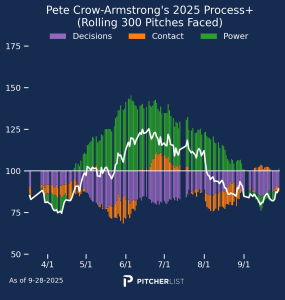
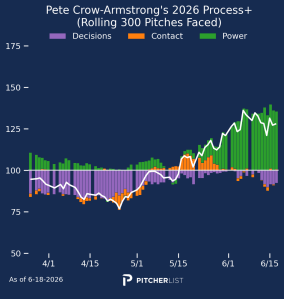
For a player whose surface-level results are as inconsistent as PCA’s, I find it useful to look under the hood and see how their process is changing as well. Above you see his rolling Process+ graphs for 2025 and 2026, with the rolling sample reduced to 300 pitches instead of the standard 400 to be more sensitive to changes. As you can see in both seasons, PCA started off poorly from a process perspective, taking until May to get to an above-average process. It’s worth noting that these rolling charts use pitches from the prior season until the sample is reached for the current season, so his poor process at the end of the prior season is doing some heavy lifting in April of each year. May is also when the power starts to come more for Crow-Armstrong, and I’m sure the weather warming up in Chicago has something to do with that. But to me, the biggest difference between this season and last is the decision making. Last season, PCA’s swing decisions were consistently awful even when he was hitting well. He swung and chased more than just about any hitter in the league. This year, with an eight percentage point drop in his swing rate and six percentage point drop in his chase rate, we are seeing 300-pitch stretches where Crow-Armstrong’s swing decisions are roughly neutral rather than actually hurting him. This allows him to tap into his power more consistently and give away fewer at-bats. As a result, his walk rate this season has nearly doubled to 8.5%, approaching the league average. It also doesn’t hurt that he’s added two ticks to his bat speed without sacrificing any contact ability!
Verdict: Possibly legit. I’m not ready to buy into the .286 batting average because of the flyball-heavy approach and mediocre strikeout rate, but everything else in the profile seems here to stay. Thanks to his improvements against lefties (137 wRC+ and 8.6% BB% in 2026 vs. 59 wRC+ and 2.7% BB% in 2025) and the struggles of Nico Hoerner and Michael Busch, PCA should be a fixture atop the Cubs lineup for the foreseeable future. I expect a downswing to come as the BABIP normalizes. But, PCA has improved enough as a hitter to shorten the length of those rough stretches, and his elite power-speed combination will always be around to prop up his value in periods where the average isn’t good.
Brandon Young, SP, BAL
Last six starts (since 5/24): 37.2 IP, 3 W, 27 Ks, 2.15 ERA, 1.09 WHIP
2026: 67.1 IP (12 GS), 6 W, 49 Ks, 3.07 ERA, 1.26 WHIP
Young has been a revelation for a scuffling and injury-plagued Orioles rotation, helping to stabilize a rotation that has lost Zach Eflin, Dean Kremer, Cade Povich, and Chris Bassitt for lengthy stretches. As a late-blooming prospect, Young debuted last season at the age of 26 and struggled mightily with the long ball, allowing 12 in 57.2 IP. So far this year, he’s allowed half as many in 10 more innings. A collapse in his HR/FB% from 26.7% to 11.1% (89th percentile) likely isn’t fully deserved, but it’s also not just good fortune. Young has slashed his barrel rate allowed by almost three percentage points (9.6% to 6.7%), and the exit velocity he has allowed on fly balls has fallen by more than five MPH (93.8 to 88.1).
When you look at Young’s arsenal, nothing jumps off the page. His best offering is probably the four-seamer (5.09 PLV), which he throws 40% of the time at an average of 94.2 MPH. Aside from the heater, he mixes in a splitter, slider, sinker, and curveball, which are all between 12% and 20% usage. None of the pitches have a PLV above 5.09, and only the slider is a reliable source of whiffs, albeit at a strong 20.8% swinging strike rate (87th percentile among sliders). But, he hardly uses the pitch against lefties and struggles mightily against them as a result. Don’t let the surface-level reverse splits in 2026 fool you. Even though lefties have posted a .625 OPS against Young this season compared to .677 for righties, a fortunate .213 BABIP is masking an awful 1.2% K-BB% against opposite-handed hitters.
Verdict: Not legit. Even during this breakout season, Young hasn’t been beneficial in WHIP or strikeouts, two of the four categories we typically care about for our starting pitchers. As much as I wish this was real for the sake of my fandom, Young’s skills are hard to buy into. Overall, this profile has a pretty low ceiling, that of a high-end Toby. In almost all ways besides the results, he seems like a similar pitcher to last year, when he struggled to the tune of a 6.24 ERA and 1.54 WHIP across 12 starts. Because of his improved ability to mitigate hard contact, Young is poised to carve out a career as a serviceable fourth or fifth starter. But, the ratio risk combined with a lack of strikeout upside has me staying away for fantasy outside of AL-only formats. He could struggle this weekend against the Nats, a potent lefty-heavy lineup.
