





As we head towards the final few matchups of the fantasy baseball season, weekly roster decisions become even more prudent. While it can be beneficial to ride out hot streaks, it is important to avoid wishful thinking if those hot streaks cool off.
Jakob Marsee, OF, Miami Marlins
After the Jesús Sánchez trade that opened up a roster spot for Jakob Marsee’s callup, August has truly been the Month of Marsee. Already with 4 home runs and 17 total extra base hits in his 23-game taste of the big leagues, Marsee’s 1.121 OPS has brought nearly 2 fWAR to the Marlins squad. Has the 29th-ranked prospect in the Marlins organization unlocked a new gear for his small MLB sample?
Though he doesn’t have the highest prospect pedigree, Marsee has always been well regarded for his speed. Over his 235 games played in the minor leagues in the past two years, Marsee stole 98 bases at an 83% rate. Not only incredible totals, but valuable efficiency too. His 7 steals in 8 tries so far with the MLB feels par for the course and could even be higher, except over half of his hits on the year have gone for extra bases. Still, a good problem to have.
But while the speed rings true, his seemingly elite contact rate is overinflated. Compared to his 98-game stretch in AAA this year, Marsee has seen improvement in both his in-zone contact rate and his overall contact rate, cutting his SwStr% from 7.7% in AAA to just 5.4% so far in MLB. While his contact rate when chasing has gotten worse in the majors, he has limited his chase rate to just 14.3% of the time, though this is likely stemming from a lower overall swing rate instead of better swing decisions.
The improvement of his overall contact rates and chase rates when jumping up to face MLB-quality pitching is not only unexpected but also unsustainable and due for regression. While he will likely sustain high walk rates, having walked at rates above 15% in each substantial stop in his minor-league career, he shouldn’t maintain an overall contact rate 4.3 percentage points higher than he has ever seen in AA or AAA.
Through an expected dip in contact rate, Marsee could see some issues with his average. Though he is hitting .346 so far with the Marlins, he hit just .246 in AAA this year with a paltry .227 xBA. Though certainly an improvement from his .200 average across his 137 minor-league games in 2024, his current hitting prowess stems more from his inflated .426 BABIP than it does from his true talent.
Even yet, the biggest question in Marsee’s profile is with his power. Having 4 home runs so far this season might be misrepresenting his true power potential. With a max exit velocity of 107.7 mph recorded across his career, Marsee’s good pull rates and groundball-avoidance can only do so much to help him put it over the fence. Here is a more realistic indication of his relative power percentiles from his higher sample size, 98-game AAA season, courtesy of ProspectSavant:
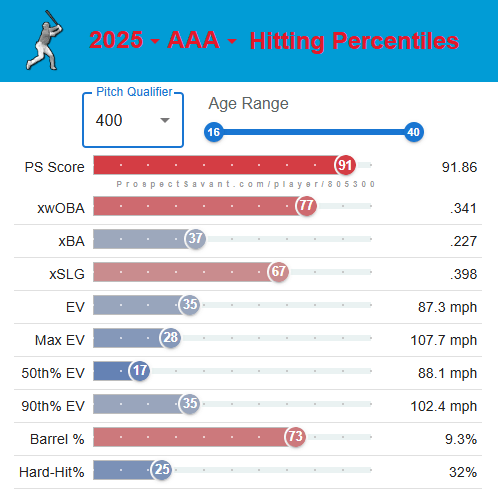
Among MLB players with over 150 batted-ball events, the highest barrel rate among those with an equal-or-worse max EV is the 8.5% rate that Danny Jansen is putting up, ranked 150th among that group. When compared to his 87.3 average EV in his larger-sample AAA results, the highest barrel rate among players with an equal-or-worse average EV is Harrison Bader at 9.9%, ranked 112th. Though Marsee has good launch angles, the comps for his QoC just aren’t great.
Verdict: Not Legit – Marsee is an intriguing steals option in fantasy leagues. With questions concerning his batting average ability and his power potential, a lot needs to go right for this not to fall apart. He is still an intriguing player and likely worth seeing how this hot streak continues, but those making keeper decisions should be wary not to expect this level of production in 2026.
Vinnie Pasquantino, 1B, Kansas City Royals
At this stage in the season, Vinnie Pasquantino has seen almost an identical amount of game action compared to his full 2024 campaign. While his .264 average and 1 stolen base match his .262/1 output in 2024 almost to a T, Pasquantino has seen a major uptick in his power output, mashing 9 more home runs through a similar amount of PA’s. Is he doing anything different this year to warrant this improvement?
With this many additional home runs, Pasquantino has made surprisingly little change to his swing. Though power surges might be attributed to an increased tilt to generate additional loft, Pasquantino hasn’t changed his swing path. Though other hitters might look to catch the ball more out in front to generate more pulled power, Pasquantino’s 2025 intercept point is only two inches further out in front of his body, a fairly marginal difference that results in a similar 9° pull attack direction.
Though he has similar swing metrics compared to last season, it is somewhat notable that his average bat speed has increased by almost a full mile per hour. This has helped Pasquantino set a new career high Max EV of 114.4 mph, within the top-8% of MLB hitters. But through marginal decreases in contact (and more notably his squared-up percentage), his average exit velocities and hard hit percentages are actually down compared to last year.
The biggest factor that might warrant this increased power output is in moving from a 7.1% barrel rate last year to a 10.4% rate this year. This is likely fueled by his improved pulled air percentage as opposed to his decreased exit velocities. But with similar tilt and intercept point between the two years, his seemingly increased aptitude for pulling the ball in the air seems more like noise than an approach or skills change.
But all this has been comparing his full 2024 to his full 2025 season. While Pasquantino has seen an increased home run total to date, 10 of those home runs have been in August with 9 in his last 14 games. But his rolling 20-game hard hit rate is right at his average, indicating that his rolling 35.7% HR/FB rate is just noisy variance. With a 6% increase in Pasquantino’s HR/FB rate on the year, and an equal number of total XBHs compared to last season, he seems to just be getting lucky with doubles trickling over the fence instead.
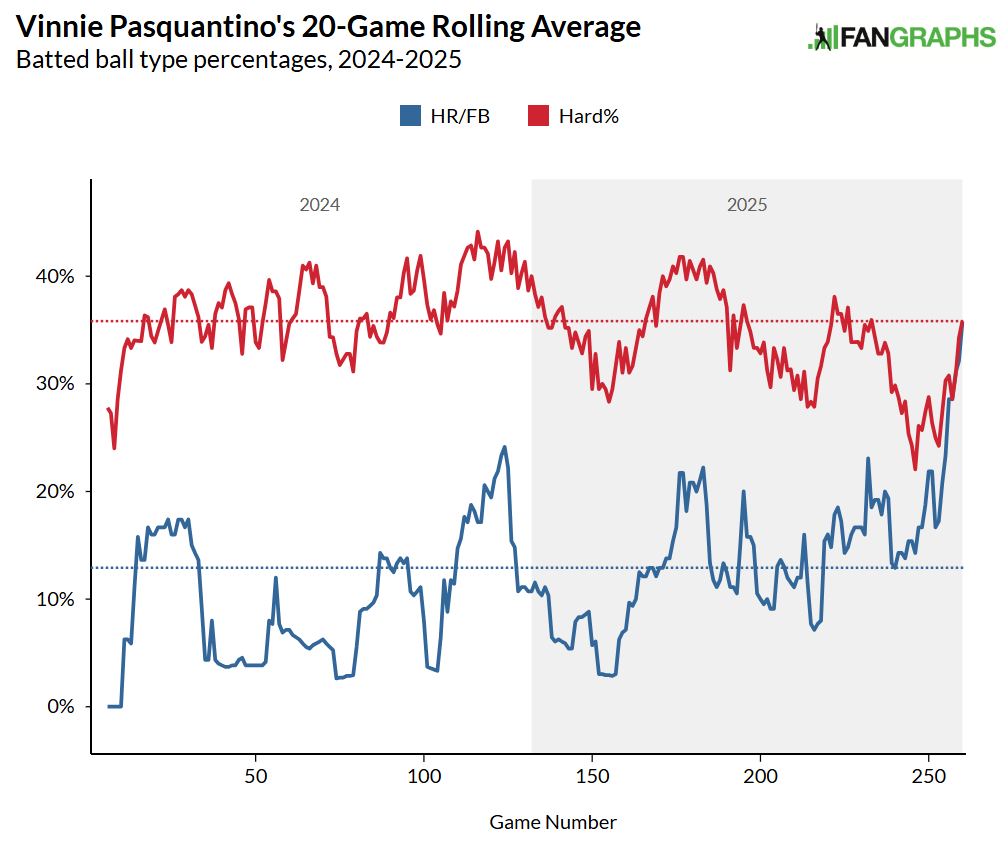
Verdict: Not Legit – Pasquantino’s hot August has been fueled by more batted ball luck than actual skills change. With most of his underlying metrics still being comparable to his 2024 season, Pasquantino’s true skill is likely somewhere between the 19 home runs he hit last year and the 27 he has hit this year. Still an obviously valuable player, don’t expect Pasquantino to maintain his 34-HR per 162-game pace.
David Peterson, SP, New York Mets
David Peterson has been putting forth a strong season for the Mets with a 3.18 ERA over 150 innings. After a strong 2.90 ERA over 121 innings last season, is Peterson a sneakily solid ratio-focused pitcher?
Well, Peterson might be excelling at limiting runs, but he isn’t doing much to limit baserunners as he carries a 1.25 WHIP on the year. His poor 8.8% walk rate combined with being fairly hittable means Peterson was allowing quite a few ducks to reach the pond. But the amount of runs Peterson has been allowing doesn’t quite match what would have been expected of a 1.25 ERA.
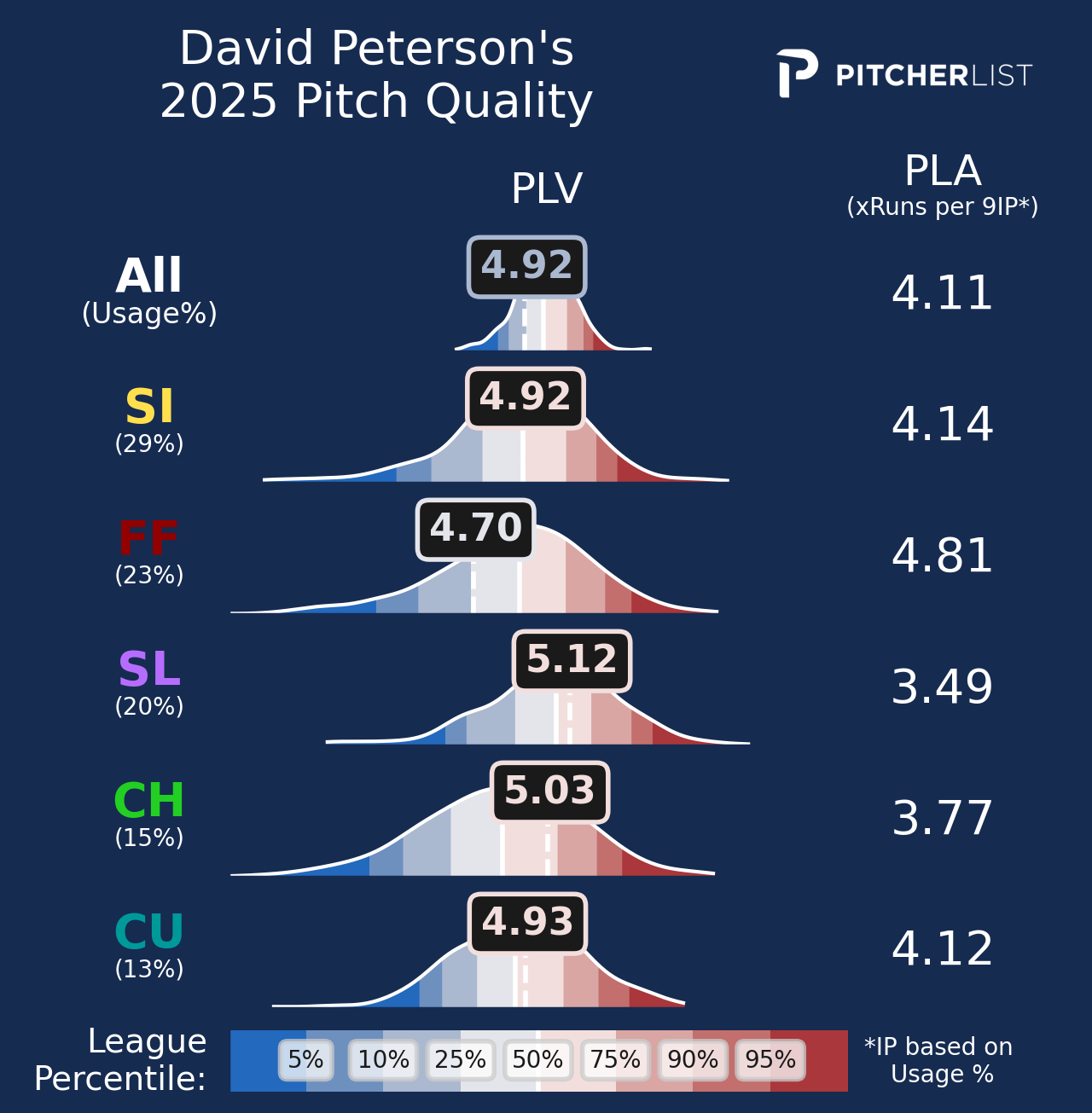
Sure, some of this can be attributed to his innate ability to induce ground balls, as Peterson is tied for the 5th most double-plays earned among pitchers. But even when hitters are getting the ball in the air, the ball hasn’t been going over the fence too often. Peterson’s 8.8% HR/FB is well below the league average of 11.7%, and well below his career average of 13.3%. This is not stemming from Peterson inducing weak contact, as Peterson is allowing hard contact 46.3% of the time, meaning Peterson is simply getting lucky.
xFIP, calculated with a standardized expected HR/FB ratio, agrees that Peterson should be seeing a higher amount of earned runs. In fact, every single ERA estimator doubts that Peterson’s results have been strictly earned. Though Peterson outperformed them last season as well, it hasn’t been for long enough to believe Peterson can beat the models.
Part of the reason Peterson has been outperforming the estimators is that every single one of Peterson’s 5 pitches has induced a batting average against under what would be expected of them. Already carrying a 1.25 WHIP, if Peterson’s overall batting average against of .236 starts moving back towards the .267 that has been expected so far, there’s a chance the house of cards would start to collapse.
Verdict: Not Legit – David Peterson lacks the foundational elements that indicate his sparkling ERA has been deserved. Getting lucky on both fly balls and batting average allowed, Peterson’s poor K-BB% and hard hitability indicate regression is looming. Though his strong ground ball rates and high extension mean Peterson can remain a decent volume play, don’t expect the low-3’s ERA to last.
Photo by Icon Sportswire | Adapted by Doug Carlin (@Bdougals on Twitter)
