





Today, we’re talking about a pitcher from Oklahoma who was picked in the second round, a 6’6” left-handed rookie who’s been tearing it up for Boston. No… the other one. Jake Bennett’s similarities to his teammate Payton Tolle don’t end there, but the way they accomplish their goals on the mound is probably the biggest noticeable difference. Unlike Tolle, Bennett was not blessed with a 70-grade fastball. Rather the opposite actually, Bennett has one of the worst 4-seamers by stuff+ metrics in the majors right now. And yet, he’s thrived to start his MLB career. Not only that, his success is being driven by that “bad” fastball.
No Ride? No Problem.
While I prefer to look at the numbers myself and make my own judgments, the stuff+ metrics out there near universally hate Bennett’s 4-seam. In a vacuum, I 100% agree with them. The term “dead zone” has been repurposed by the analytics community recently. It now usually defines a fastball that falls into the most generic region of shape based on release. Previously, it meant that the pitch fell somewhere in between the ideal shape for a 4-seam and sinker. In practice, this looks like having less rise than average for a 4-seam, and less run than average for a sinker, without having so little movement as to be a gyro fastball. This would result in it having the weaknesses of both and the benefits of neither. It’s not hard to imagine the problems that would arise with a fastball like that.
Unfortunately, that is the definition that applies to Bennett’s 4-seam. It has an abysmal shape. 11.9” of rise from a 5.6’ release height is miserable; this pitch should live on the barrels of bats. Even his 7.1’ of extension isn’t enough to save it from having a HAVAA closer to the average sinker than 4-seam. Surely it doesn’t also have a whiff rate higher than Tolle’s… right? There’s simply no way it’s in the 90th percentile or better by most expected results metrics. And yet— here we are. So how is it that it’s been one of the catalysts for the hot start to his career?
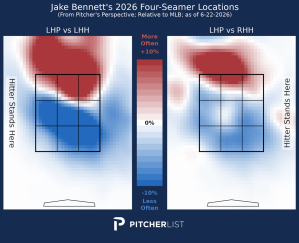
That. That is how. I’m not sure I’ve ever seen a 4-seam location frequency plot that good. Bennett has a near-singular gift for elevating his fastball. He is placing this pitch directly above the zone with such remarkable consistency that it doesn’t matter that his fastball has a bad shape. It’s very difficult to hit any fastballs in that spot, and his ability to put it there is getting him results that make his 4-seam look elite.
It doesn’t matter that he’s in the 4th percentile for zone rate and 2nd for called strikes with this pitch because he’s in the 98th for chases and 96th for SwStr%. These are absurd numbers that put him in company with arms like Wheeler and Cease despite having a fastball at least 15 points lower on the 20-80 stuff scale than either of them. If a pitch is theoretically prone to giving up loud contact, the best thing you can do is find a way to use it out of the zone where there’s less danger. Bennett is doing this better than just about anybody else in the game today. He’s even getting hitters to make mediocre contact when they’re getting the bat on it.
That’ll play. Just throwing his 4-seam high isn’t enough for him, though. His other two primary pitches are working synchronously with it to elevate it to the level it’s playing at. His sinker, unlike the 4-seam, has a good shape. It combines excellent depth with good run, allowing it to force ground balls at will, especially in tandem with the 4-seam. They look almost the same at first with nearly identical spin profiles at release. He plays a dangerous game with his sinker, but it’s done in the service of helping his other pitches play up.
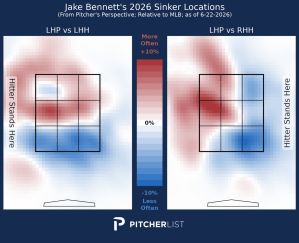
You can probably see why this chart would ordinarily make anyone nervous. He’s throwing his sinker in the vertical middle-third of the zone 36.5% of the time, in the 96th percentile. However, with his fastballs looking the same out of his hand and being located where they are, they tunnel brilliantly, helping them both play up. This, combined with his sinker’s heaviness, is why he’s gotten away with this thus far. He’s not trying to get called strikes; he’s trying to force weak contact and work off/with the 4-seam. It’s difficult to argue with its results.
The third entry in the trio that makes up the vast majority of Bennett’s pitches is his changeup. It’s a bit of a unique pitch, as despite only having 85% active spin, it features no seam-shifted wake. While it doesn’t have much movement separation from either of his fastballs, the spin and release deception it creates while also having a 9 mph velocity gap is more than enough for it to perform. There’s plenty of precedent for success with an offspeed pitch despite its movement not being particularly dissimilar from the fastballs. It helps that he also locates this pitch well.
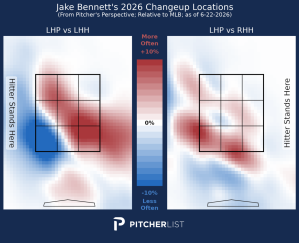
The spots against lefties are a little bit weird, but those aren’t as important as how he’s placing it in platoon matchups. That bar of red along the bottom of, beneath, and off the far side of the zone is exactly what you want to see. This is boosted by the locations of the other two pitches as well, as they stack vertically, creating an up-down mode of attack that functions despite middling movement disparity. It’s spots like that that are helping this pitch return the monster numbers it’s seen so far.
Bennett’s last three pitches are more prospective than real offerings right now, but there’s a lot to like there. We’ll talk about them as best we can given the limited sample. His sweeper and curveball are interesting pitches. He’s operating without a go-to breaking ball right now, but both of these have potential. These two pitches come out of his hand looking the same, but wind up moving pretty differently, something he could potentially use to his advantage. For now, he’s using them as platoon breakers, slurvy sweepers to lefties, and curves to righties, pretty standard fare.
Lefty-lefty sweepers don’t need to have great stuff; they’ll play so long as they aren’t being thrown down the middle constantly. As for the curve, though, that pitch has outstanding potential. He doesn’t throw it super hard, but its tight 12-6 shape coming from a low 3/4s arm slot gives it a unique look that hitters could struggle with. It’s pretty close to what has been labeled in recent years as a “deathball”. This would be especially effective against right-handed hitters, and would be harmonious with his already vertically-aligned gameplan if he could develop more feel for it.
Speaking of looks hitters struggle with, Bennett’s cutter has the potential to be excellent too. This is an odd one. I think he’s throwing it with a cutter grip, but its movement is much more akin to a gyro slider, and the spin profile is something in between. It’s hard to say much of anything about a pitch he’s only thrown 15 times, but I’d love to see more of it. Much like the curveball, there could be something there, especially as a fit in his mix.
It’s kind of funny; even his developmental pitches seem perfectly aligned to work with his arsenal. Their spin characteristics and shapes all synergize well with what he’s doing with his main three and each other. It’s just a shame he doesn’t trust them enough to use them more consistently yet.
If It Ain’t Broke
There’s no reason to mess with what Bennett’s been doing until it stops working. He will inevitably need to work more pitches into his mix; 4-seam, sinker, changeup probably isn’t a reliable starter’s mix long-term. But for now, until he gains confidence in one of his other offerings, this is the best thing he can do. If this strategy starts to fail him, I think it’ll likely be due to a regression in fastball locations or hitters getting wise to the middle-cut sinkers. In which case, the best move he could make would be to drop the sinkers lower in the zone and accept that his 4-seam and changeup may see some diminishing returns for the sake of reducing damage to the sinker.
Bennett’s an interesting study as he’s got an effective three-pitch mix, but it’s not one that a starter can usually be built from. Furthermore, the quality of the stuff of this trio is mediocre on paper. Without great stuff, his game is predicated on inducing chases and weak contact. His three other pitches all have potential, but he rarely throws them. Even with the optimism I generally have for pitchers, I don’t think it’s realistic to expect all of Bennett’s prospective pitches to develop into core parts of his arsenal.
That said, with his command of everything else, I might be more surprised if none of them did. Even one of them turning into a reliable fourth option instantly elevates him from a “promising curiosity” to a pitcher to be feared. That’s not something you can usually say about a pitcher with a fastball like his; his future isn’t quite unlimited. But it’s a testament to his other skills that he’s that close to a real breakout.
(Statistics as of 7/2/26)
Photo courtesy of Icon Sportswire | Adapted by Aaron Polcare (@abeardoesart on Bluesky and X)
