





Jared Jones throws hard. Like really, really hard. This isn’t a groundbreaking statement; you all know this. I’m not sure anyone could’ve known he’d come back from Tommy John surgery looking like this, though. He’s throwing even harder. It’s not by a small amount either; he’s gained more than a full tick on the radar gun across all of his pitches. Now, everything he’s been doing thus far must be taken with a grain of salt. He’s on an exceptionally strict pitch limit, never surpassing 80 pitches in a game (even when he has a perfect game through six innings).
While it stands to reason he might be able to burn a little brighter when he knows he doesn’t have to save anything for a nonexistent 100th pitch of the game, it seems unlikely that a guy throwing 5 innings instead of 6 or 7 is really going to be going that much more intensely. When he’s eventually let off the leash for full-length outings, we might see a slight drop, but the gains he’s shown this season are probably too substantial to be fully erased by that.
An increase in velocity for a guy who was already a power pitcher is exciting news, but it’s not all that’s changed. He’s also changed his game plan, and his slightly modified mechanics have altered his stuff. Let’s break down what’s different about Jones this year, and what there is to love about it.
High Voltage
The 4-Seam
Remember when scorebugs used to light up or have little animated flames around the velocity reading when it was over 95 mph because that was just so fast? The bar has been raised substantially since then. Jones already cleared that mark with the overwhelming majority of his fastballs when we last saw him in 2024, averaging 97.3 mph and maxing out at 101.4. He topped his career best with a 101.5 in his first game back this year, and he’s averaging 98.6 mph now. That’s the third-fastest among starters, behind only Misiorowski and Dollander.
While the movement regressed due to him cutting the ball a bit more and dropping his arm slot slightly, it’s still a great 4-seam. It comes in at a very shallow angle, which at that velocity is frankly unfair. While the movement is pretty close to what would be expected for his release, the velocity and angle make the somewhat generic shape an afterthought. Adding to this, it’s not just the velocity that’s helped to up this pitch’s whiff rate for him; he’s locating it far better this year.
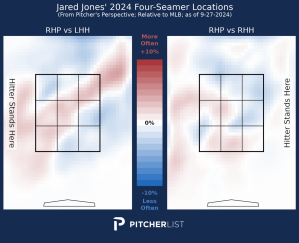
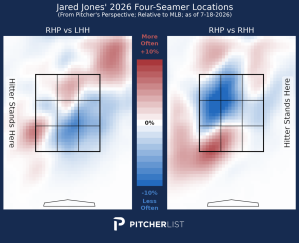
Any worries about rust or lost feel for locating the fastball should be pretty thoroughly eradicated by these charts. While it’s not a standout chart, the avoidance of the middle of the zone and light red clouds above it are exactly what you want to see in a 4-seam. Improved fastball command showing up immediately post-surgery isn’t something you see every day, and it’s usually associated with pitchers that were working through an injury that was causing already good command to falter. Jones had a lat strain in July that he pitched poorly after, but his fastball command actually improved during that stretch.
Not satisfied with just bettering his fastball, he managed to start throwing his slider harder without sacrificing any depth as well. This is a pretty objective improvement for this pitch, albeit a small one. It’s a perfect complement to a high 4-seam, a diving gyro breaker that confounds hitters on the way to the plate. The unfortunate news is that unlike his fastball, his feel for locating this pitch hasn’t bounced back, let alone improved.
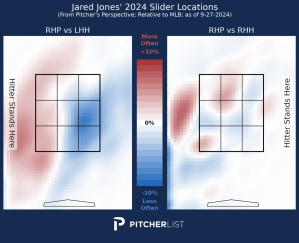
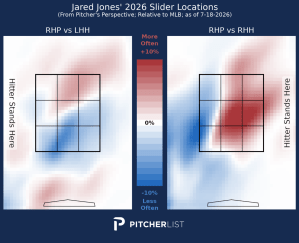
What he had previously showcased as above-average slider command has regressed into a more scattershot pitch map with a lot of pitches winding up in the middle of the plate. He’s been struggling to keep it to the glove side as much as he used to, and he’s not burying it as well either. It’s doing well because the stuff is so good that it’s difficult to do anything with even when it’s in the zone, but I’d like to see him sharpen this up.
The Changeup
Jones has been lamented for being a predominantly two-pitch pitcher, but during his time away, he got in the lab and worked on expanding his skill set. He finally trusts his changeup enough to use it as a legitimate third option, increasing from 6.5% to 14.7% usage.
He throws it at an absurd velocity, harder than any other starter’s offspeed pitch, but maintaining a 5 mph gap from the fastball should keep it from being too firm to be effective. This can actually add to the pitch’s ability to fool hitters, as the release angles of those two pitches are highly similar, along with the well-duplicated delivery and spin-based deception. The chase rate being slightly below average is more a product of his still-developing command of it.
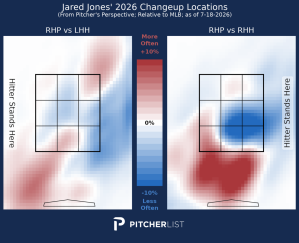
It’s a small sample, but that bubble in the perfect spot against righties suggests at least a nascent feel for spotting this pitch. He may get into his head when throwing it to lefties in a way he doesn’t against righties, but the bad misses way off target just haven’t happened nearly as much in non-platoon matchups. In any case, even with the sometimes questionable locations, this pitch’s shape allows it to act as a splinker. It should generate ground balls even when it’s not below the zone.
The Curveball
His last pitch is a curveball that has significantly leveled up in stuff quality since we last saw him. He somehow found a way to add 4(!!) mph to this pitch without sacrificing any movement.
This is immediately in rare air. Nobody in the league right now throws a curve harder than this with this much downward movement. Some trail very close behind, and I don’t want to mislead you about how absurd this pitch is, but that doesn’t sound as cool. This pitch is an absolute hammer regardless. Unfortunately, he doesn’t really know where it’s going yet.
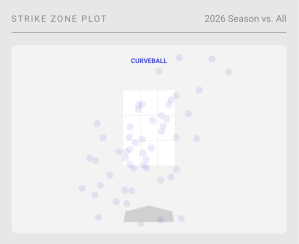
No pitch location relative heatmaps for pitches with this few instances, unfortunately, but we have a zone plot to work with. The cluster of pitches low and to the glove side is somewhat inspiring, just way too many waste pitches with this one right now, though. The pitch is incredibly promising, but the locations must improve for it to be a significant factor in his arsenal.
The Outlook
At present, Jones is cruising mostly on his great fastball and overwhelming secondaries. It can be difficult to struggle when you have four pitches with above-average SwStr% rates. Despite the rough spots in his command, he’s consistently challenging in the zone with his premier stuff, even if I’d like for some of those challenge pitches to be a little less center-cut.
He’s experimenting with his usage right now. His last five games are kind of funny to look at; the last two featured his highest fastball percentages, at an astronomical 71.4% and 64.9%. However, the three games before that register as the lowest, second-lowest, and third-lowest rates of fastball frequency in his 31 career starts. The 71.4% game was also the one in which he threw two-thirds of a perfect game, so I can’t say I blame him for sticking with the strategy in the next one if he was really feeling his fastball.
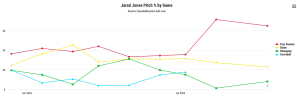
Also worth noting is that he was caught by different catchers for those stretches. Henry Davis was behind the dish for both all-fastball games, and Jones had previously only been caught by Endy Rodríguez this season. I can’t speak to who’s calling pitches when Jones is on the mound, but that could certainly be a factor. Pitchers frequently shift between identities from start to start based on matchups but rarely by that much. With him spotting his fastball better than ever and the quality of the stuff he’s throwing it with, if he wants to melt faces with heater after heater until batters adjust, he might as well.
His arsenal is more suited towards platoon matchups, but at present those are the ones getting the better of him while he torches righties with a steady diet of fastballs and sliders. I mentioned earlier he’s gotten criticism for being a two-pitch guy in the past, but I think he might be better off simplifying to lefties until he can clean up his spots on the changeup and curveball. That is where most of the damage he’s allowed has come from, and while pitching is a job in which you are expected to fail sometimes, I think the amount of damage shifted onto the fastball and slider from increased usage would be preferable. This seems to be the way he’s moving anyway if the last two starts are anything to go off of.
There’s a lot to be excited about with Jones right now, and a lot to watch for. How will his pitch usage evolve? Will it go back to normal the next time Endy is his battery mate, or will the extreme fastball usage stick until it fails? Can he get back to spotting his slider glove-side and low consistently? Can his tertiary pitches progress to the point of consistent viability? As is, he’s an explosive starter for better or worse, but it would only take one of many possible improvements to propel him to excellence.
