





There’s an eerie feeling when you learn about a pitcher in Los Angeles, for reasons that could not be further apart. For pitchers who call Chavez Ravine their home, the player development pipeline is one of the best in baseball, but it comes with immense injury risk. For those who reside in Anaheim, the Angels hold the longest active postseason drought and don’t seem close to breaking it.
While it may seem like a blow to optimism when a pitcher goes to Anaheim, a homegrown bright spot has emerged. José Soriano is thriving in his second season as a starter in Anaheim, posting a 3.54 ERA through 86 innings.
The 26-year-old signed with the Angels for a meager $70K as an international free agent in 2016, slowly rising through the minor leagues before undergoing Tommy John surgery in early 2020. The Pittsburgh Pirates selected him in the 2020 Rule 5 Draft, but he only threw three rehab innings in 2021 and had a second Tommy John procedure in two years.
Soriano made his big league debut with the Angels, becoming a middle reliever for them in 2023. His profile looked to be nothing more than a potential backend reliever: he posted a mid-3.00s ERA with high strikeout and walk rates. With a new manager in town heading into 2024, the Angels decided to try to stretch him out. He quietly joined the Garrett Crochets and Reynaldo Lopezes of the world, jumping from reliever to starter. His last time starting (or throwing more than three innings) came in 2019, nearly five years prior.
What Worked Last Year
Soriano’s transition to the rotation was a success: A 3.42 ERA, 1.20 WHIP, and 20.7% strikeout rate in 113 innings was the makings of a formidable groundball-focused starter. Though injuries did slow him down at the end of the season, he topped his previous innings record by 31.
With many transitioning relievers, there is an expected decline in stuff quality when more innings are required. Soriano didn’t just maintain his high velocity on his sinker; he improved it. His 96.6 mph sinker suddenly sat at 97.8 mph, topping out at over 100 mph. Despite increasing velocity, he still got exceptional drop on the sinker. The pitch was in the 96th percentile for horizontal drop below expected among sinkers, leading to a nearly 75% groundball rate.
The sinker didn’t generate a ton of whiffs or called strikes as he struggled to throw it for strikes consistently, but it limited hard contact. A 29.2% Ideal Contact Rate (ICR) was 10% below the league average.
His go-to secondary was the curveball, which came with similarly high velocity. At 86.4 mph, Soriano just needed to throw it competitively and watch the batters flail at it.
The curveball had a 41.3% CSW% (98th percentile) at 25.4% usage, making it a lethal and consistent weapon. Its only issue was that a few center-cut pitches got hit hard, which is the tradeoff for high usage. Despite only a .226 average against, there was a .400 BABIP and a .472 xwOBACON. Nearly half of the hits off the curveball went for extra bases.
Soriano also utilized a splitter for lefties and a slider for righties, giving his arsenal a secondary, slower pitch for all hitters. The splitter, which graded out at over 110 Stuff+, got whiffs and limited damage against lefties. The slider achieved similar results against righties, getting whiffs and weak contact as a compelling third pitch.
Finally, he had a fastball as his strike-throwing pitch. Everything else in his arsenal held a sub-47% zone rate, and the fastball was the lone pitch above 50%. This resulted in all hitters teeing off on the pitch, as it was frequently thrown while behind in the count.
The outlook on Soriano was exciting: he had three above-average pitches according to Stuff+ (sinker, splitter, and curveball), and was able to induce whiffs and weak contact. The only question was if the command could take a step forward in year two as a starter.
How This Year is Shaping Up
Soriano’s surface-level stats look relatively similar to last year, but generally are slightly behind where we’d hoped.
The ERA is stagnant, but he’s allowing significantly more baserunners and striking out fewer hitters. Going one level deeper, the contact suppression and overall CSW% are holding. He altered his pitch usage and focused on throwing more strikes, but it isn’t paying off.
He’s leaning into the sinker more this year over the fastball, which has been a double-edged sword. The sinker’s zone rate is up six percent, at 51.0% overall, which is a much-needed improvement. However, these sinkers directly replace the “need a strike” fastballs. He’s throwing nine percent more sinkers in the heart of the zone. Additionally, his Mistake Rate on the pitch has nearly doubled and is around league average. The velocity has also tapered off slightly, not in a horrendous fashion, but it’s down to 97.0 mph.
There are also significantly fewer sinkers inside to righties, where the pitch performs best. His armside location rate on the sinker decreased from 58.4% to 45.8%, giving hitters more of those pitches in the heart of the plate.
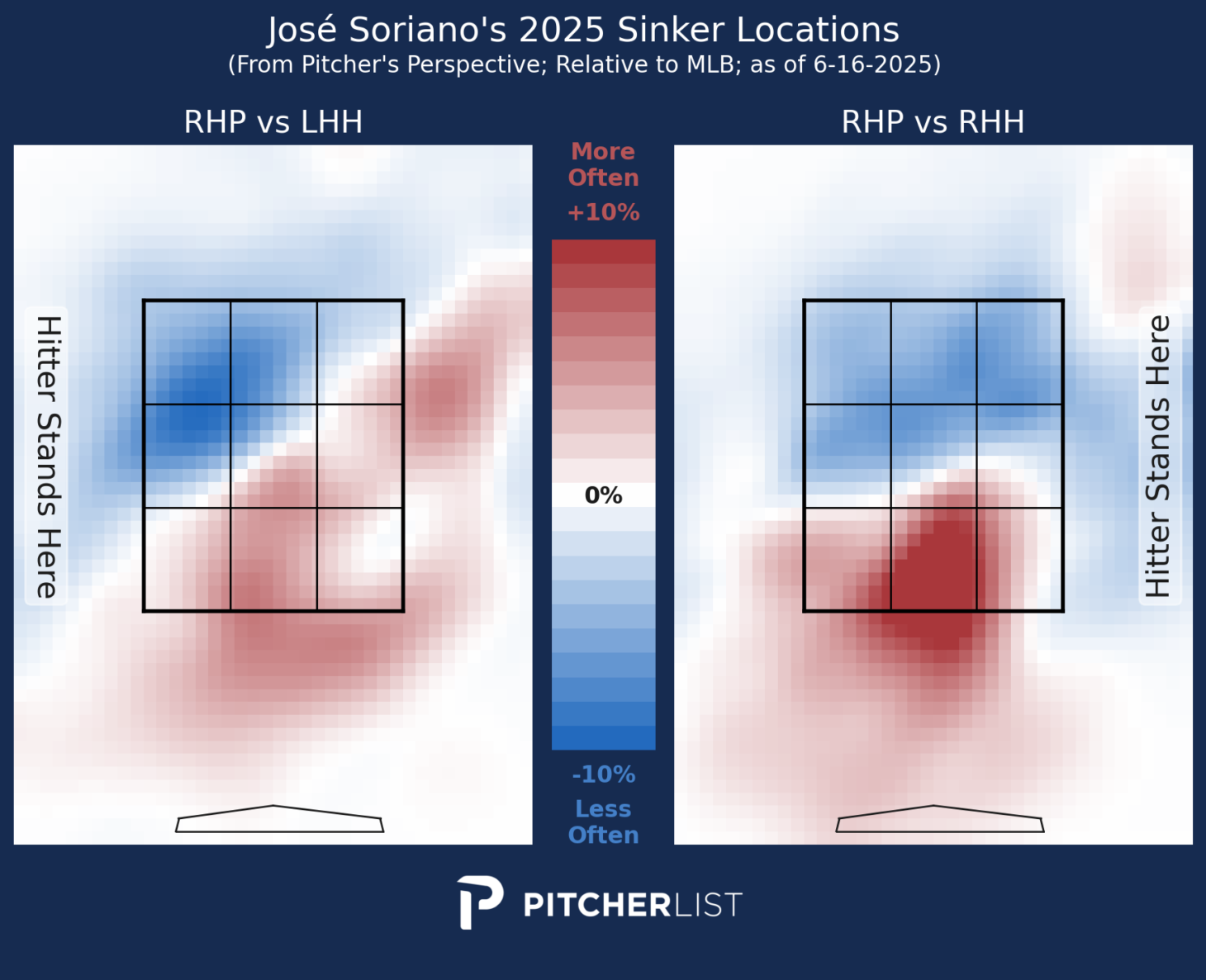 He’s still keeping it down, driving a 78.5% groundball rate while maintaining an above-average ICR. Everything is still working otherwise; the more central location is just lending itself to more damage. This suggests his control of the sinker improved, but not the command. All but two extra-base hits against the sinker have come in 1-0 or 2-0 counts.
With immense velocity and drop, the pitch is challenging to homer off. Soriano has a 0.31 HR/9, down from 0.64 a year ago. The sinker’s shortcomings this year can be shielded by keeping the ball in the ballpark.
The curveball continues to dominate as a second pitch, but its metrics are confounding. The pitch also lost a tick of velocity, but added two inches of drop as a tradeoff. The pitch’s Stuff+ grade dropped from 104 to 71 this year. That figure is the worst Stuff+ grade among all curveballs by qualified starters.
Despite what the grade suggests, the pitch has a 37.7% CSW% (89th percentile) and a 25.6% ICR (88th percentile). It’s doing all one can ask for from a breaking pitch with high usage. Like the sinker, Soriano is keeping the curveball down too. His low location rate has improved by 13%, and he buries the curveball 68.9% of the time. The only problem the curveball is creating is zone rate: it’s down five percent this year, and he needed to maintain it along with the gains on the sinker.
His handedness-specific secondaries, the splitter and slider, took a step back. With even marginal progress back to where they were last year, Soriano could reach a higher ceiling.
The splitter has a paltry 20.8% zone rate against lefties. From a stuff perspective, the pitch still has potential, but it needs to be thrown more competitively. Hitters whiff at it 37.0% of the time, which is above the league average, but it needs to be elite figures to make the low zone rate worthwhile. The splitter only had a 9.3% called strike rate last year, but it’s down to an impressive 1.0% so far in 2025.
The slider is also dealing with the same issue. Against righties, it has an elite 42.9% whiff rate but only a 2.5% called strike rate. The zone rate has slightly increased, but hitters swing more at the pitch. The slider shape has transformed the most in his arsenal year-over-year.
The slider lost 2.5 ticks of velocity, adding four inches of drop and 1.5 inches of sweep. The Stuff+ grade has improved from a 95 to a 109, reinforcing its whiff potential. However, the batted ball results have been uncharacteristically poor.
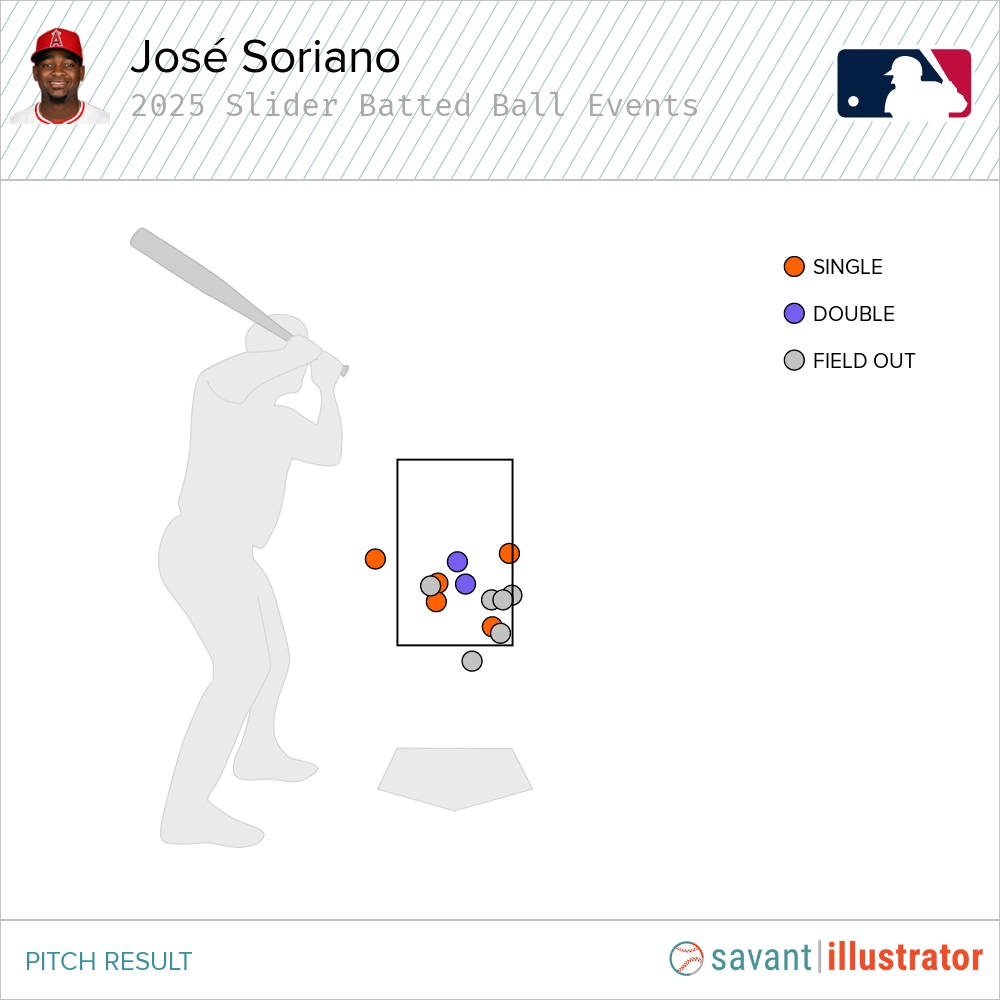
More hitters are swinging at the pitch and getting rewarded. A 53.8% ICR is over double 2024’s figure, resulting in a .280 average against. A .538 BABIP is unreasonable and unlikely to stay, but those locations don’t lend themselves to good batted ball results. Across the board, Soriano has more sliders leaking back into his armside, and righties are punishing him.
Where Does He Go From Here?
Soriano’s upper-echelon velocity and shapes continue to provide a ceiling for a groundball pitcher that also earns whiffs. He could become a mini version of prime Sandy Alcantara, boasting a 24% strikeout rate with an immense amount of groundballs. It doesn’t help that the Angels’ defense is fourth-worst in baseball, but the skills matter more.
The sinker must continue to be buried, but Soriano also needs to show the ability to run it inside to righties again. He’s always been able to get whiffs with the sinker, but the inside pitch sets up sliders in the zone. Giving hitters an extra worry about the east-west approach with the slider in play helps the curveball and sinker come together.
Against lefties, the splitter needs to appear more competitive and consistently. Like everything else in the arsenal, the lefty approach has swing-and-miss potential, but it requires command of three pitches to make it work.
Soriano hasn’t missed a start yet this year, and his previous innings totals set him up to be around the 150 mark if all goes according to plan. The Angels, believe it or not, have developed a pitcher. While the organization might need a few more hits before it can eye the postseason, Soriano is a great place to start.
