





When Kevin Gausman was the ace of a 107-win San Francisco Giants team, his rise to stardom was one of the best stories in the sport. San Francisco was playing with house money in a season where nothing could go wrong. It rolled the dice on Gausman’s short-season flashes in 2020 and reaped the benefits of the qualifying offer. The Giants found surplus value; Gausman was about to earn his keep.
After one of the most lucrative contract seasons in baseball history, Gausman parlayed his 2021 campaign into a five-year, $110 million deal with the Toronto Blue Jays.
Gausman’s new status demanded scrutiny. He was a two-pitch pitcher with one year of excellence to his name. Burdened with the Blue Jays’ blossoming competitive window, every yellow flag in his profile was a potential crack in Toronto’s foundation. What would happen if his fastball command wavered, or its velocity dipped a bit too far? What if the home runs returned or the strikeouts left as he pitched into his 30s?
Gausman no longer flirts with 95 mph with much frequency, nor does he average double-digit strikeouts per nine innings. But since signing north of the border, Tarik Skubal is the only American League pitcher to generate more fWAR. His consistency is almost confounding, and his profile only makes the past half-decade more impressive.
Gausman Just Keeps Going
I have long considered myself a Gausman fan. He’s a fun story and an entertaining watch. Still, long-term pitching contracts are always scary, and Gausman’s unique path provided plenty of reasons to hesitate.
Relying on two pitches is fine until it isn’t, and a stuff or command decline could have landed Gausman in hot water. Subsequently, it made sense to project Gausman’s slider, the red-headed stepchild of his three-pitch arsenal, to become increasingly important over the length of his deal. It hasn’t. He’s actually throwing it less with age, as he continues to succeed with his fastball-splitter combination.
All Gausman has done since signing is post. He’s on Year 5 of a sub-4.00 ERA with the peripherals to match, and having earned 1.5 WAR in his first 10 starts, he’s on track to be worth at least three wins for the sixth consecutive season. He’s never thrown fewer than 170 innings in a full season as a Blue Jay, either. If the Energizer Bunny threw a splitter, he’d probably perform a lot like Gausman.
The results tell the most important part of this story. By the box score, Gausman is the same guy, year-in and year-out. What’s more intriguing is how he’s found these results despite fluctuations in potency and fortune.
Gausman is very much the same guy he’s always been. Like the rest of us, though, he’s a little older, and his strikeouts have faded since his prime. He’s weathered that storm successfully. Yet, he’s not doing so with incredible batted-ball luck or newfound contact suppression. The home run rates are similar, and the luck is pretty normal; there’s no obvious answer for how Gausman has remained a top-20 starter.
That hasn’t stopped him. Set in his ways and unflinchingly committed to the same game plan, Gausman has turned himself into an outlier atop Toronto’s rotation.
Two and a Half Pitches (and a Dream)
This article would be a lot shorter if Gausman had reinvented himself with a refined breaking ball or a new fastball to keep hitters off-balance. The only real change in Gausman’s arsenal has been his aging. His fastball and splitter have lost nearly 1.5 mph since his first season with the Blue Jays. That hasn’t stopped his heater from missing bats 19% of the time, his highest rate since 2021. Nobody is mistaking him for Mason Miller, but it’s the kind of contact avoidance that keeps him ahead in the count.
We can assume that Gausman’s command is a big piece of this puzzle. Even if it hasn’t presented itself as a skill jump, Gausman’s locations are a testament to his consistency, and his fastball is earning more strikes than ever before. In 2026, it’s getting swings and called strikes 77.2% of the time, a 99th-percentile mark, but only marginally better than years past.
Similarly, Gausman’s fastball spots grade out favorably. By plvLoc+, his fastball command has been a constant, earning scores of 104, 105, 104, 107, 107, and 107, respectively, since 2021.
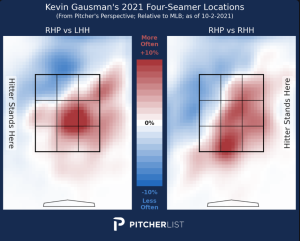
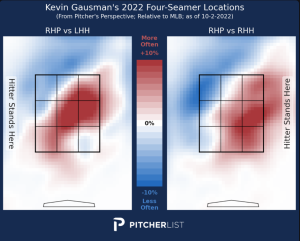
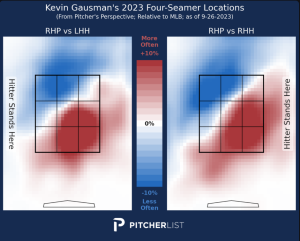
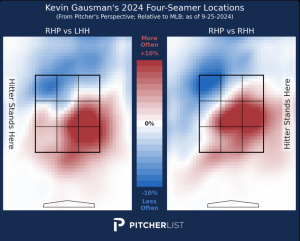
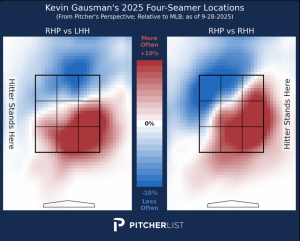
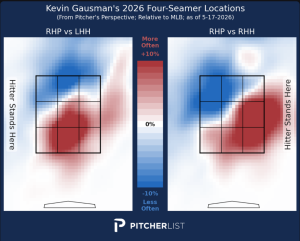
Talk about sticking to a plan.
The benefits here are threefold. Gausman doesn’t walk anybody, something he’s doing even better in 2026 (his 3.9% BB% is in the 98th percentile for starters). Secondly, keeping the ball down and arm-side tunnels well with his splitter. Gausman’s release points don’t mesh as well as one would expect for someone so reliant on two pitches, but keeping his fastballs low still blurs the line at the bottom of the strike zone. He doesn’t have to worry about hitters giving up on the splitter because it’s the only offering below the belt. Gausman is happy to live there, and the risk of hitters dropping their barrels to it is secondary to how it helps his splitter win.
Interestingly enough, Gausman’s slider tunnels with the fastball and splitter better than they do with each other. According to Baseball Prospectus’s Surprise Factor and Pitch Type Probability, the slider he shies away from is his most deceptive offering (and it’s not particularly close). Throwing it less than 10% of the time, it likely overperforms its ugly metrics because of that tunneling.
Gausman doesn’t command his breaking ball very well. Locating his main pitches, though, may have created the contact quirk keeping hitters in check—guys just can’t stop hitting pop-ups.
Generally speaking, we don’t want our high-IVB fastballs being thrown low in the zone. It’s an easy way to sacrifice swings and misses while serving home runs on a silver platter. Gausman has avoided this, despite consistently keeping his fastballs down. I think that might be a manifestation of his splitter. Gausman obviously gets guys to go fishing; he’s made a career out of it. Might that make him more liable to get guys to swing under his fastball?
Operating at the knees has a contrasting effect with his IVB, keeping his batted-ball distribution fairly typical. But as his pitches grow a little more hittable, he seems to be trading some would-be whiffs into infield flyballs.
The 2023 season was Gausman’s last as a strikeout artist. Each year since has seen him generate pop-ups on at least 10% of his batted balls. While that’s not a very high rate for most pitchers, it’s an improvement from his younger self and exceeds the expectations of his locations. For parts of three seasons, he’s survived diminishing strikeout rates by keeping guys just off the barrel.
I’m not sure how long that will be sustainable. If a breaking ball hasn’t been developed by now, it probably isn’t coming, and Gausman is unlikely to add velocity after his age-35 season. This approach worked at 95 mph, then at 94. Sitting at 93.8 mph through 57.1 innings, it’s working to the tune of a 3.45 ERA.
With margins so thin, the next dip in Gausman’s velocity might be his last. But given his elite command and unique arsenal, I won’t be out at the first sign of trouble. We can safely pencil in Gausman for another 3+ WAR season as he makes good on one of the best pitcher contracts in recent memory.
