





Behind enemy lines in the 2025 All-Star Game, Kyle Schwarber stole the show. In the first-ever swing-off, a mini home run derby that gave 3 players on each side 3 swings to decide the result of the game that was tied 6-6 after 9 innings thanks to a brilliant comeback by the AL, he went yard a perfect 3 times to help clinch a victory for the NL side. It was the perfect exclamation point to a brilliant first half for Schwarber. His 35 runs of value at the plate are 4th in baseball, his 157 wRC+ is 5th, his 34 home runs are 5th, and his 78 RBI are 7th. He has been swinging a loud, productive bat, leading the charge offensively for the contending Phillies.
This is a contract year for Schwarber, and he’s playing like it. After successfully betting on himself in 2021 by taking a 1-year deal with the Nationals and eventually getting traded to the Red Sox at the deadline, he signed a 4-year, $79M deal with Philadelphia before 2022. To say it has worked out would be an understatement—only Aaron Judge and Shohei Ohtani have hit more home runs since he put pen to paper. The advent of the universal DH allowed him to be a fixture in the lineup with no strings attached. The Phillies have won a pennant, a division title, and made the playoffs every year since he joined. Their sights are firmly set on October once again, where they’ll take another crack at the World Series title that has become elusive after back-to-back playoff failures.
What happens next is the hard part. By wRC+ and fWAR, Schwarber is on pace for his best season at age 32. Phillies owner John Middleton publicly made it clear in the days following his swing-off heroics that he wants to retain him. Schwarber has been quite vocal about how he sees Philadelphia as home, but the two sides couldn’t reach an extension after negotiating last offseason, and he even acknowledged he was intrigued by the possibility of playing for his childhood team, the Cincinnati Reds. Failed extension talks followed by a career year are usually clear signs of a player about to test free agency. After all, Schwarber has bet on himself once and backed it up with a career year in 2021, and it got him paid elsewhere. So, what are the possibilities if he decides to leave town? He’s going to be an age-33 DH next year, but has been one of the most prolific power hitters of the past few seasons. If his true value and worth seem like tough questions to nail down, that’s because they are.
In early May, ESPN’s Jeff Passan predicted that Schwarber would earn $100M on his next contract. In the months that have followed since, the price tag figures to have only increased with the season he’s having and the lack of elite hitters in this upcoming free agent class. Passan rightfully mentioned that such a deal would push boundaries of what DH-only types usually get when they’re approaching their mid-30s, but believed that, thanks to Schwarber’s remarkable production and his reputation as a leader in the clubhouse, “nobody would blink” at giving him something that closely resembles a 4-year contract at $25M per year. As far as the future of his on-field production goes, there are some red flags to discuss. For one, take a look at his ZiPS projections for 2026 and 2027, courtesy of Fangraphs:
Uh oh. His projected OPS in 2027 is basically 200 points lower than it is now. In this hypothetical timeline, Schwarber goes from A-1 power hitter to serviceable to not quite good enough to be a full-time DH, and that’s in just 2 years. What happens if a team is comfortable paying him through 2029 like Passan hypothesized? Of course, a player’s age and current skillset are two of the many things considered by ZiPS. It sees that Schwarber’s about to enter the wrong side of the age curve for a power hitter that doesn’t play defense, and the forecast isn’t too bright. ZiPS projections are the average result of a great number of simulations, meaning that even their most extreme evaluations are still fairly closer to the mean than what actually ends up happening often times which is why, in Schwarber’s defense, he’s obliterating the .803 OPS/2.2 fWAR he was originally slated for this year.
Thanks to recent advancements in bat tracking by Statcast, we can now see there’s another trend that Schwarber’s working against: The bat speed age curve. Released by Tom Tango in April of last year, it shows that bat speed stays flat until age 31, before it falls off quickly. In fact, the average drop in bat speed between age 32 and 33 (where Schwarber is right now) is the first precipitous year-over-year decline on the curve. The same can be said, to a slightly lesser extent, for exit velocity. Schwarber’s average bat speed is 77 MPH on the year, slightly down from 77.5 MPH last year. Even if it falls to ~76 MPH next year, which is in line with the bat speed aging pattern, it would still be well above-average.
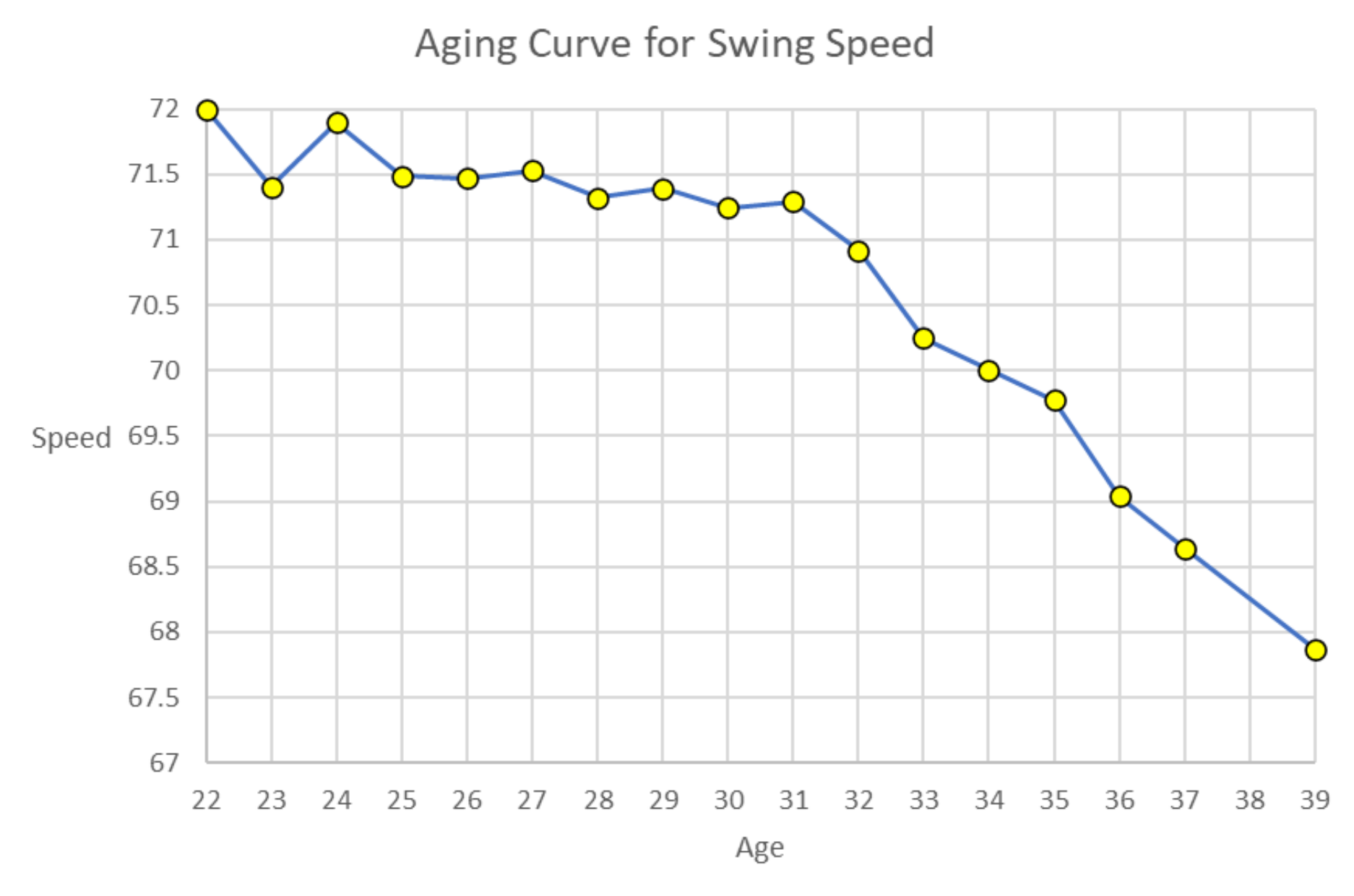
Bat Speed Age Curve (Tom Tango, April 2024)
History and the law of averages aren’t on his side here. As we know, though, Schwarber’s style of hitting has been bucking trends for a while now. I wanted to get more specific in examining his traits to see if there were any recent comparable seasons to the one he’s having that might tell us what the future holds. Schwarber is a three-true-outcomes guy in every sense of the term: Plenty of home runs, strikeouts, and walks. From Baseball Savant, here are all the hitter-seasons since the start of 2021 that meet the following, 2025-Schwarber-like requirements: Between the ages of 31 and 33, an average exit velocity over 92 MPH, an average K-rate over 25%, and an average BB-rate of over 10%, with our subject himself included on the list as a point of reference.
Thompson, Miller, and Choi aren’t in the league anymore, and they have the lowest EVs on here, so we can pretty much conclude that within this decade, the standard for what Schwarber’s doing right now is Judge and Stanton. That’s it. Pound for pound, do you consider Schwarber a better power hitter than Stanton? He probably is right now, but the farther back you go to answer that question, the more difficult it gets. Chase and walk rates would indicate Schwarber is certainly more disciplined—Stanton mostly crosses the 10% BB threshold because he gets pitched around, not because he has a great eye. Something that stands out about this list is how high Schwarber’s wOBA is this year. To me, that indicates he’s achieving roughly the highest level of offensive production possible with this blend of exit velocity, strikeouts, and walks. I feel more convicted in saying that because the one guy above him is easily on pace to go down as the best power hitter of the past decade. All else equal, this seems like more evidence he can’t repeat this next year. I’d be more inclined to say an optimistic take on Schwarber’s 2026 would be closer to the territory of his 2024, when his wOBA was .366.
Let’s get even more granular. What if, instead of looking at walks and strikeouts, we looked at chase and in-zone contact rates instead? Same years, same age bounds. Here’s every hitter-season since the start of 2021 that features a zone contact rate below 80%, a chase right below 25%, and an average exit velocity over 90. This one’s from Fangraphs, containing some data from Statcast.
In case you needed any further proof that Schwarber’s an outlier. This is what makes him so tough to project, and why it’s hard to say how much money he’ll make this offseason: Besides a guy who deserves his own tier in these discussions, nobody else hits like this. He’s the only one with this extreme combination of elite power, poor bat-to-ball, and great discipline. Muncy doesn’t hit the ball as hard, and the same goes for Suarez, who’s a couple of years older at age 34, and for what it’s worth, his quality of contact has slightly improved since last year, but his chase rate has notably jumped the past couple of years. I’m having trouble buying into him beyond 2025. If we widen the goal posts in this sample and take away the chase% threshold, only 3 more hitters are added to the group: 2022 Luke Voit, 2024 Teoscar Hernández, and 2024 Adolis García. Even then, I have a hard time comparing Schwarber to any of those guys because they’re all free swingers. It has been the downfall of Garcia the past couple of years, and right now, we’re seeing a down year from Hernandez, and Voit’s playing overseas.
Do you give Schwarber Judge money, then? No, because Judge has the highest ceiling in terms of power that we’ve seen in the game today. Do you give him Stanton money? No, because Stanton signed his current contract way back in 2015. Suarez and Muncy are in the same region, but not comparable enough. Again, even if his bat speed declines to 75-76 MPH instead of 77 and his 50th-percentile exit velocity drops to ~104 MPH instead of the 105.4 that it’s currently at, he’ll still have a very high propensity for power. There are so few solid comparisons prior to this, though, that even with all this information at our disposal, pinning down his salary for next year and beyond feels like pure guesswork.
Kyle Schwarber is a very special case indeed. He’s dearly beloved in a baseball-crazed market and has reached a new peak in his contract year. He loves where he is, and I’m going to go out on a limb and say he’s also professional enough to understand the business side of the game better than most. The type of hitter he is has not aged well historically, but he is also pushing the boundaries of what the archetype of a power hitter can be. After all, just 2 years ago, he hit under .200, stole 0 bases, and was still the primary leadoff man for a team that lasted until game 7 of the NLCS. It strongly feels like he’s at the pinnacle of a great career. Aging curves expect a slight decline from him next year, and proprietary projection systems are considerably less optimistic than even that. He’s such a rarity that he’s instantly the most fascinating pending free agent to follow when it comes time for business. That rings true when you consider the crossroads the Phillies are at: Aging core, many pieces of their roster peaking at the same time, and other expiring contracts in Ranger Suárez and J.T. Realmuto. Personally, I find Schwarber an easy guy to root for, fun to watch, and one of the better interviews in the game. I’d feel okay giving him a $25M salary next year, and maybe even the year after that. Term beyond 3 years, though? I’m hesitant. Whoever ponies up is going to be taking an unprecedented risk in doing so—but then, what’s that thing people say about the relationship between risk and reward? Only one way to test the waters.
All figures entering July 25, 2025
