





We’re already into the second month of the season, and it’s around this time that we have to really start adjusting our expectations from the preseason. While I and many other analysts preached patience all through last month, it was merely to buy time for the harsh realities and sweet surprises of April to ripen and take shape.
While it’s probably still too early to consider yourself out of contention in redraft leagues, it is high time to start exploring trades, cuts, and other roster maneuvers to either move up in the standings or solidify your place at the top.
Today’s article will focus on season-long expectations for players who have perhaps had a hot or cold start, and what kinds of things we should evaluate for these players going forward.
Let’s see how the other hitters did Sunday:
Isiah Kiner-Falefa (SS, TEX): 3-5, 2B, 3 R.
Kiner-Falefa has been as hot in May as he was in April, as he’s currently slashing .412/.462/.735 so far this month and has three multi-hit games in his last four starts. It’s starting to look like he could finish as a 12-15 home run, 15 stolen base bat with close to 80 runs scored. I wish I could be a little rosier on the power projection, but virtually all of his damage has been done against fastballs and Statcast suggests he’s had considerable batted ball luck against breaking pitches. Hopefully, Kiner-Falefa can make adjustments against non-fastballs before his luck runs out to maintain his strong batting average, but don’t be shocked if he’s slugging closer to .350 than .450 in the coming weeks as more and more pitchers try to attack him differently. If there’s one thing that can help protect him from a big drop, it’s that his contact ability remains solid and his batting average should continue to be an asset.
Charlie Culberson (3B, TEX): 2-4, HR, 2 R, RBI.
Culberson’s 73 point gap between his actual wOBA and his expected wOBA is the fourth-highest in the league (50 BIP minimum). While the 141 wRC+ we’ve seen from the 32-year-old journeyman is neat, batting the bottom of the Rangers’ order is hardly a profitable position, and that 35.6% whiff rate on fastballs and 52.6% whiff rate on breaking balls will surely catch up to him sooner rather than later.
Kyle Tucker (OF, HOU): 2-3, 3B, HR, 3 R, 4 RBI, BB.
I had Tucker inside my top-10 outfielders to start the season, and while the .188/.258/.393 line has been crushing many of my fantasy teams, there is definitely a pot of gold waiting for us at the other side of the rainbow. Tucker’s quality of contact suggests that he’s been hit with a lot of poor luck in the early goings, evidenced by his .273 xBA (85 points better than his current BA) and .514 xSLG (121 points better than his current SLG). Equally encouraging is his improved plate discipline. Normally, we might expect to see a young player with a slow start to press at the plate and strike out more, but Tucker’s 8.3% walk rate and 18.8% strikeout rate suggest he’s being as patient as ever. Call it bold if you’d like, but I still have Tucker in my top-10 outfielders going forward.
Andrew Vaughn (OF, CWS): 1-3, 2B, 2 R, BB.
It may only have been one hit, but for the first time this season, Vaughn had an extra-base knock in two consecutive starts. Due to the endless parade of injuries befalling the White Sox, Vaughn is finally starting to see more consistent playing time, and with that playing time, we can only hope that he learns to unlock more of the power potential in his bat. To do that, he’ll need to continue to work on breaking pitches, which is probably the most difficult thing for a young hitter to do when they break into the big leagues (Vladimir Guerrero Jr., for example, still doesn’t have a hit against offspeed pitches in 2021 and had only five in 2020). Because of the difficulty of the adjustment, I have Vaughn outside of my top-20 first baseman and my top-80 outfielders, though I wouldn’t begrudge anyone who wants to hold on to him in 12-team leagues that need a corner infielder and five outfielders.
Yermín Mercedes (DH, CWS): 2-5, 2B, 3B, R, 3 RBI.
Mercedes has a hit in nine of his last 10 starts and 25 of his 28 starts on the season. He’s slowed down a bit over the last few weeks with respect to home runs, but as long as he’s in the heart of the order on the South Side, he’s a viable fantasy option in virtually all formats for the foreseeable future. In leagues where Mercedes is catcher-eligible, he’s definitely in the top ten at the position, and thanks to his volume, he could even make a run at the top five.
Whit Merrifield (2B, KC): 2-3, 2B, R, RBI, SB.
He’s been 2021’s top second baseman by a wide margin, in large part due to him swiping 11 bags while being caught just once. The power will likely come and go, but he should finish with a .280 batting average, 15 home runs, and 30-35 steals at this rate. The only question in my mind at this point is whether the eventual return of Adalberto Mondesi will eat into Whit’s green light on the base paths (since they can just use Mondesi to run instead), but after losing eight games in a row, I’d imagine that Merrifield will be running quite a bit against the Tigers and White Sox, who will be his opponent for 10 of his next 12 games.
Jared Walsh (1B, LAA): 1-3, 2B, 2 RBI, BB, SB.
Regardless of what you feel about how the Angels handled the release of Albert Pujols, you have to admit that the Angels had to do something to keep Walsh in the lineup on a daily basis. While Statcast indicates he’s had some luck in the batting average and slugging departments, it is less concerning than it is for others due to his strong performance against breaking and offspeed pitches. His .229 xBA against fastballs is dramatically different than his actual .356 batting average, but I expect that xBA against heaters to go up as he continues to get consistent playing time at his natural position. With an adjustment against fastballs, I think Walsh could push for 30 home runs and 90 RBI, and that upside puts him near my top-15 at first base.
David Fletcher (SS, LAA): 2-4, R, SB.
It’s a good thing Fletcher leads off, or else that batting average would be almost entirely empty. The now-explosive Angels offense should help Fletcher cross home plate 80 to 90 times this season, and while he won’t hit double-digit home runs, he should get close to 10 stolen bases to go along with his .290 batting average. He’s a versatile fill-in at a lot of fantasy positions, though he’s not exactly the type you want to rely on at any one position for very long in 10- or 12-teamers. In Yahoo’s standard format, which only uses three outfielders and no corner or middle infielder, it becomes even tougher to justify using that roster spot unless you’re really battling injuries.
Dansby Swanson (SS, ATL): 2-3, HR, R, 2 RBI.
Things finally appear to be looking up for the embattled shortstop as he had his fifth multi-hit performance in eight games and his second home run in his last three. The recent surge provides at least some evidence that Swanson can rebound to finish the season as a top-15 shortstop, though the elevated strikeout rate, and in particular, the 31.9% swing-and-miss rate on pitches in the zone, leaves doubts as to whether he can get his batting average above .250.
Jake Cronenworth (2B, SD): 2-4, 2B, HR, 2 R, 2 RBI, BB.
Cronenworth ended April slugging just .404, and while this home run and double from Sunday helped, it was actually just the second time this season he had two extra-base hits in the same game. While it’s definitely safe to project 140 or more games from Cronenworth in 2021, I think his time as a leadoff hitter is probably over, and he’s a lot more likely to slug .400 than he is .450. He’s more or less a clone of David Fletcher or Luis Arraez, except he bats sixth instead of first and is more of a lock to get to double digits in steals and home runs.
Lewis Brinson (OF, MIA): 3-4, HR, R, RBI.
He looks like he has an everyday role in the outfield until the return of Starling Marte, and his two home runs in his last four games shouldn’t be too surprising to those who have been on this roller coaster before. It’s only a matter of time before he hits another 0-for-20 stretch with 15 strikeouts, but in NL-only leagues, you can enjoy the power and speed until that happens.
Ryan Mountcastle (1B, BAL): 2-4, 2B, 2 RBI.
His .306/.314/.429 line since April 26th is quite promising, but the lack of power and elevated strikeout rates have me moving on in almost all 10- and 12-team leagues. There are just too many other good options at first and outfield.
Wilmer Difo (OF, PIT): 3-5, 3B, 2 R, 3 RBI.
He had three hits and y’all would give me the business if I didn’t include him.
Joc Pederson (OF, CHC): 3-4, R, 2 RBI.
While this appearance broke a streak of four straight games as the leadoff man, the fact they faced southpaw Tyler Anderson made it less concerning, as having Joc bat first against a lefty would not exactly be considered wise management. While the overall Statcast data is extremely discouraging, his rolling expected wOBA paints a much more promising picture.
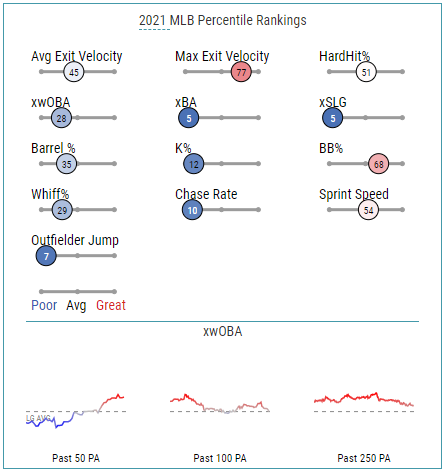
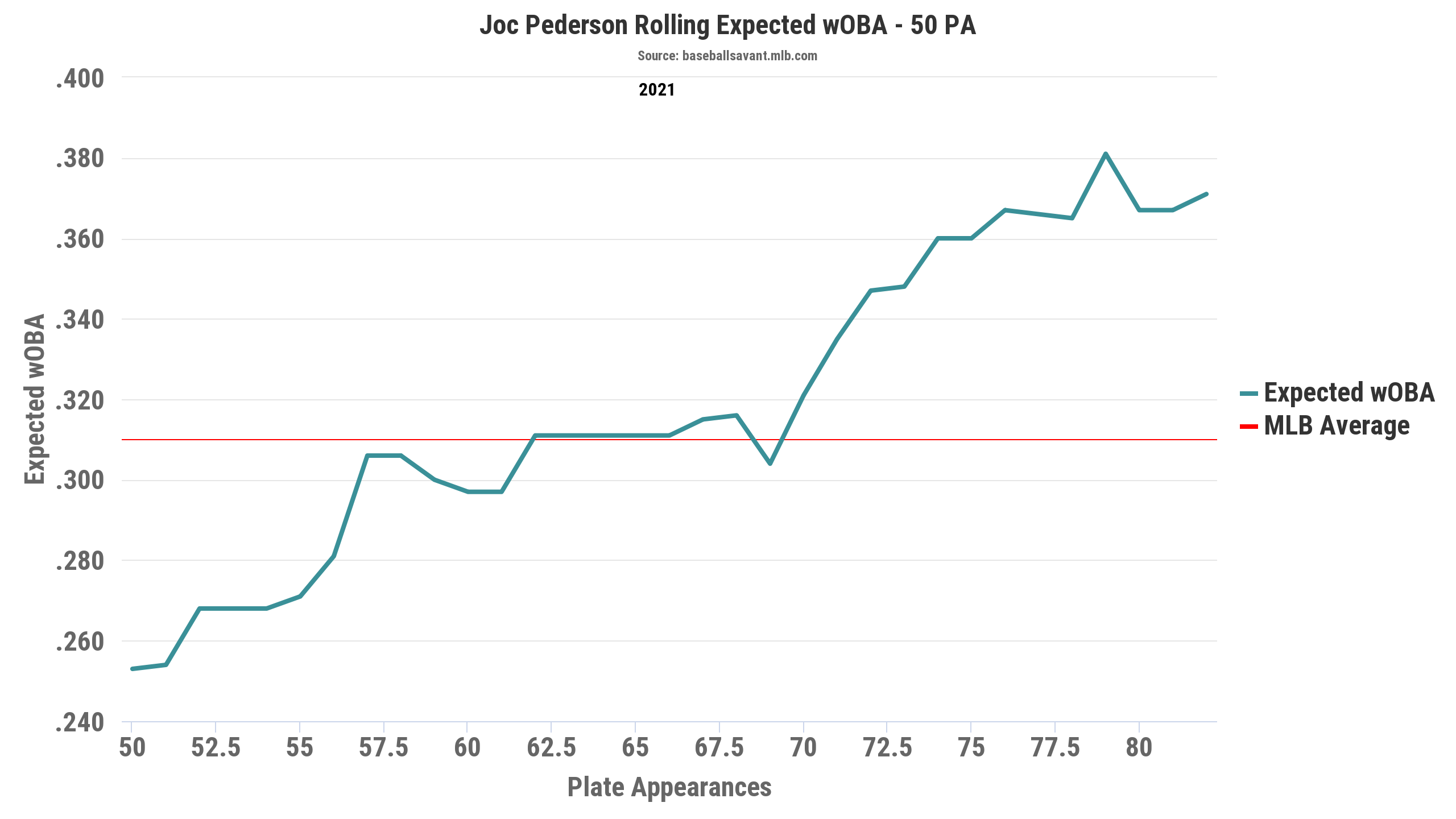
Pederson is always going to be a liability against left-handed pitching, and his streakiness can be maddening at times, but his willingness to take a walk and ability to hit for power make him a useful corner infielder or fourth outfielder in most formats.
Rowdy Tellez (1B, TOR): 2-4, HR, R, RBI.
His recent call-up gives him a chance to get at-bats as a DH due to the injuries to George Springer and Alejandro Kirk. Kirk is likely out for the long term after being moved to the 60-day IL, and the bench options to take at-bats from Tellez aren’t terribly intimidating. There’s plenty of power in this bat, though he’s probably a bit over-extended as a fantasy first baseman and is better suited as a corner infielder in deeper formats.
Want to chat about a player who is driving you nuts, or someone who you aren’t sure is legit? Drop it in the comments!
Featured Imaged by Ethan Kaplan (@DJFreddie10 on Twitter)
