





Keeping tabs on your current dynasty pitching options is hard enough. Looking for the next diamond in the rough on the minor-league side is a job all by itself. Thanks to PLV, we can look at some arms of note and the Triple-A pitchers doing the most in 2026.
With that in mind, let’s take a look at some Triple-A standouts from the season so far and check in on a Top 100 arm.
Check out the card tool at: https://milb-pitch-analysis-card.streamlit.app/ and other tools at: https://pitcherlist.com/pl-pro-tools-hub/
Top 100 Prospect Spotlight
Robby Snelling, Miami Marlins
2026 Stats: 6 GS | 29.0 IP | 1.86 ERA | 2.92 FIP | 40.0% K% | 13.6% BB% | 31.3% CSW%
Last Week: 5.0 IP | 0.00 ERA | 0 H | 0 ER | 1 BB | 9 K
Robby Snelling has struck out 44 batters in 29 innings at Triple-A Jacksonville this season. He owns a 1.86 ERA, a 0.90 WHIP, and opposing hitters are batting .138 against him. His last start was five no-hit innings with nine strikeouts and one walk. He is 22 years old and he is still in the minor leagues. Explain that to me.
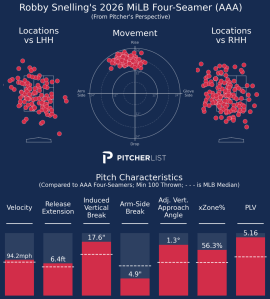
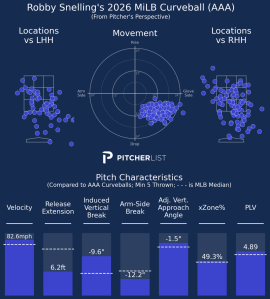
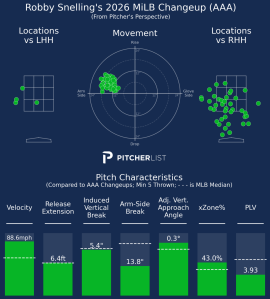
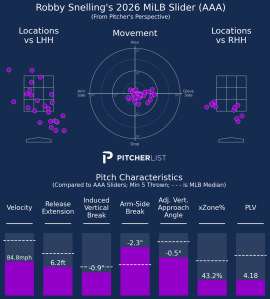
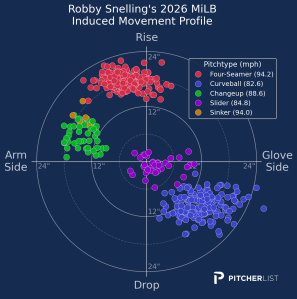
The full-season data makes the case for a debut even more clearly than the box score. His four-seamer at 94.2 mph is his primary weapon at 51.6% usage, generating a 20.9% whiff rate and a 42.9% strikeout rate across 56 plate appearances, with 6.35 feet of extension that makes the pitch play harder than its velocity implies. The curveball at 82.6 mph follows at 30.8% usage with a 32.4% whiff rate and a 44.7% strikeout rate. And then there is the detail that should genuinely move his dynasty price: the changeup, the pitch scouts have flagged as his developmental holdback for three years, is generating a 47.6% whiff rate across 43 pitches this season. That is not a work in progress. That is a weapon. Add a slider running 40% whiff at 7.6% usage, and you have a four-pitch arm with no real weakness in the current data.
Snelling’s four-seamer averages 94.7 mph and tops out at 98 with wicked movement, and his curveball has shown improved power and spin since arriving in Triple-A, now sitting at 2,650 rpm. It is all development and feel that contrasts sharply with a player who was once recruited to play linebacker.
From his first start at Jacksonville in July 2025, Snelling posted the top ERA (1.27) and most strikeouts (81) at Triple-A. The full 2025 line reads like a fantasy asset already arrived: 136 innings, 2.51 ERA, 10.99 K/9, 2.58 BB/9, 50.8% groundball rate, 0.66 HR/9, and a 2.77 FIP that confirmed the results were earned. The Marlins named him their Minor League Player of the Year. Manager Clayton McCullough said “the hype is real” after watching Snelling in major league camp this spring, and the on-field results suggest that was not just preseason bluster.
The only thing keeping him in Jacksonville right now is the calendar. The Super Two deadline in mid-June means promoting him now costs Miami an extra year of arbitration eligibility. That is an organizational decision, not an evaluation. The performance has been unambiguous for the better part of a year.
From a dynasty perspective, buy before the debut tax hits. Think high-floor SP4 with SP3 outcomes in Roto formats thanks to ratio stability, a strong groundball tendency, and a strikeout rate that should land near league average or better at the big league level. In points formats, the strikeout-to-walk efficiency plays even cleaner. He does not beat himself, and that is bankable. The changeup development showing up in 2026 data is the detail that elevates his ceiling above the preseason consensus. If that pitch holds at the major league level, the SP3 outcome becomes the base case, not the upside. The window to acquire him at prospect prices is almost closed. He is a priority stash in all leagues.
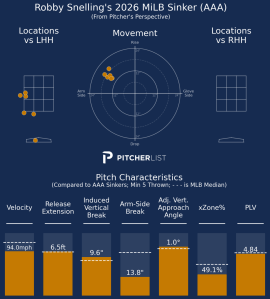
Here are his PLV cards:
Triple-A Standouts
Tanner McDougal, Chicago White Sox
2026 Stats: 6 GS | 24.0 IP | 3.00 ERA | 4.46 FIP | 27.6% K% | 13.3% BB% | 31.9% CSW%
Last Week: 1.0 IP | 3.00 ERA | 0 H | 0 ER | 0 BB | 1 K
McDougal landed on the 7-day IL with a right flexor strain after leaving his last start with forearm tightness. Further testing is underway. The timeline is unknown and the injury warrants monitoring.
Before his forearm shut things down, Tanner McDougal was making the best case of his career for a call-up. Through six Triple-A starts, he posted a 3.00 ERA with a 1.04 WHIP and held opposing hitters to a .150 average, and the full-season data reveals a much richer arsenal than early looks suggested.
The four-seamer sits at 98.4 mph and leads at 57.7% usage with a 22.4% whiff rate. Behind it, the slider at 85.5 mph is generating a 59.5% whiff rate across 75 pitches, solidifying the offering as a plus pitch this season. The curveball adds another layer at 57.1% whiff. And the changeup, used just 3.3% of the time, has an 80% whiff rate on its limited looks. This is a five-pitch arm at 23 years old sitting 98 mph. The profile, when healthy, is that of a future rotation piece, one perhaps overshadowed by Noah Schultz and Hagen Smith but no less legitimate.
The concern is obvious. Forearm tightness and flexor strains have a documented relationship with elbow ligament issues, and McDougal already went through Tommy John surgery in 2021. Until the testing results are known, his dynasty value is frozen. Don’t buy, don’t sell, just wait. But what he showed before the IL deserves to be on the record. If he comes back clean, he remains an intriguing breakout candidate in the White Sox system.
Carson Palmquist, Colorado Rockies
2026 Stats: 9 G | 2 GS | 17.0 IP | 4.76 ERA | 4.84 FIP | 22.8% K% | 12.7% BB% | 23.5% CSW%
Last Week: 6.0 IP | 3.00 ERA | 5 H | 2 ER | 0 BB | 6 K
Carson Palmquist is the kind of arm that statistical analysis loves in the abstract and the real world keeps complicating. He throws from a near-sidearm slot that produces genuine deception. His 7.34 feet of extension on the four-seamer is elite and helps the 91 mph heater play up considerably. The sweeper at 72.2 mph generates a 42.9% whiff rate. The cutter checks in at 30% whiff. These are more-than-serviceable numbers from a Colorado Rockies system that struggles to develop arms to help the big-league rotation.
The complications are real too. The cutter is producing a .600 BABIP and a 14.3% walk rate this season, and when it does not land, it becomes a problem. The walk issue has followed Palmquist at every upper-level stop, and his major league track record of an 8.91 ERA across two stints in Colorado reflects the margin for error that comes with 91 mph stuff. The overall profile reads more as a multi-inning reliever than a starter, and at 25, the organizational patience for a role change may be reaching its limit. Still, the underlying pitch shapes are interesting enough to keep him on the watch list, particularly if the Rockies deploy him in shorter bursts where the sweeper can do maximum damage.
Coleman Crow, Milwaukee Brewers
2026 Stats: 5 G (4 GS) | 25.0 IP | 5.40 ERA | 4.50 FIP | 28.6% K% | 10.5% BB% | 31.6% CSW%
Last Week: 5.2 IP | 0.00 ERA | 1 H | 0 ER | 2 BB | 7 K
Coleman Crow has been bouncing around long enough that his name barely registers in dynasty circles. A 28th-round pick out of the 2019 draft, two Tommy John surgeries, multiple trades make for a career path that tends to make fantasy managers look elsewhere. Could a stint in the Milwaukee Brewers organization be the turning point for him?
The 2026 data clarifies what the early sample only hinted at. The cutter leads his arsenal at 26.8% usage, doing the volume work at 87.5 mph. His curveball at 74.7 mph comes in second at 22.1% usage with a 34.3% whiff rate and 2,916 rpm of spin, the pitch that makes scouts stop and pay attention. The sweeper, used more sparingly at 6.3%, is generating a 50% whiff rate. The four-seamer at 11.2% usage has a 31.6% whiff rate. One flag worth noting: the four-seamer is getting hit hard in contact, with a .455 batting average against, suggesting hitters can sit on it when they pick it up. Crow’s job is to make sure they cannot.
His debut on April 17 against the Marlins was exactly what you want to see: 5.1 innings, two earned runs, four strikeouts, 55 of 77 pitches for strikes. The Brewers sent him back to Nashville only because Kyle Harrison was returning from a wrist issue. He will be back. The dynasty value here is limited, as a 25-year-old with no prospect pedigree, but if you need a back-end streaming arm or a spot-start option, Crow’s arsenal is deeper than his name suggests.
Low-A Long Shot
Mac Heuer, New York Yankees
2026 Stats: 1 GS | 3.1 IP | 2.70 ERA | 1.39 FIP | 30.8% K% | 0.0% BB% | 29.1% CSW%
We are working with a debut sample of 55 total pitches, so treat everything here accordingly. Mac Heuer is not a dynasty priority right now, but a name to keep in the back of your mind.
The Yankees drafted him in the eighth round last year out of Texas Tech, paying $400,000, nearly double the recommended slot, because the physical tools were obvious even when the college ERAs were not. His pro debut started late due to arm soreness in extended spring, and when he finally took the mound on April 29, the first thing worth noting is that he led with a cutter at 93.6 mph rather than a fastball. Most young arms lead with the heater. Heuer is already pitching from a plan.
His curveball, buried at 14.5% usage, flashed a 66.7% whiff rate. The slider checked in at 37.5% whiff. And sitting behind all of it is a four-seamer at 96.2 mph that he barely used, with 6.4 feet of extension that gives every pitch additional play. The 6-foot-5, 265-pound frame adds projection that the debut stat line cannot capture. The New York Yankees have a track record of turning athletic later-round arms into rotation pieces. Heuer fits that mold precisely. One start does not make a prospect, but the building blocks are worth watching develop over the next few months.
