





Welcome to Week 14 of our Patience or Panic series! Here, we look at players underperforming, evaluate possible reasons, and examine their worth. Do they deserve some grace? Some more time before you pull the plug? Or is it time to yank the cord from the wall and cut your losses? Let’s not waste any more time. So, shall we?
Gunnar Henderson, SS, Baltimore Orioles
Conventional wisdom dispels this very notion. This is Gunnar Henderson. Y’know the Gunnar Henderson. The guy who finished eighth in MVP voting and won a Silver Slugger and Rookie of the Year in 2023. This is the guy who then finished fourth in AL MVP voting the next season and was one of three stars on the face of MLB The Show. He is a cornerstone. He is the very definition of stud and stallion and about 10,000 other synonyms that communicate the same idea. There is no reason to preach patience or panic when it comes to Henderson.
Except there is. Kind of. Henderson, for all his synonyms, has yet to sniff 2024. Some would say that’s reasonable. 37 home runs, 92 RBIs, 31 doubles, a .893 OPS, 154 wRC+, and 7.9 fWAR all as a 23-year-old. It’s all-world type of stuff. Yet it also feels so long ago. Kind of. 2025 was not a demonstrable season. It wasn’t even bad. Nor was it any other applicable word. Henderson hit .275/.349/.438 with a .787 OPS and a 120 wRC+. Even if it’s not quite 2024, it’s a great, great year. And it seemed to be another tick off the superstar checklist. He’s had his great rookie season, his breakout look-at-me-I’m-a-super-duper-star season, and his stable, albeit slightly underwhelming, season. What should’ve come next was another MVP-caliber season.
That’s what the Orioles and Henderson penciled into 2026. That expectation, however, has been erased. 2026, so far, is one of those demonstrable, bad seasons strictly by Henderson’s previous standards. He’s hitting .221/.294/.410 with a .701 OPS and 95 wRC+. In accordance with that last metric, he’s not even league-average. And to exhibit a rare display of brevity, here is where Henderson’s facing career-lows: Batting average, OBP, slugging percentage, OPS, wRC+, HR%, HardHit%, Barrel%, Barrel/PA, ISO, and —
Alright. Maybe not so concise. The point here is that Henderson is having the worst season of his career. It’s not even close. He was more productive as a rookie than he is in his prime. Why? In case it wasn’t obvious, there is no clear one answer. The simplest one is this: He’s playing badly because all his numbers are bad. Now that’s concise! Sadly, it’s not very informative. So, let’s try this again.
The biggest reason for Henderson’s struggles is his HardHit% and Barrel%, the two pillars of 21st-century player analysis. On the surface, neither is dropping much. In 2025, he had 8.6 Barrel%, 5.8 per plate appearance, and a 49.2 HardHit%. This season, he has an 8.1 Barrel%, 5.5 per plate appearance, and a 44.8 HardHit%. The latter shows the most decline, but in the grand scheme, it’s still not much. In year-to-year losses and gains, Henderson’s -4.4 dip is the 55th-highest out of 186 qualified hitters.
The real discrepancy shows between 2026 and Henderson’s vaunted 2024. During that hallowed year, Henderson had an 11.2 Barrel%, 7.4 per plate appearance, and a 53.9 HardHit%. That last metric placed him in the 97th percentile. It was also accompanied by a 94th percentile ranking in Average Exit Velocity, 96th in Bat Speed, 92nd in xBA, and 94th in xWOBA. His whole Savant page was read, save for four hitting categories. Nowadays, Henderson’s page is blue. And where it is red, it’s a pale, muted hue.
One actual, specific answer for all of this is Henderson’s overcompensating. Part of what made 2025 a disappointment was Henderson’s power. He hit just 17 home runs, 20 fewer than in 2024, despite only playing four games. That was the biggest year-to-year change in baseball. Henderson’s ISO met a similar fate, dropping more than anyone else. It was a strange, weird, kooky — alright, this bit is getting old for me too — development.
Henderson is not unaware of all this. And if anything, he might be too aware. He’s pulling fly balls way, way more than he did a year ago. Then, he pulled 15.3% of all flyballs. Now, he’s pulling 25.5% of them. That +10.2 percent is another mammoth year-to-year change. In fact, it’s the second-biggest increase in baseball. And it’s wholly unnecessary. Henderson clubbed 37 home runs while pulling 14.9% of all his flyballs. He hit 28 in 2023 while pulling 15.8% of them. This isn’t a Fernando Tatis Jr. situation. He hasn’t gone from pulling to not doing so at all. He never did all that much, and he never needed to. Now, for some reason, Henderson does.
To his credit, the change has worked. Henderson has hit 16 homers, one less than last season’s total. His 4.2 HR% is closer to his career average, and the same can be said for his .189 ISO. Fixing this one problem has led to others. Because while Henderson is hitting tanks, he’s not doing much else. He’s striking out more, walking less, and being of less value than ever. It’s robbing Peter to pay Paul. It’s Charlie Daniels going down to Georgia. It’s a band-aid over a bullet hole. Take your pick.
Perhaps stranger than this is the shortstop’s numbers against fastballs. Henderson’s always fared well against the pitch type. We’re talking a .305 average in last season’s down campaign, a .275 average in 2024, and a .269 average in 2023. It’s never been a problem. This year it is. Henderson is hitting .219 on all fastballs and is among the worst hitters of a four-seam fastball in the game. That’s not an exaggeration or well-worn hyperbole. He’s hitting .132 and slugging .263 with an xBA of .198 and a -6 run value. Cutters, sinkers? Not a problem? The classic four-seamer? Kryptonite.
The Verdict: Be positive. Henderson is too talented to stay like this. He knows it. Odds are, he’ll find a happy middle ground between his want of power and Baltimore’s need for consistency.
Geraldo Perdomo, SS, Arizona Diamondbacks
Last season, Geraldo Perdomo was a man afire. Twenty home runs, 100 RBIs, 33 doubles, five triples, 27 steals. All while hitting .290/.389/.462 and posting an .850 OPS. 138 wRC+ and 7.1 fWAR. Perdomo swung a hot bat to say the least. And it carried him toward a Silver Slugger and a fourth-place finish in 2025’s NL MVP voting. Yes, really. Perdomo, who before 2025 averaged a .657 OPS, trailed only Shohei Ohtani, Kyle Schwarber, and Juan Soto in MVP voting.
The flame seemed eternal. Perdomo was just 25 then, would be 26 this season, and finally found himself peaking. Yet as of now, Perdomo’s flame is flickering. Through 78 games, the shortstop is hitting .245/.357/.361 with a .718 OPS, a 105 wRC+, and 2.0 fWAR. He’s just about average. His counting stats are also down substantially, with just 11 doubles, five home runs, and 28 RBIs. MVP votes are not in his future. Nor is another Silver Slugger.
So, what’s made Perdomo nothing but hot air?
At first, it’s a hard question to answer. With most struggling hitters in this series, the starting point is HardHit% and Barrel%. It’s simple. Is Player X hitting the ball hard and putting the barrel to it? If not, well, that’s what’s wrong.
That is not Perdomo’s problem, however. Not entirely. His HardHit% is almost the same, going from 31.9% last season to 30.9% this season. One good week could put them even. That said, there is a discrepancy in his Barrel numbers. Perdomo’s Barrel% is halved, falling from 6.2% to 3.3%. The same goes for his Barrel/PA, falling from 4.5% to 2.4%.
There’s half the problem. Perdomo isn’t barreling. Okay. What about his expected numbers? Last year, Perdomo ranked in the 91st percentile in xBA and the 51st in xSLG. Is he getting cheated? No. Perdomo’s expected rankings are down, but not drastically. He’s in the 66th percentile in xBA, and there’s only a -.014 difference between his xBA and his average. In terms of pure bad luck, there’s not much here. Nor is there in his slug. Perdomo’s slugging percentage is .361. His xSLG is .350. He’s actually outperforming expectations in that regard. And worse, he’s only inviting more haze into this equation.
In short, Perdomo isn’t hitting the ball any less hard. He is barreling it half as much. But he’s not bearing the brunt of much bad luck. In one regard, he’s actually benefiting from it. So, again, what’s made Perdomo nothing but hot air?
Well, with the usual suspects falling short, the next target has to be what opponents are doing to Perdomo. And here, the flint catches. Last year, Perdomo excelled at hitting fastballs and breaking balls, hitting to the tune of .310 and .295, respectively. Offspeed pitches are a different story. Against them, Perdomo hit .219 with a .368 slugging percentage. Seeing this, opponents have found an extinguisher. Perdomo is seeing offspeed pitches 4% more than last year and struggling even more. Right now, he’s hitting .194 against the pitch type with a .256 slug. Ten of his 12 hits against it are singles. All that’s to say he’s cinders against it.
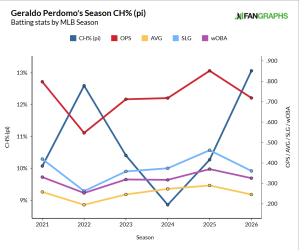
In particular, Perdomo is falling victim to changeups, sliders, and curves. Changeups have Perdomo hitting .227, sliders hitting an improved .242, and curves a much, much lower .167. Had he enough at-bats to qualify, Perdomo would be one of the worst curveball hitters in baseball. His .167 average would rank 10th-worst while his .167 slug would be tied for sixth-worst. Perdomo is also striking out 28.3% on curveballs, as if that weren’t enough to fan the flames.
Pitch arsenal stats aside, there are other changes worth mentioning here. Perdomo, for instance, is pulling all batted balls 7% more than last year. Likewise, he’s not putting as many balls into the air. That manifests on the stat sheet most obviously in his 1.5 HR%. But broadly, it shows up in his simple fly-ball and air rates. His FB% is down 4.6%, and his AIR% has gone from 60.2 to 53.7. The two are odds with one another. If Perdomo is trying to pull for power, he needs to keep the ball airborne. He’s not. The napalm is only hitting him.
Perdomo might be realizing that. Over the last 30 games, he’s heating up, hitting .282 with a .398 slug. He’s possibly accepted he’s better off chasing 2025’s .290 average than the season’s 20 home runs.
The Verdict: Cautiously buy. That said, there is far greater evidence that Perdomo is a little above league-average bat than there is that he’s a Silver Slugger or MVP candidate. People should be patient in understanding this and not panic over his regression. Still, Perdomo is a good player. He is a good hitter. And if the rest of the season goes as the last month has, he can be better than that.
Christian Walker, 1B, Houston Astros
Christian Walker looked born again over the first month of this season. The 35-year-old hit .293/.366/.552 with a .918 OPS and a 152 wRC+. He’d collected seven homers, 24 RBIs, nine doubles, and a .310 BABIP. He was every bit the player Houston signed and not at all the one they received in 2024. Salvation arrived. Had this article been written then, the overwhelming judgment would not have been patience or panic but praise. Pure, unadulterated praise.
But time passed, and fortunes have since changed. Since that hot start, Walker has frozen over. In his last 53 games, a far greater sample size than that first month, Walker is hitting .209/.277/.433. He boasts a .710 OPS, a 95 wRC+, and a .221 BABIP. As a result, he’s dragged his OPS this season all the way down to a still-respectable but much-worse .787.
These splits are, well, concerning. They’re even more concerning because they’re worse than Walker’s 2025 numbers. Then, Walker hit .238/.297/.421. He played so poorly that people feared he was done. That his glory days were behind him. Houston even agreed. They had trade conversations with other teams centered on Walker. These conversations partly stemmed from Houston’s crowded infield. They also were born of Walker’s play and how little he had in common with his $20 million AAV.
Walker still has little in common with that contract. And now, he’s done something far worse than underperform. He overperformed and provided hope just to provide the opposite and leave Houston back to where they started, with an overpaid first baseman whose bat seems over the hill. It’s both Walker and Houston’s long night of the soul.
Can they overcome the darkness and refind faith in the future? If they’re going to, Walker needs to do a couple of things: First, he needs to get back to hitting the ball hard. In April, Walker had a HardHit% of 48.9%. In May, that dropped to 43.8%. In June, Walker has a HardHit% of 38.2. It’s an arrow heading down. It’s also a rapid, rapid decline. Either Walker is wearing down, or pitchers have adjusted to his adjustment. Regardless, that trend needs to change if he’s going to bring himself back from the dead.
That’s doubly true for Walker’s Barrel numbers. He started the campaign really well, with a 12.8 and 13.8 Barrel% over the first two months. Strong numbers very much in tune with his career averages. This month, Walker has an astoundingly low Barrel% of 1.5. Let’s say that again. Walker, who’s averaged a Barrel% of 10% or greater since 2022, barreled just 1.5% of all balls seen in June. That is the 12th-lowest Barrel% in baseball this month. It’s jaw-dropping. His contemporaries here make some sense. Walker, who routinely hits 20 homers and 20+ doubles a season, should never be here. No matter what.
There are plenty of other leper-like numbers plaguing Walker. He’s not hitting fastballs or curveballs. His bat speed is in decline compared to last season. His xSLG is in the 45th percentile, making those HardHit% and Barrel% numbers seem less fluky and even harder to curb. Likewise, his average exit velocity is down yet again. These are all problems, especially when Walker’s profile preaches power.
And it’s because of that nothing much matters besides his HardHit% and his Barrel%. For Walker to be himself, and to be the hitter the Astros need if they’re to save their season, he needs to be making loud contact. He needs to be driving the ball. Can he? That’s a different question made for a higher power.
The Verdict: Stay away. Since joining the Astros, Walker’s been more of a disappointment than anything. There’s little evidence to think that will change.
All stats accurate as of 6/29/26
