





Welcome back to Week Twelve of our Patience or Panic series, where we take a look at three struggling players and provide recommendations on how you should react to their slow starts and subpar performance. This week, we’re studying some stolen base specialists, struggling for strategies to stand on first or slide into second.
Nico Hoerner, 2B/SS, Chicago Cubs
With just a .233 average so far in 2026 and a .293 expected average, Nico Hoerner is the second-unluckiest hitter in baseball among qualified hitters. Hoerner’s .239 BABIP to this point would be more than 50 points lower than any of his previous four seasons. But surprisingly, in some respects, he’s performing better than he has previously in his career. Hoerner has improved his contact skills to career-bests in strikeout rate, walk rate, and zone-contact rate, not including a shortened 2021 campaign.
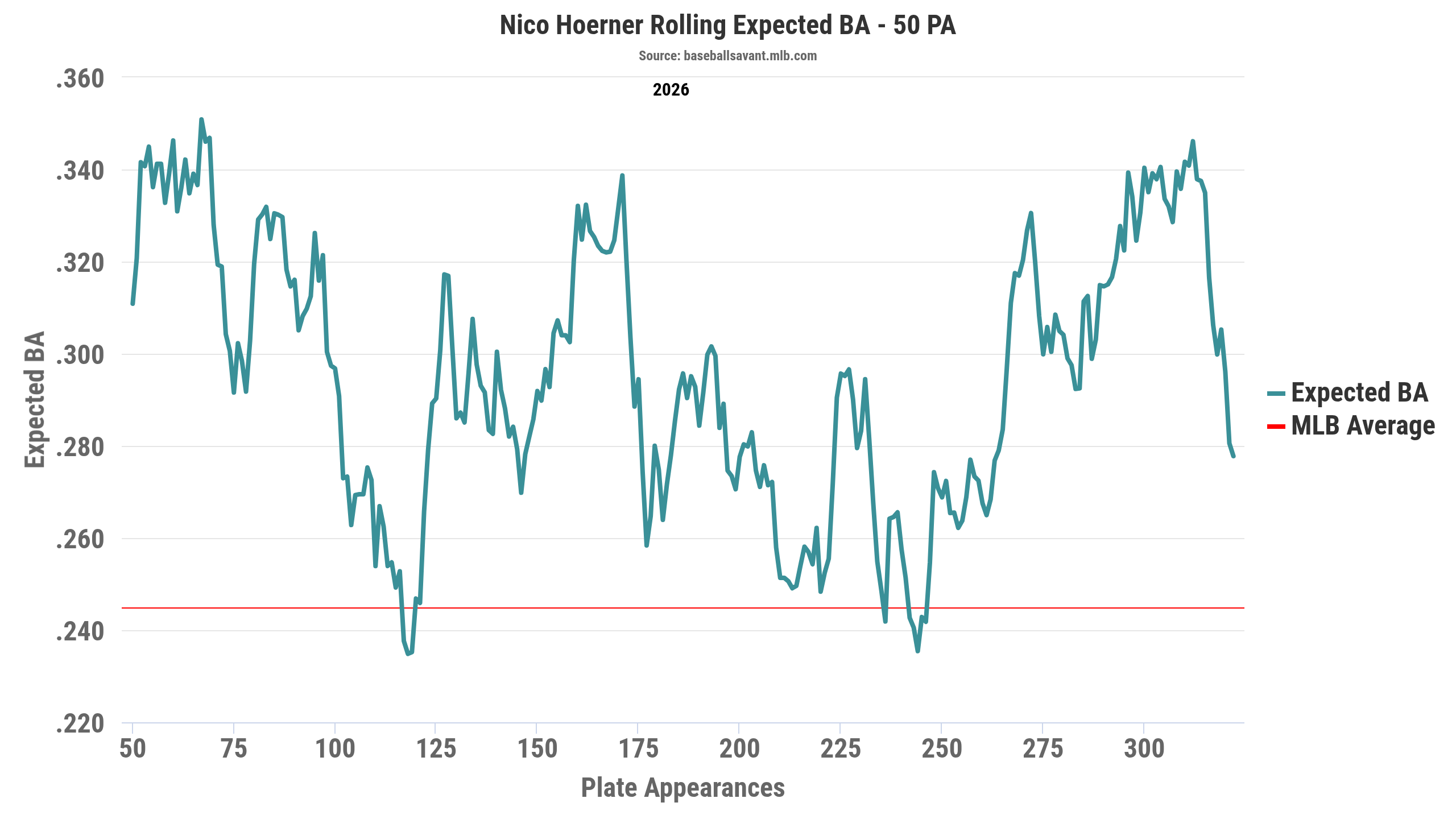
The trend has intensified this month, with Hoerner’s June average down to .143 in 54 plate appearances, while his expected average remains steadily above league average. Despite this, the improved walk rate has kept Hoerner’s on-base percentage close to his career norms and preserved opportunities for stolen bases. With 12 steals so far this season, he’s still on pace to challenge last season’s 29. As the weather warms up in Chicago this summer, the average should rise in unison. Nothing in his profile suggests a long-term concern for managers.
Verdict: Patience
Chandler Simpson, OF, Tampa Bay Rays
It’s difficult to account for game-breaking speed when looking at certain metrics. A ground ball could have an incredibly low expected average for your average hitter, but Chandler Simpson is not that. The speedster can turn more routine plays into infield hits, and those hits effectively into doubles after a stolen base, a recipe for success in 2025 with 44 steals and a .295 average in just over 100 games played. Hitting atop a Rays lineup, Simpson can be a major contributor to three categories: runs, stolen bases, and average.
This year started with similar success to last season, a .308 average and 14 steals on 18 attempts through Simpson’s first 40 games, which concluded with two stolen bases on May 11 in Toronto. However, after running out a groundball in the 8th inning of that May 11 contest, Simpson left the game with cramps in his left leg. He sat out the next day, and all tests came back normal. But the results since then tell a different story.
In the 28 games since Simpson returned to the lineup on May 13, he has hit .189 and, more importantly, has yet to steal another base. He’s only attempted a stolen base four times in this span, with the last of those coming 19 games ago, by far the longest streak of his career without an attempted steal. There’s no definitive evidence that an injury is the cause of this trend. Correlation is not necessarily causation. But if Simpson is even a step or two slower, it would explain the drop in average and steals, as the margin for error at this level is often less than a step. Perhaps the Rays are protecting Simpson. Either way, the strengths are quickly fading away as Simpson struggles to get on base and has fallen in the order. Managers in need of steals should look elsewhere.
Verdict: Panic
Jackson Holliday, 2B, Baltimore Orioles
After missing the start of the season with a broken hamate bone in his hand, Jackson Holliday has been back for almost one month, and so far, he’s shown mixed results. Three home runs and three stolen bases show the upside of a power/speed combo that has excited real-life and fantasy managers alike for the former No. 1 overall draft pick. The consistency is still a work in progress, with a .189 average and almost 30% strikeout rate. He’s also in a platoon, sitting against almost all lefty starters since his return.
While it’s too small a sample size to draw any reliable conclusions on most of Holliday’s metrics, a hamate bone injury can often sap a player of their power. Therefore, it’s most important to look at max exit velocities and any other signs of hand and wrist strength to determine if he’s feeling any nagging effects from the injury. If those numbers are down, then he may be limited long-term.
The max exit velocity is the only number showing a notable decline from last season, but it’s not enough to offset the results so far when Holliday generates hard contact, which he’s done more consistently than in 2025. He’s worth holding onto in deeper formats with the hope he can get the strikeout rate back down and the average up as he settles in.
Verdict: Patience
Photos courtesy of Icon Sportswire | Adapted by Aaron Polcare (@abeardoesart on Bluesky and X)
