





Welcome back to Week Twenty of our Patience or Panic series, where we take a look at three struggling players and provide recommendations on how you should react to their slow starts and subpar performance. It’s an AL-only column this time! Let’s get into it.
Zach Neto, SS, Los Angeles Angels
The ingredients for a sustained slump were always present for Zach Neto, even dating back to last season. Neto’s decision-making cratered in the second half of 2025, chasing and whiffing about 30% of the time, which has worsened this season to 37% and 33%, respectively. Despite this, he’s been productive from a fantasy standpoint, particularly in standard leagues where the strikeouts hurt less, coming off a 26/26 season last year and on pace for 32/21 at the All-Star Break this year. Most of that damage has come against fastballs, hitting 33 of his 46 HR (72%) over the last two years, sitting dead red.
Since then, it’s been a different story. In his last 21 games, Neto has just four extra-base hits (one HR) and three steals on five attempts. Opposing pitchers have begun to throw fewer breaking balls and more off-speed pitches, up almost 5% in August from the start of 2026. And it’s working. For his career, Neto has hit just .157 against off-speed pitches, but has been able to lay off enough to stay in counts and survive until he gets another fastball. This year he has struggled to identify the changeup, swinging at those offerings half the time, up 6% from last year. Since the All-Star Break, Neto has swung at over half of the total changeups he’s seen, whiffing 40% of the time, and hurting his confidence in attacking the harder stuff. That reliable production against the heat has cooled off considerably.
The walk rate has fallen to 5% over this stretch, the power has disappeared, and the Angels traded away Jo Adell, weakening a lineup already struggling with offensive depth. Neto was dropped from leadoff to the cleanup spot this past week due to his extended slump, further limiting his opportunities for run production. Managers will have to wait and see if he can turn it around, but with the fantasy playoffs less than a month away, some difficult decisions may have to be made should Neto not turn it around quickly.
Verdict: Panic
Kazuma Okamoto, 1B/3B, Toronto Blue Jays
Let’s run it back. Chase rate? Not great at 28%. Whiff rate? Worse at 34%. Power outage since the All-Star Break? Just two HR in 23 games played. Kazuma Okamoto is running the same playbook as Neto, with Okamoto’s 117 Power+ rating generating 24 HR and 70 RBI, both top-10 marks in the AL. So has the culprit also been the same?
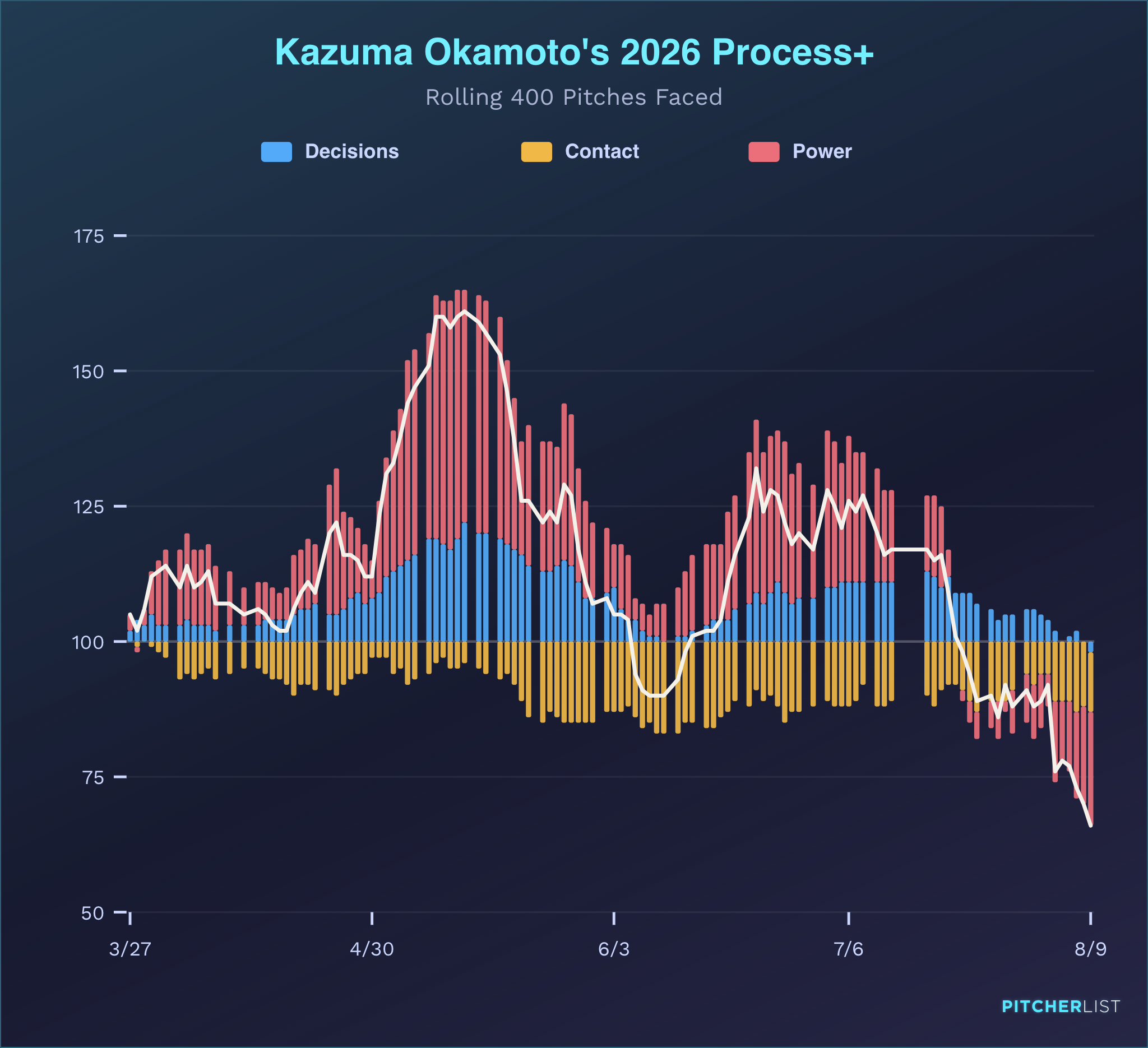
As shown by his rolling Process+ chart, Okamoto’s approach has remained quite consistent, while his Power+ has dropped significantly, as indicated by a 4% barrel rate since the Break, down from his 12% mark for the season. Some of this could be attributed to poor results against a difficult schedule that has included strong pitching staffs in the Red Sox, Phillies, and Rays. Okamoto went 3-for-37 (.081) across those three series. For the season, he’s struggled greatly against above .500 competition to just a .663 OPS, doing much more damage against weaker opponents – an .835 OPS.
And there aren’t any clear skies on the horizon. The upcoming schedule will feature more strong pitching: Red Sox, Yankees twice, Rays, Mariners, and Guardians in a six-series stretch. After that is smoother sailing, but perhaps too late for managers making a late-season push. The wire is not an easy place to shop for 3B, but managers in win-or-go-home mode should consider streaming rather than waiting on Okamoto until September rolls around.
Verdict: Panic
Taylor Ward, OF, Seattle Mariners
One of the most dramatic offensive approaches from last season to this season belongs to Taylor Ward. After a career-high 36 HR and 103 RBI last year with the Angels, Ward has just seven HR to his name in his first year outside the organization that drafted him. He swings at the lowest percentage of pitches of any qualified hitter in baseball, and naturally, chases the least as well. This passive, contact-driven approach has reduced his power significantly, but hasn’t increased his average too dramatically, only up 12 points at the cost of about 25 HR over a full season. His value in standard leagues has taken a huge hit, but an excellent 16% walk rate makes him viable in OBP leagues.
He was acquired at the deadline by Seattle, and it is not a good fit. Statcast’s park factor measures his new home as the worst-hitting environment for RHH in MLB, an environment almost as pitcher-friendly as Coors is hitter-friendly. It’s a considerable downgrade from Camden Yards, which ranks in the Top 10 for RHH. At least he’s hitting leadoff, though! He can continue to walk a lot and score some runs. Right?
Not off to a good start there either. It appears early on that the Mariners are looking to tap back into some of that aforementioned power that Ward may have left in the tank, which may snatch away the last morsel of value Ward has left to provide fantasy managers in 2026. Even those in OBP leagues should be very concerned and keep an eye on that walk rate. It takes about 120 PA (around one month of play) to stabilize, and we’re only a week in. But for a player offering little production otherwise, look for the nearest exit now. And remember. It may be behind you.
Verdict: Panic
Photos courtesy of Icon Sportswire | Adapted by Aaron Polcare (@abeardoesart on Bluesky and X)
