





Welcome to a new article series where we’ll be analyzing hitters through one of Pitcher List’s very own PLV metrics, Decision Value.
If you’re unfamiliar, PLV stands for Pitch Level Value and analyzes every pitch thrown in MLB games, not according to the outcome of the pitch — ball, strike, hit, out, etc. — but on a more granular level according to the pitch’s velocity, movement, location, and more, regardless of the outcome. You can check out a much more thorough primer on PLV here.
Putting pitches under the PLV microscope can tell us more than whether something was a good or bad outcome. Maybe that single came against an incredibly tough pitch to hit and should be viewed as particularly impressive, or a batter’s choice not to swing at a pitch potentially cost his team runs because similar pitches have resulted in loud contact more often than not. This level of analysis is where we find Decision Value — the modeled value of a hitter’s decision to swing or take. At first, Decision Value may sound like just another plate discipline metric, but it’s more than that. If a batter chooses to take a nasty slider from Jacob deGrom that dots the corner of the strike zone in an 0-0 count, that’s a good take. An elite pitch with impeccable placement is not going to produce good outcomes very often, even if contact is made. In that scenario, the batter is better off to take that pitch and fall behind in the count 0-1 rather than risking rolling over the pitch for an easy out.
That scenario is a prime example of what Decision Value is getting at. It’s deeper than whether a hitter can recognize the strike zone. It’s whether he can correctly identify the pitches that he has a good chance of turning into favorable contact. We can also break this down further by looking at pitches both in (zDV) and out (oDV) of the strike zone.
Like many metrics, Decision Value is graded on a scale where 100 represents the league average. Every 15 points above or below 100 is one standard deviation.
With all of that out of the way, let’s take a look at which hitter breakouts seem legit based on their swing decisions.
Spencer Torkelson – 133 Decision Value
It’s been a wild 2025 for Spencer Torkelson. There was a legitimate discussion during Spring Training about whether or not the former first overall draft pick would even have a roster spot, and now he’s playing the best baseball of his career. Through 43 games, Torkelson is slashing .240/.344/.526 with 11 home runs, 30 runs, and 34 RBI. His 142 wRC+ is not only a career-best, but also the 26th highest among qualified big-league hitters.
It’s not just the results on the field that are making waves, but under the hood, all signs point to a meaningful breakout. After a disappointing 2024 season where he posted below-league-average production (92 wRC+), he’s reversed course by posting the best strikeout (24%), walk (12.6%), and barrel (14.2%) rates of his young career.
Decision Value gives Torkelson’s breakout even more legitimacy. His 133 mark is the fourth-highest among hitters who’ve seen at least 400 pitches (the threshold where Decision Value becomes more meaningful). That represents a significant improvement for Torkelson after he posted back-to-back seasons with a 113 Decision Value in 2023 and 2024.
Just telling you how good Torkelson has been at picking his pitches may not be enough, so take a look at his rolling Decision Value chart.
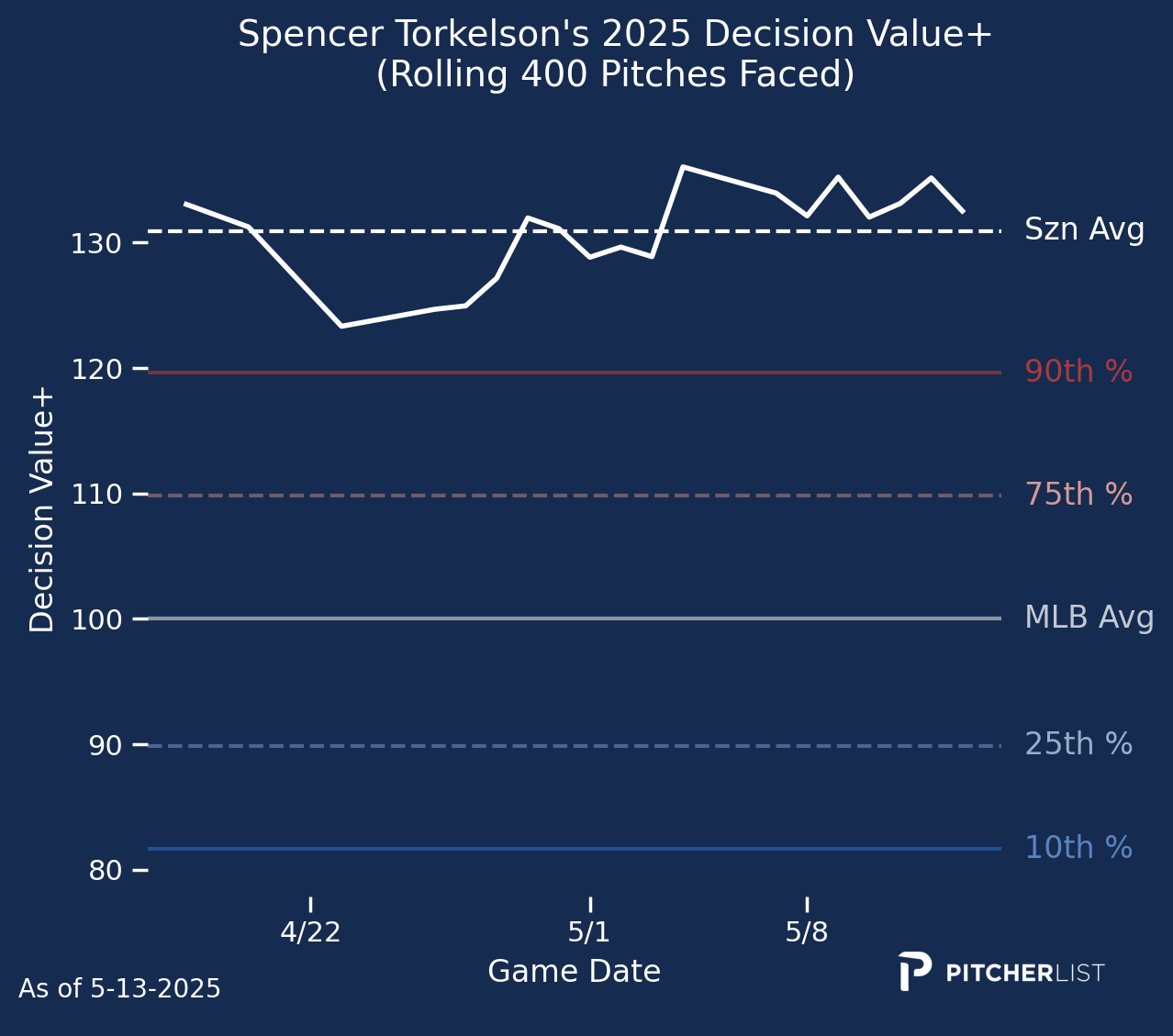
Tork has consistently been making some of the best swing decisions in the game — well above the 90th percentile! — for over a month and a half. If there was any question about whether his production was just an extended hot streak or not, I think we have an answer. The former first overall pick is finally playing up to the prospect hype he carried a few years ago, and it doesn’t look like he’s going to stop anytime soon.
Carson Kelly – 128 Decision Value
When the Cubs inked Carson Kelly to a two-year, $11.5 million deal this offseason, I don’t think even the most optimistic members of Chicago’s front office expected this kind of outcome. After posting an 85 wRC+ over nine big-league seasons with four different teams, Kelly’s been one of the most productive hitters in baseball in 2025. He’s sporting a slash line of .300/.436/.650 with eight home runs in just 101 plate appearances. His 201 wRC+ is the third best among players with at least 100 plate appearances, trailing only Aaron Judge and Freddie Freeman. Pretty good company, I’d say.
Kelly made a notable swing change in 2024 that saw him bounce back from a disastrous 2023 season, raising his wRC+ from a miserable 56 to a nearly league-average 99. This year, he’s combined that swing change with much-improved swing decisions, and the results speak for themselves.
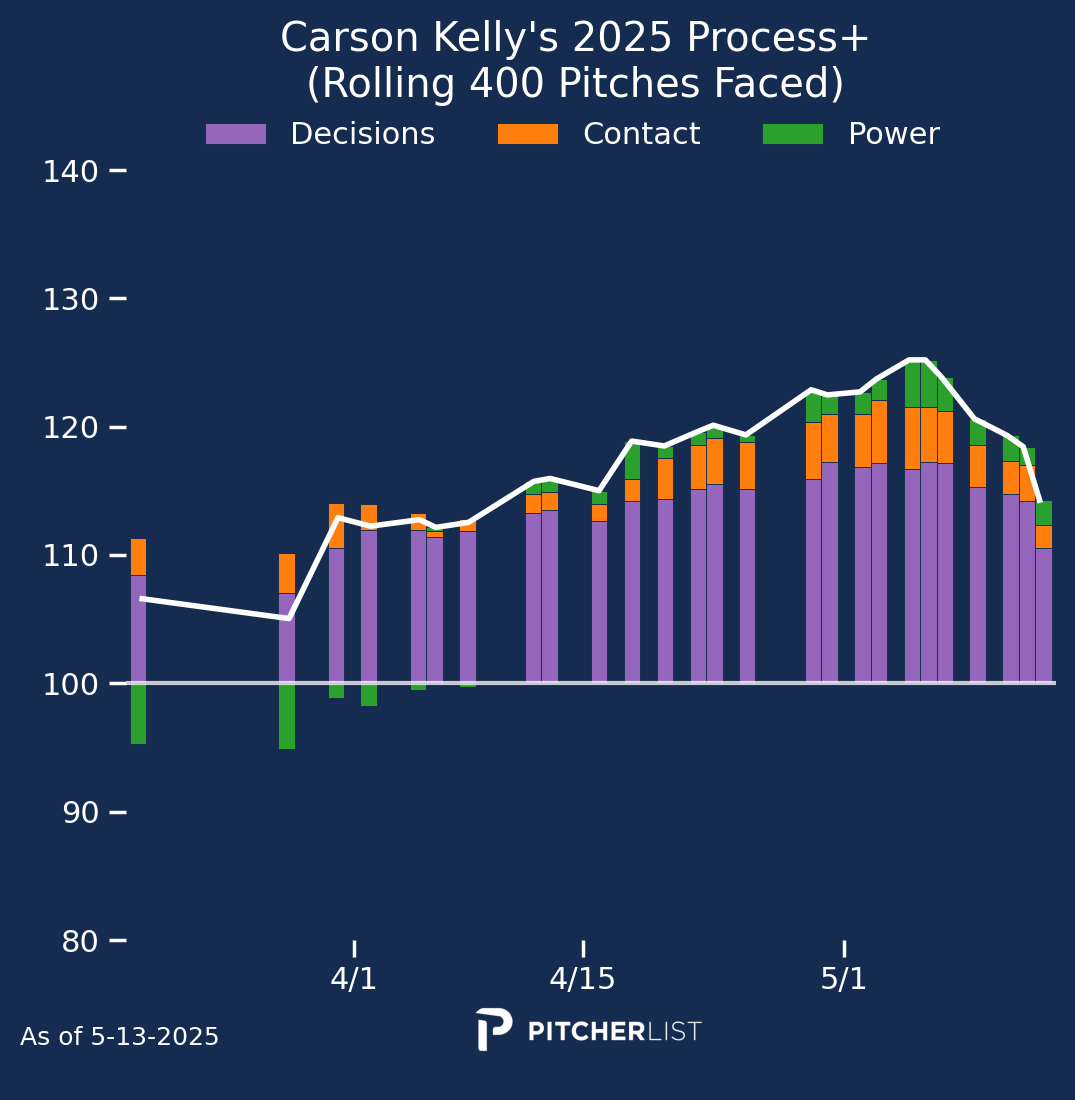
Kelly’s shown an elite ability to target pitches he can do damage with, and he ranks sixth on the Decision Value leaderboard. It’s just another step up in an area he’s been continually improving — he’s seen his Decision Value rise from 108 in 2023 to 120 in 2024 to 128 in his breakout 2025 season.
Six weeks ago, no one would’ve believed you if you told them that Kelly would have the best numbers in one of the top-scoring lineups in baseball, yet here we are. Kelly’s still splitting time with Miguel Amaya behind the plate, but he’s taken over the lion’s share of starts. He’s going to regress at some point, but regression from this level of performance should still make him a worthwhile starting catcher in most fantasy leagues. Unless you’re selling high and getting good value back in a trade, I’d be happy to hold Kelly and reap the rewards.
Rhys Hoskins – 126 Decision Value
After a torn ACL in Spring Training kept Rhys Hoskins off the field for the entire 2023 season, he returned to the diamond with the Milwaukee Brewers last year, but the numbers weren’t what we’ve come to expect from the big-swinging first baseman. Hoskins entered 2024 with a career .242/.353/.492 slash line and he struggled to regain that form, slipping across the board to .214/.303/.419. While his power hasn’t fully returned this year — his .413 SLG and .143 ISO are career lows — he has seen a resurgence in overall production thanks to a vastly improved Decision Value.
Hoskins posted a 111 Decision Value in each of his last two full seasons, but he’s excelling in that department so far this year, jumping a full standard deviation to a mark of 126. When you combine those better decisions with an improved hard-hit rate and LA Sweet-Spot%, you get Hoskins’ impressive .270/.376/.413 slash line, which is good for a 123 wRC+.
High average and OBP marks aren’t what we’ve come to expect from Hoskins over the years, but that’s what we’ve gotten so far in 2025. With his .333 BABIP sitting 60 points above his career mark and just a seventh percentile sprint speed, you have to expect that BABIP to come down, but swinging at better pitches and making better contact should keep things from falling too far. With his underlying power metrics either improved or right in line with where he’s been in years prior, I think as we get into the summer months, Hoskins will likely find his power stroke, especially if he continues to make strong decisions at the plate.
Anthony Volpe – 122 Decision Value
The Yankees have breakout bats up and down their lineup, but Anthony Volpe is the one who’s impressed the most in terms of Decision Value. The third-year shortstop truly looks like he’s unlocked something at the dish, improving from an 82 wRC+ in his 2023 rookie season to an 86 wRC+ in 2024, and now he’s sporting a 119 wRC+ this year.
Volpe’s breakout goes far beyond surface-level stats; his .294 BABIP is actually down from last year’s mark. Volpe’s seeing everything better at the plate, bumping up his 105 Decision Value from 2024 to 122 in 2025. Where he’s really shined is picking up on pitches outside of the strike zone. His 123 oDV is the 16th highest in the majors, and as you’d expect, it’s been a boon to his walk rate. Volpe has nearly doubled his rate of free passes from 6.1% in 2024 to 12% in 2025.
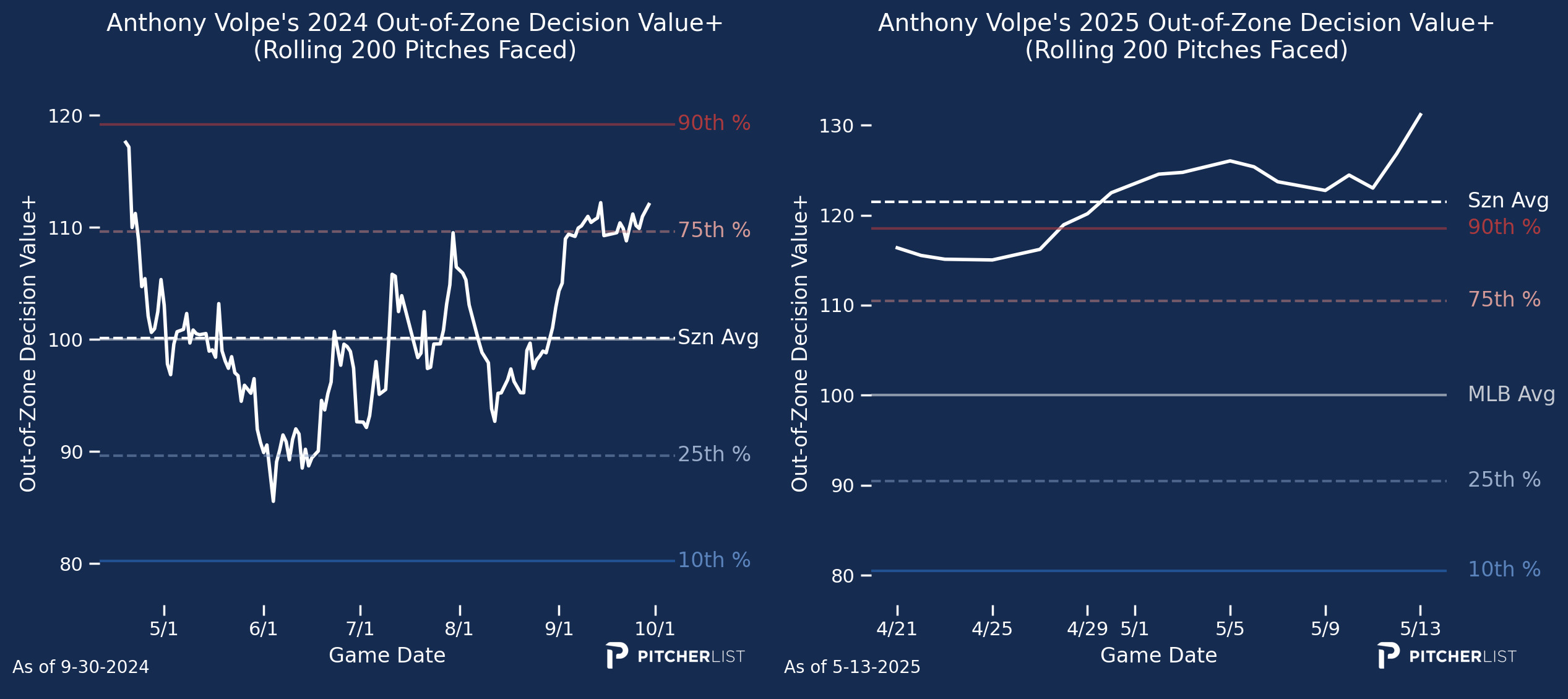
Volpe’s better play has been masked a bit by a good, yet not eye-popping .240/.337/.433 slash line. Fantasy managers are certainly enjoying Volpe’s six homers and seven stolen bases, but like the rate stats, his counting stats haven’t been extreme enough to garner significant attention to his underlying improvements.
In addition to the better Decision Value and skyrocketing walk rate, Volpe’s also more than doubled his barrel rate from last year’s 3.9% to a 10.2% mark so far. He wrapped up his rookie campaign at 9%. If Volpe can keep up the improved plate discipline while generating that ideal contact more often, a 20/30 season is in the cards, and there’s room for even more. He makes for a great trade target at the moment since he’s been good, but not so good that the manager rostering him would reject an offer for him outright. The sky’s the limit for the 24-year-old if he can keep improving his Decision Value.
Wilyer Abreu – 121 Decision Value
Very few hitters have outperformed their preseason projections more than Wilyer Abreu. Last year, the 25-year-old right fielder put up a respectable .253/.322/.459 batting line in his rookie season to go along with 15 homers, eight steals, and a Gold Glove award. This year, through about just a third of the at-bats he had in 2024, Abreu’s raised his slash line to .281/.375/.555 and is already approaching his counting stat totals from last year with 11 home runs and four stolen bases.
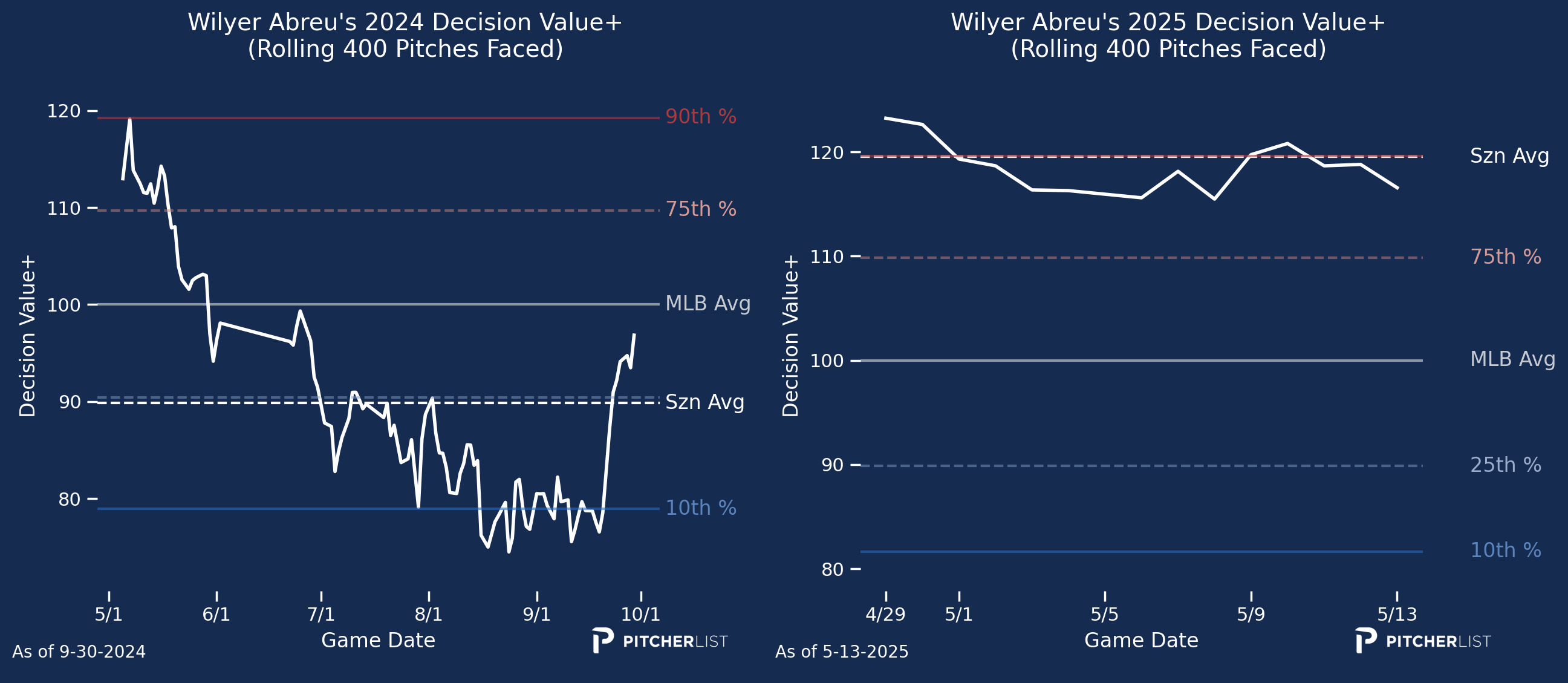
If you can find a metric, there’s a good chance that Abreu’s taken a step forward in it, and that includes Decision Value. He posted a below-average 94 Decision Value in 2024 and has raised it all the way to 121 in 2025. He’s been particularly good at identifying which pitches inside the strike zone he can do damage on. His 127 zDV is the sixth-highest in baseball.
Here’s a good look at how much Abreu’s improved his Decision Value from his rookie campaign:
If you’ve been thinking about selling high on Abreu, especially in dynasty or keeper formats, I’d reconsider that. Not only is he making better swing decisions, but his Statcast sliders have improved practically across the board and have become a sea of red. He ranks in the 80th percentile or better in xwOBA, xBA, xSLG, barrel rate, hard-hit rate, bat speed, whiff rate, and walk rate. If he’s even remotely on the market in one of your long-term leagues, I’d think about putting together an offer for him.
