





As we look at risers and fallers in points leagues, the focus should not just be on how players are performing, but what their role is.
Are your hitters suddenly leading off or batting lower in the order than expected? Have they gotten an off-day, and is it because the manager put them in a platoon? Or did they get subbed out at the end of a game for defensive reasons?
As for pitchers, did they get pulled after just 70-80 pitches, or were they allowed to work deep into the game? And could anyone on the IL or in the minors threaten their rotation spot?
As volume is everything in points leagues, these are the questions you want to answer beyond just whether a player gets hot. So, given their role and their performance, who should you buy in on, and who should you leave alone?
Risers
It’s not often a player fractures a rib and is back in the lineup within two weeks, but that’s what DeLauter’s done. Even more impressive, he’s playing better than ever before. A few days after his return, DeLauter smacked a 110-mph double off the wall, signaling that not only was he fully healed from his injury, he’d possibly leveled up as a player.
And he’s continued to rake. Since his return on June 28, DeLauter’s hitting .373 with a 1.023 OPS. Things have kicked up a notch from even there after the All-Star Break, as he’s batting .438 with an OPS of 1.096. That gives him four homers on the month.
Perhaps even more surprising, he’s started to run more, with a pair of steals in the last ten games. While I wouldn’t say DeLauter’s a five-tool player given his 34th-percentile sprint speed, he could be good for double-digit steals by season’s end.
If you’re in a points league, though, you care less about steals and more about contact. In that regard, DeLauter’s got tools that are a points leaguer’s dream. He’s striking out just 13.4% of the time with a 9.4% BB rate, has a 95th-percentile Chase Rate (which is incredible for a rookie), and pairs all of this with a 91-mph Average Exit Velocity. He squares up the ball at an elite level and carries a solid 45% Hard-Hit rate, also well above average.
Really, the only reason DeLauter doesn’t hit more homers is that his Line Drive rate is so high and his Fly Ball rate is so low (which also explains his 6.7% Barrel rate, which only counts batted balls with launch angles between 22- and 32-degrees). He could be a 30-homer bat once he gets a little more lift, but regardless he’s a must-own in any points format.
Three years ago, in his first season with Philadelphia, Turner was having an awful first half. Then, after a particularly terrible stretch where he was hitting around .100 for the week and the frustration was starting to show, the Philly fans gave him an unsolicited standing ovation as he came to the plate. The rest is history: Turner ‘turned’ the corner, broke out of his slump, and had a great second half.
It’s hard to tell this early, but this might be the start of history repeating itself. After another terrible first half (and really, this one’s been significantly worse), Turner’s hit four homers in his last four games, including a pair of dingers on Monday. And he’s collected six total hits in those efforts.
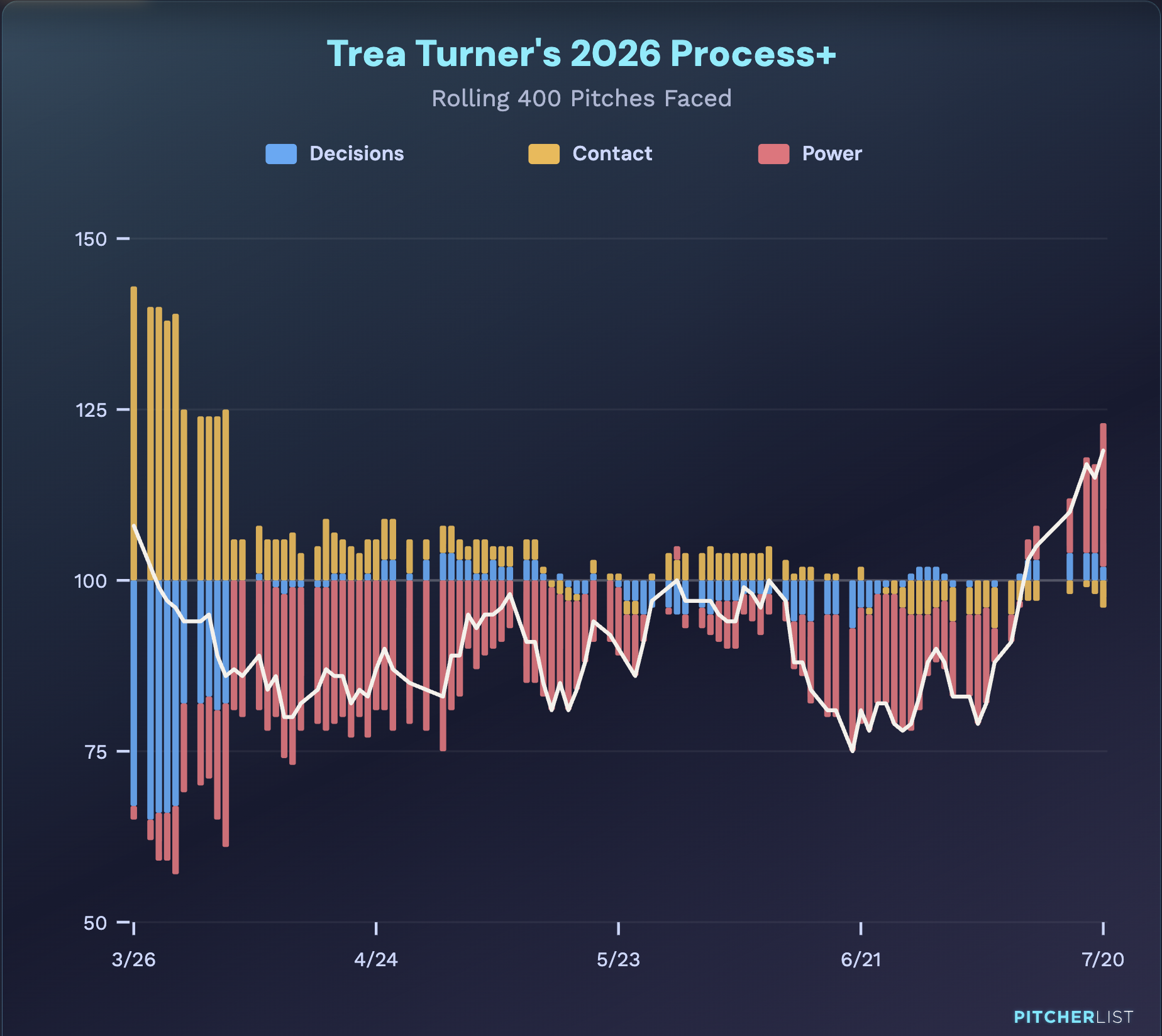
Could this be a turning point? Well, Pitcher List’s updated Process Chart might provide some answers. Turner started the season with great contact and poor decision-making, with his power output basically average. Then the power never showed up while the contact and decision metrics reverted to neutral. They stayed that way most of the season—if anything, the contact took a dip over the last month. Over the last week, though, the power has taken off, and his overall numbers have gone up with it.
Still lagging, though, are those contact metrics, which remain stubbornly below-average. So I would hesitate to call this a repeat of 2023, but it is good to see Turner making progress in any category. Time will tell if this is just a week where Turner’s bat is catching lightning in a bottle.
Speaking of four homers in four games, Abreu also accomplished that feat this week. Once a platoon bat who sat against lefties, Abreu’s now an everyday player who mashes the southpaw. He’s got a .351 average against them this season with a 1.011 OPS, and 15 XBH’s in 114 AB’s.
Overall this year, Abreu’s made strides in other key categories. First, he’s only striking out 20% of the time (a career best by far) and walking nearly 10%. His Barrel rate is also a career best at 13.1%.
How’s he done all this? Over the offseason, Abreu worked on fixing his pull-heavy swing and became a ‘hit-to-all fields’ machine. It’s resulted in more solid contact, and his line drive percentage has risen by five points. While his Pull Air rate is down seven percent compared to last year (it’s generally a stat you want to go up as it results in more homers), in Abreu’s case it’s been a blessing, as his pull contact was generally weak.
While Abreu’s probably owned in your points league (he’s up to 65% now on ESPN), congrats if you held on through May and June. He’s been key to the Red Sox resurgence and is playing the best baseball of his career.
A few years back, Mead ranked in top-100 prospects list (he was #36 according to Baseball America) as he worked his way through the Tampa farm system. But he fell off when he hit the Majors and landed in Washington for almost nothing. Now, he looks like a different player (as does the rest of the Nationals lineup; their hitting instructors need a raise).
Mead’s in the 75th percentile or better in Whiff rate, Chase rate, Expected Slugging, and xwOBA. He’s carrying an elite .858 OPS over the season—last year it was .620—and is batting .400 since the break. The only knock on him is his defense, as he doesn’t really have a good enough arm to play third base. The good news there? He’s getting some reps at second and could be eligible there soon. He’s also gotten a handful of starts at DH for those of you with those designated lineup slots.
Bottom line? He’s only 25%-owned on ESPN, and that’s far too low. Once he gets that 2B eligibility, he could be top-10 in the position.
