





As we look at risers and fallers in points leagues, the focus should not just be on how players are performing, but what their role is.
Are your hitters suddenly leading off or batting lower in the order than expected? Have they gotten an off-day, and is it because the manager put them in a platoon? Or did they get subbed out at the end of a game for defensive reasons?
As for pitchers, did they get pulled after just 70-80 pitches, or were they allowed to work deep into the game? And could anyone on the IL or in the minors threaten their rotation spot?
As volume is everything in points leagues, these are the questions you want to answer beyond just whether a player gets hot. So, given their role and their performance, who should you buy in on, and who should you leave alone?
Risers
Sheets was actually having a pretty good April in his platoon role, often hitting fifth or sixth and slashing .264/.556/.868. He had just 77 plate appearances on the month, however, where most full-time starters topped a hundred. But May has been a different story, with five homers already on the month and a 1.108 OPS, plus he’s getting on base 43% of the time. That production has gained the trust of management, as Sheets has tripled his at-bats against lefties this month (it’s nine to three, but still) and is pacing toward more than 90 appearances. He’s also improved is K:BB ration from 14:4 in April to a highly impressive 10:10 in May.
He’s not an everyday player yet—and given his .398 OPS against lefties this season, that day might never come—but he’s doing everything to make his case, including a two-homer night on Sunday.
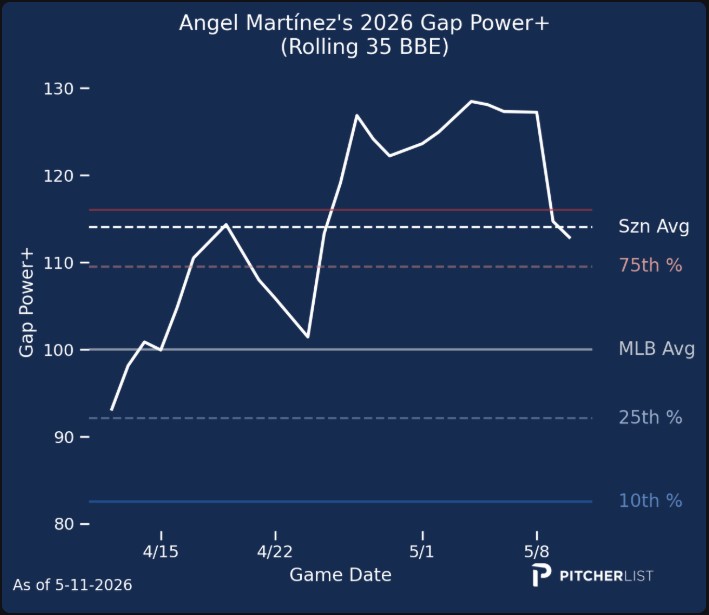
Martínez debuted in this space a few weeks ago and, well, the verdict hasn’t changed. But the player profile actually has.
As of mid-April, he had only one strikeout in something like 50 plate appearances, and he was a gaps-only hitter who was putting the ball in play. But as the season’s gone on, he’s selling out for more power. His OPS has climbed from .594 in March to .825 in April, and now it’s .870 in May. It’s almost as if he’s discovered he can hit the ball over the fence after all and is trying for that result more and more.
A 3.7% walk rate does not make Martínez your prototypical points-league hitter, and neither does his swing-happy sixth-percentile Chase rate. Basically, if it’s close to the zone (or even not-so-close), he’s going to take a crack at it.
But here’s the thing—whether he swings at balls or strikes, he typically makes contact. He actually is carrying a 17.7% whiff rate, which is 83rd percentile. There’s really no bigger discrepancy of Chase-to-Whiff ratios in the league. Martínez’s ability to make contact and net both XBH’s and (lately) home runs still makes him very viable in the points format, and his high average keeps that low Walk rate in check.
Even as the Mets have scuffled this year (putting it mildly), there are some bright spots to the season, namely in Benge and AJ Ewing. An Opening Day starter out of camp, Benge made an instant impression by homering in his first game.
Unfortunately, things went south after that, as he had a .091 average as of April 7 and was hitting under .200 until May 4. But what a difference a month makes.
Benge has gone from a bottom-of-the-order bat to a points machine in the leadoff spot, getting on base more than 40% of the time when hitting at the top of the order. And it looks like Francisco Lindor is out for around another month, so Benge should get a lot of run over the next few weeks hitting ahead of Soto and (dare I say it?) an improved Bo Bichette. Buy, buy, buy.
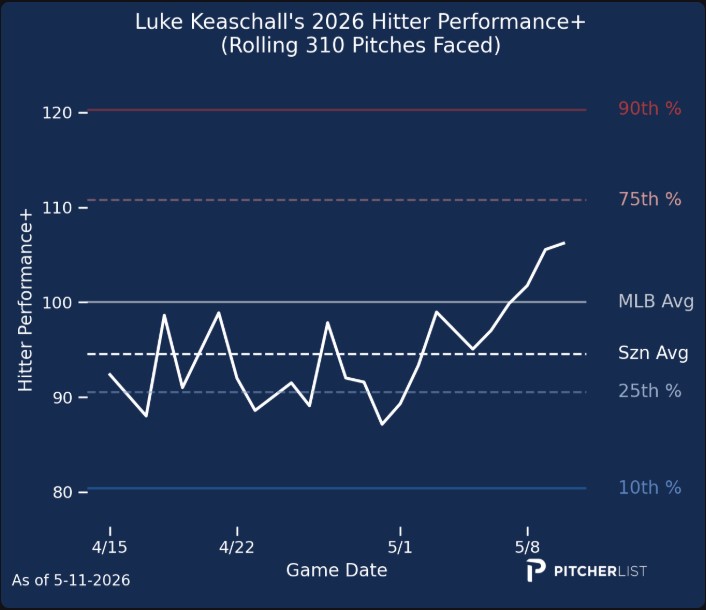
All is not lost, Keaschall fans. After coming in as a Rookie last season and slashing .302/.334/.827 in 207 plate appearances—more importantly, doing all that with a 14% K-rate and a 9.2% BB rate—he was points-league gold.
But things can change season to season, and certainly did in the early going for Luke. He’s struggled mightily in the power department, with just a single homer this season, and carries a .624 OPS, which is pretty weak.
Good news, there are signs of life here.
For starters, his plate discipline in May has been a vast improvement, with a 20:6 K:BB ratio in April flipping to a 10:11 ratio this month. And his OPS is .813 in his last fifteen games, including five extra-base hits. The best news of all is that he’s getting on base 42% of the time, which is better than last year’s season rate of 38%. Keaschall might not be quite the player drafters were hoping for, but he’s showing he has the talent to be close.
Ginn’s primarily a sinker-ball pitcher who used to approach both righties and lefties the same way, but has now refined his arsenal.
Last season, lefties were a problem. He gave up ten homers against them (compared to seven against RHBs) and had a 1.95 WHIP (compared to 0.94). So his ‘throw the same stuff to everyone’ mantra wasn’t cutting it.
This year, things are different. Ginn’s using his sinker 54% of the time against righties (similar to 2025), but just 25% against lefties. He’s then mixing in his changeup (and its 68% groundball rate) 24% of the time (which is used just 6% of the time against righties). And it looks like this new strategy is working.
Ginn’s a mediocre strikeout pitcher with a 22% K-rate, but he’s pitching deep into games with eight innings pitched in two of his last three starts (one of which was thisclose to being a no-no but ended much worse than that).
Fallers
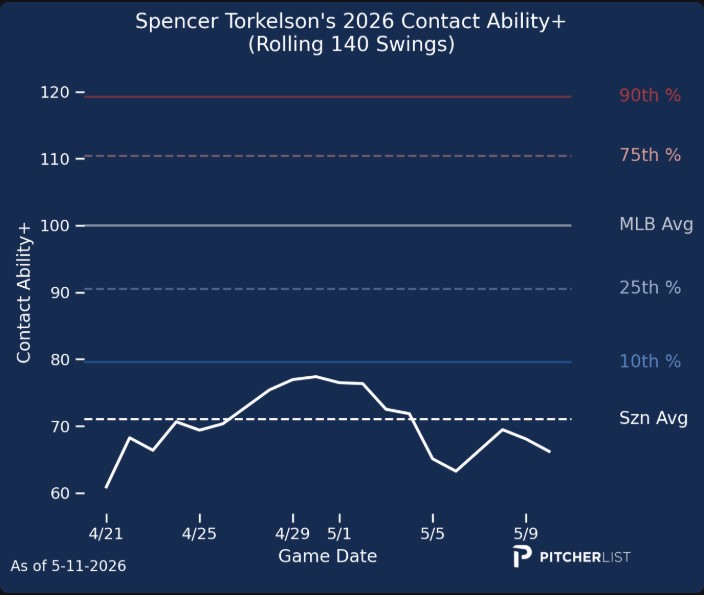
Tork’s been up and down this year, as many all-or-nothing sluggers are wont to be, but it’s been pretty down of late. Yes, he did have a home run last night. Yes, he also struck out twice.
Torkelson’s K-rate, always around the 25-27% range, now sits at 33.0% and has been climbing. His batting average has been dropping and now sits below .200. He’s now in the range where management might be looking for other options, and Tork’s been pushed aside or demoted for extended stretches before. Given he’s hitting about .115 over his last ten games and is having an incredibly hard time making contact, it’s hard to say how long this will last before decisions are made.
He’s shown he can get incredibly hot at times, but he’s shown that the cold spells can last for months. I think it’s time to cut the cord.
Chandler was supposed to be the prospect to own last season, one who had great command and dominated the minors. And in his limited action in MLB (around 30 innings), he had a middling ERA (4.02) but spectacular WHIP (0.93) and all his other ratios looked solid. So it’s disappointing to see he’s lost four of his last five starts and has a 5.14 ERA this season.
Control seems to be the issue, as he’s walked fifteen batters in his last four outings (and is averaging nearly a walk per inning during that stretch). He’s only made it to six innings once this season (on April 17, so it’s been a minute), but averaging around twenty pitches an inning will do that. His last outing against the Phillies was especially poor, where he walked four in just three IP and was pulled at 73 pitches. He’s young enough and good enough that things will get better, but I wouldn’t own him while waiting for the adjustments to be made.
