





Anyone who followed the progress of American League Rookie of the Year candidates realized a while ago that Athletics slugger Nick Kurtz would be the likely winner. Maybe even unanimously.
Kansas City Royals left-hander Noah Cameron seemed good with Kurtz winning the Jackie Robinson Award when Pitcher List asked him at Kauffman Stadium in September.
“Nick is awesome, he’s killing it right now,” Cameron said. “Obviously, he’s going to run away with it. Like, he should be a first-teamer, all-league guy.”
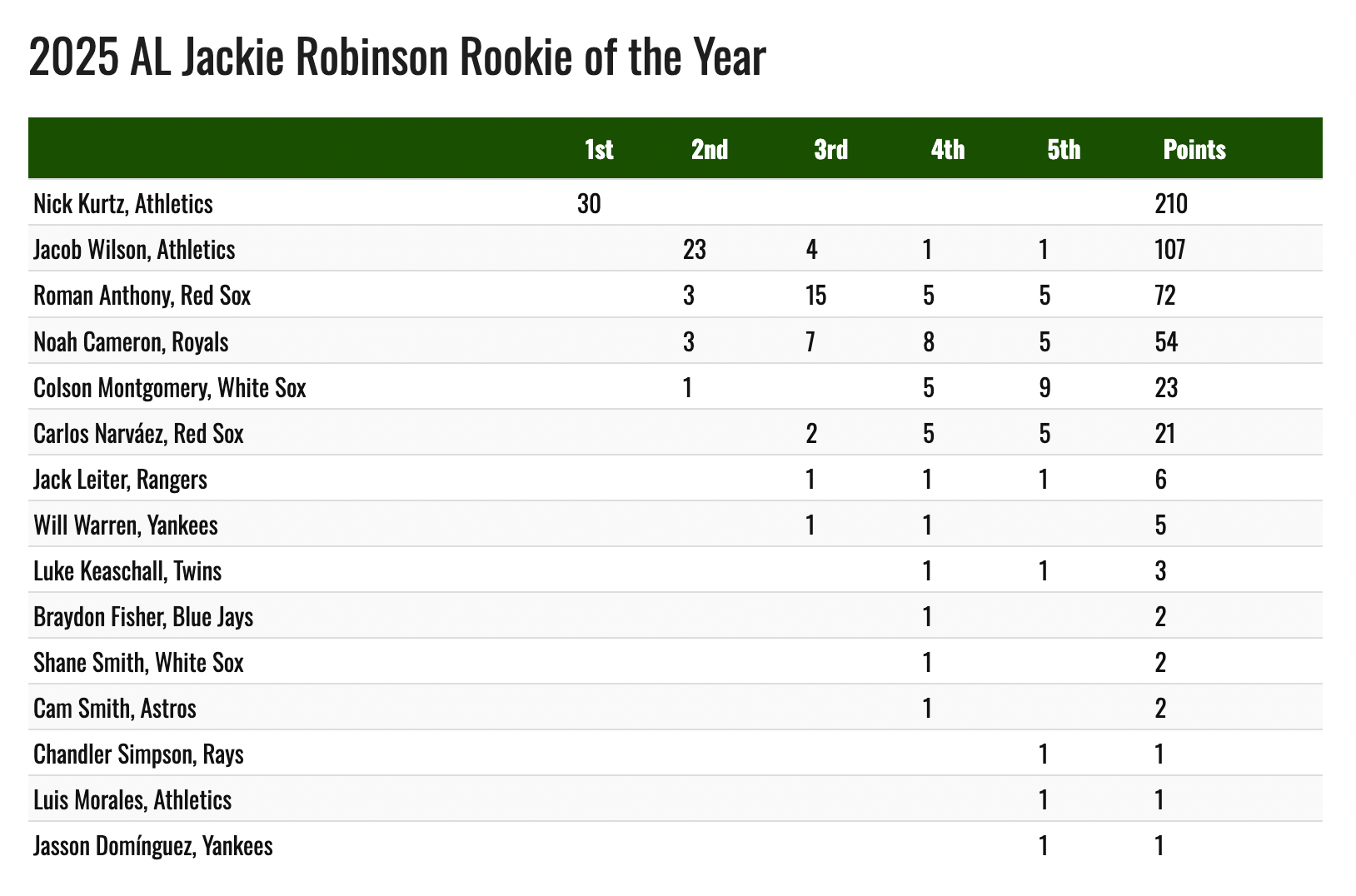
The All-MLB team is yet to come, but the Baseball Writers Association of America announced Monday on MLB Network that Kurtz had received all 30 first-place votes, becoming the 29th player from either the AL and NL to win unanimously.
Cameron finished in fourth place on the AL ballot after Kurtz and a teammate, shortstop Jacob Wilson, and Boston Red Sox outfielder Roman Anthony. Cameron, who received three second-place votes (including one from the writer of this story), posted a 2.99 ERA in 24 starts, and produced additional stats that made him worthy of consideration.
BBWAA
“Wherever I place, it doesn’t matter to me necessarily in how I value myself or how I value the season,” Cameron said in September. “It’s obviously been an incredible year, and obviously we’re not really where we want to be in the (standings).”
Cameron was referring to the Royals finishing with an 82-80 record and out of the postseason field a year after beating the Baltimore Orioles in the first round. But with Cameron, the Royals organization can enjoy an individual victory in player development. Cameron’s performance in his first season, along with its recognition by analysts, says something extraordinary about a seventh-round pick who never ranked among MLB’s top 100 prospects.
Making his debut April 30, Cameron fell short of the required number of innings (162) to rank among league leaders officially, but among all 127 pitchers who logged at least 100 innings, he stands out in multiple categories:
• ERA: 22nd
• Win probability added: 19th (better than Joe Ryan and Max Fried)
• Batting average against: 18th
• Expected ERA: 47th
• Exit velocity average: 14th
He accomplished all of this with 20th-percentile fastball velocity (92.3 mph average), and without commanding what Cameron says had been his best pitch for most of his life: the changeup. It’s not that Cameron’s changeup was bad, it just wasn’t great, registering minus-1 run value at Statcast. So, almost neutral, if you look at the glass as being half-full. Batters hit .204 with a .378 slugging against the change. No matter: Having a diminished changeup threw Cameron a real curve.
“My whole life pitching, I’m not kidding, 15 years, that’s been my bread and butter,” said Cameron, who turned 26 in July. “This is the first year I could answer that it’s not my best pitch, which is different for me, and hard for me, just because it’s been a pitch that I’ve relied on.”
Cameron’s most effective pitches in 2025 were the curveball and slider. Against the curve, opponents hit .153 and slugged .189, with a 37.4% strikeout percentage. Cameron’s curve was so effective at plus-9 run value that, in the entire league, only Phil Maton’s plus-10 curve was better.
Keith Law, the prospect analyst with The Athletic, gave a positive preseason review to Cameron, but noted that he would benefit from a sharper cutter to protect his pedestrian four-seamer. Cameron’s cutter results weren’t great (minus-4 run value), but the improved curve was another way to accomplish the same thing. Royals pitching coach Brian Sweeney and his top assistant, Zach Bove, worked with Cameron on dropping his arm slot. Another key to the curve’s effectiveness is its higher velocity, Cameron said, which works well because of its proximity to his fastball velocity.
“Being able to throw a curveball 83-84-85 (mph) plays up, because you have a lot smaller gap,” Cameron said. “So it looks like a fastball a little bit longer to hitters, and that’s kind of why it’s able to get some good swing-and-miss.”
Cameron’s slider value (plus-7) ranked as the 35th-best pitch of its type in the league, putting him in the 99th percentile in the league for breaking-ball effectiveness. They’re great weapons. He’d still like to regain the full effectiveness of his changeup, though. Cameron said he and the Royals’ staff put in work, and the results started to improve down the stretch. The change is coming back, it’s just going to take longer.
“This offseason, for sure, the changeup is a big, big project, to get that back where I want it,” Cameron said.
One possible reason for Cameron’s dominant breaking balls and his changeup inconsistency comes from the mechanics of how the respective pitches are executed. Curves and sliders require wrist supination (palm up), while the changeup is thrown with the palm down. Sometimes, it can be hard for an individual to stay consistent within this reality.
“I think you just get used to throwing other pitches,” Cameron said. “And obviously I’ve been supinating a lot, so the changeup, you pronate a lot and and throw the cutter, the slider and the curve while you’re supinating. So wrist movement and wrist adjustments are made, and that’s kind of when it takes away a little bit from the changeup.
“You just learn new ways to throw stuff, whether that’s using a new grip or whatever.”
Bove, who has a reputation for being a guru with grips, described Cameron as “getting around” his changeup and not staying through the middle of the ball as he delivered it. Cameron also was missing with poor locations — for example, throwing it down and inside to right-handed batters. Bove agreed with Cameron that the changeup’s results were improving late in the season.
“We were getting away from what his superpower was,” Bove said. “So we took a step back to get him back to his strengths.”
Since their hiring in December 2022, Sweeney and Bove have developed one of the best reputations in the league for any coaching group. Having open communication, with positivity and honesty, along with sound ideas and an ability to apply them are among the reasons. Players still have to do the work and live with the consequences, Bove said.
“It’s his career,” Bove said. “We can have all the greatest ideas in the world, but it’s his career. What has really helped us is, you got a guy like Michael Wacha, you got a guy like Seth Lugo, who were obviously really good before they got here, and they’ve come in with this open mindset of: ‘What do you have for me?’
“We let them drive the bus. We set up some guardrails, and say, ‘Hey, we’re speeding up, slowing down’ — stuff like that. But we just want to support them, give them resources and maybe go at their pace.”
That, right there, might be the Sweeney-Bove superpower. Right-hander Michael Lorenzen, who joined the Royals down the stretch in 2024, said Royals coaches don’t take it personally (at least they don’t act like it) when a pitcher disagrees with their advice and tries a different tack.
“A lot of coaches get frustrated if you don’t listen to them, but at this level, we’re all adults. It’s our jobs,” Lorenzen said. “We’re trying to do what’s best for us, too. And if you’re able to communicate with them why you don’t want to do what they’re asking you to do, they’re totally on board with it. It’s not like, ‘My way or the highway.’ It gives them a lot of freedom to express ideas, and you have the freedom to receive them, or say: ‘No, not for me.’ It’s all open-minded.”
No matter the advice he was getting, Cameron’s steady success as a rookie, even when he didn’t have all of his pitches working all of the time, showed Bove a lot.
“It’s awesome, and I say that because, that was his identity — a changeup guy, right?” Bove said. “Maybe just a command guy. But he’s added shapes — the slider, the curveball is a little harder, things like that. He added the cutter on his own two years ago. The fastball got a little wonky, we got that back. So it’s like his identity is now more than just a changeup guy, like he has multiple options to get a hitter out. You need that at the big-league level based off who the hitter is, what kind of hitter they are. Now, he has multiple weapons. It is awesome to see it. All the credit to him.”
The Royals collectively finished fourth in runs allowed and Cameron, as player in his first year, was a big reason why. His performance impressed manager Matt Quatraro, who said so at a media conference on the last day of September.
“I kept waiting for the hiccup, and it never came,” Quatraro said. “It seemed like he got better and better.”
Quatraro praised Cameron’s ability to adjust on the fly, even within a single game, inning or moment. Sometimes after getting hit around by the opponent.
“What stood out with him: He’d have games where he’d give up some runs early, but he’d still be in there in the sixth inning,” Quatraro said. “That’s a sign of a very mature pitcher. So being a rookie, being able to do that, is really impressive.”
The process of working out imperfections in his game will change this winter for Cameron, who grew up near Kansas City in St. Joseph, Mo. The Royals need a new assistant pitching coach, with Bove moving to the Chicago White Sox and getting a promotion with them.
After a short break and a resumption in the gym, Cameron said he planned on picking up baseball again in the first or second week of November. So, about now.
“Work starts right away,” Cameron said.
