





Every postseason is an opportunity for previously anonymous relievers to become big names. When your season comes down to a close game in the late innings, the arms that pitch in high leverage have a chance to etch themselves into baseball lore.
All the bullpen arms that were traded to contenders before this past week’s deadline have a chance to be one of those guys. That includes Ryan Zeferjahn, who was just dealt from the rebuilding Angels to one of the better teams in baseball, the Cubs. Zeferjahn didn’t make his MLB debut until 2024 when he was 26 years old. Last year was his first full season at this level. Then, after 45 games of pitching predominantly between the 7th and 9th innings in Anaheim, Chicago was willing to give up 22-year-old Moisés Ballesteros for his services. These are relatively humble origins for a late bloomer that was deemed to be worth the price of one of the more projectable young hitters on the market, but this trade might be just the beginning for Zeferjahn.
The Cubs were drawn to him for two main reasons. His team control through the 2030 season came with an obvious shine, but the other may not be so obvious. Simply put, he’s been better than almost any pitcher in baseball at missing bats and generating weak contact this year. He’s nasty.
Opponents are hitting .083 and slugging .104 against his four-seamer this year, which are both the lowest marks among any qualified individual pitch type in MLB. It’s so successful because of its cut-ride shape and 97-98-MPH velocity from a slightly below-average arm slot. He pairs this with a hard, rising sweeper that generates plenty of cut despite its mid-80s velocity. This is why he gets so much swing-and-miss, and on the rare occasions when hitters do put the ball in play, they pop it up a lot. He’s also capable of keeping the ball down, though, with his gyro slider and power sinker. Both of those offerings have groundball rates over 60% this season. Between that and the bat-missing, popup-inducing fastball/sweeper combo, there isn’t much room for opposing hitters to breathe.
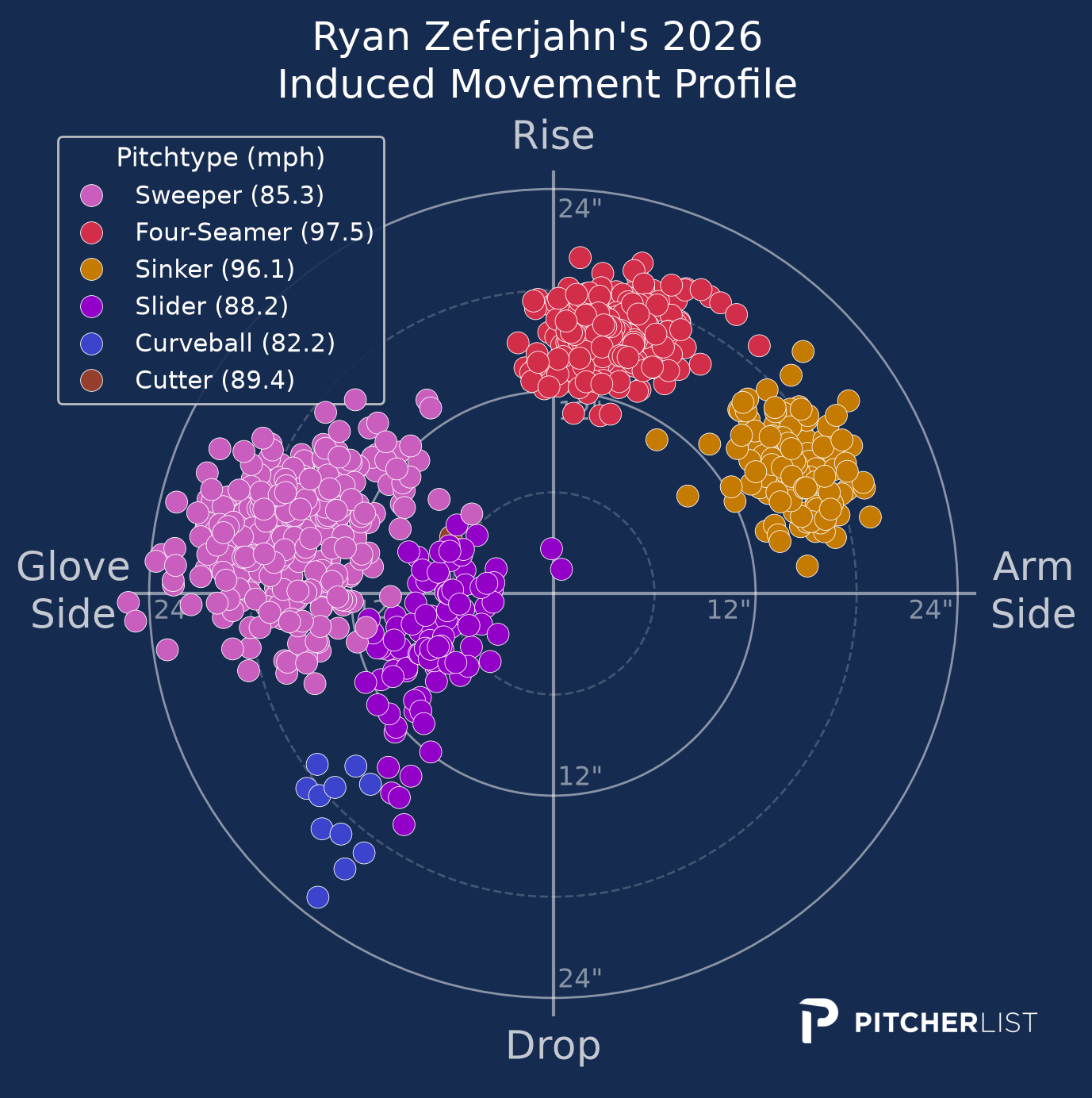
He cuts his fastball and knows how to spin the ball in general, two traits that the Cubs absolutely love. The sweeper’s shape, especially relative to its higher velocity, is outstanding on its own, but what really stands out about it is Zeferjahn’s ability to command it. A pitch that moves this much isn’t easy to locate, but he throws it for strikes with regularity. Pitcher List’s location model gives him a score of 108 (100 is average), and his ability to zone it is consistent against both lefty and righty hitters. What’s important to understand is that the heater’s physical characteristics are already so good that they give Zeferjahn a little more margin for error in locating, but he checks both boxes nonetheless.
Looking at his profile beyond the plus-plus sweeper, there are some oddities. For how great his stuff is and how often he gets batters to swing and miss, Zeferjahn greatly struggles to get batters to chase. I’ll leave his Baseball Savant percentiles to do the talking here; it is a truly bizarre skillset he has.
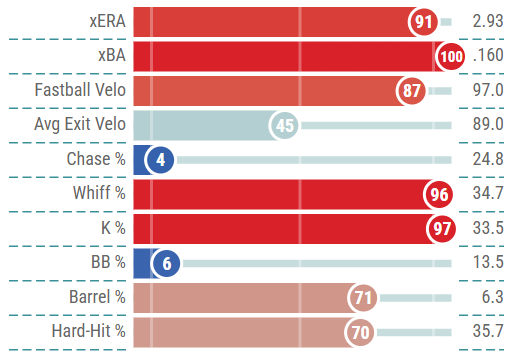
Ryan Zeferjahn Baseball Savant Page, 2026
How can a guy who locates his nastiest pitch walk this many batters and induce so little chase? The combination of an elite propensity to suppress quality contact and the boatload of strikeouts should make Zeferjahn one of the very best relievers in the game, except there’s just one problem: He has absolutely no idea where his fastball is going. The zone rate on the fastball is about 6 percentage points lower than the sweeper. It’s usually the other way around, but he’s an outlier, and that discrepancy is why he can’t reliably get hitters to expand even though he’s so tough to hit.
Pitcher List’s Location+ gives the fastball an underwhelming score of 86. He has an astounding 50% K rate with the heater, but the walk rate is similarly inflated at 18%. Again, its overall performance suggests this has been more than worth the tradeoff, but at the same time, you could argue his lack of fastball command, which appears to be a direct byproduct of the difficulty he has repeating his mechanics on it, is the one thing holding him back from stardom.
A natural question to ask, given that he cuts his fastball and can spin the ball, is whether it would make sense to adjust his mix or even learn a new pitch for next year so he can better locate a high-velocity offering. If you go back and look at his pitch plot above, you might notice a lot of blank space in the middle. Theoretically, hopping on the start-throwing-a-cutter bandwagon would be a sound process by which Zeferjahn could bridge his movement profiles together and adopt a second weapon he can throw for strikes.
The problem with that is, he came to the big leagues already armed with a cutter. In fact, it was his primary pitch in 2024 before taking a backseat to the fastball and sweeper last year, and it was originally a part of his arsenal for good reason: Indeed, he threw it for strikes more than any other pitch in his repertoire. The pitch had a zone rate of 59% last year, and it was a half-decent swing-and-miss option for him.
Unfortunately, it got clobbered. Opponents slugged .550 against it, a number that actually outperformed its even uglier .638 expected slugging, and when it was put in play, it was hit hard 43% of the time. Zeferjahn scrapped it completely this year, introducing the sinker in its place to give him another arm-side offering instead and doubling down on the fastball/sweeper dual threat. As it stands, he can throw the sinker for strikes more often than the four-seamer, but it doesn’t miss many bats and is more of a show-me pitch when he wants to keep the ball on the ground. So, he already throws 2 different kinds of fastballs, and getting rid of the cutter has helped him get better. What should he do?
This is hard to do in-season, but I’m going to bet that the Cubs traded for him with some sort of plan already in place to improve the location on his fastball. As a staff, they’re top-10 in the league in four-seam usage this year and top-5 in four-seam zone rate. The model hosted at Fangraphs says Cubs pitchers have a collective 105 Location+ on four-seamers this year, 2nd in the league only to the Mariners. PitchingBot, the other pitch quality model at Fangraphs, has them 5th at 55 (20-80 scale). It’s a skill they seem to actively seek out and know how to develop. If Zeferjahn is going to find a way to throw it for strikes without altering his arsenal, this is one of the best possible places to do it.
Last year, in addition to walks, he was prone to damage (1.89 HR/9). We’ve established that he’s refined his arsenal since then, and some of those home run problems were thanks to his now-defunct cutter, and it’s also not as simple as “fastball zone rate goes up -> all else remains equal -> he truly breaks out”. Still, it’s impossible not to wonder what Zeferjahn would look like if he was even a little less erratic than he is now with his four-seam fastball. He seemingly already has everything else: Top-shelf strikeout stuff, top-shelf quality contact suppression, two distinct supplementary offerings he can induce groundballs with, and a devastating breaking ball with above-average command.
Relievers can often be overvalued during trade season, but with his raw talent and team control, I can see why the Cubs, more than most teams given their strategy when it comes to acquiring and developing pitchers, were willing to do what it took to bring him in. He hasn’t gotten much of a spotlight to this point, but Zeferjahn has what it takes to get big outs in big spots during the upcoming stretch run and into the postseason.
All stats entering August 6, 2026.
