







For as ubiquitous as major league pitchers undergoing some version of Tommy John surgery has become, casual baseball observers can be forgiven for thinking that it’s a sure thing that they’ll return as good as new. Hardly a week goes by, it seems, where there isn’t news of a big league hurler heading to the injured list with an elbow in need of repair. Many of them (most of them, even) find themselves back on a big league mound after 12 to 18 months of arduous and painstaking rehab.
However, making it back to the big leagues isn’t the same as making it back and pitching well. And pitching well isn’t the same as pitching like you could before you got injured.
When your name is Sandy Alcantara, and your prior level of performance was Cy Young Award-winning good, returning to form is all the more difficult. Alcantara has been finding that out firsthand in 2025, his first season back after elbow surgery. While he has gotten off to a bumpy start — 6.69 ERA in 74 innings across 15 starts — better days seem to be ahead as he adapts to his new reality and regains more precise command and better feel for execution.
A Throwback Ace
Alcantara debuted in relief as a Cardinal in 2017 and was traded to Miami (along with Zac Gallen) the following offseason as part of the deal that brought Marcell Ozuna to St. Louis. By 2019, Alcantara was a regular in the Miami rotation. From that point through the 2023 season, he developed into baseball’s most prominent symbol of a bygone era of starting pitching.
Over those five seasons, Alcantara started 132 games, which tied with Zack Wheeler for the ninth-most in MLB. Yet, the 6’5″ Sandy embodied the workhorse aces of the past by working 858.1 innings over those starts, baseball’s second-most innings total. Only Gerrit Cole surpassed him in total innings, but Alcantara accumulated his innings in nine fewer starts than Cole.
Alcantara took the ball seemingly every time it was his turn, and he was never placed on the injured list. His average of 6.5 innings pitched per appearance led baseball, and no other pitcher faced more hitters than the 3,495 that Alcantara stared down. He also led the field in finishing what he started, completing 12 games, twice as many as Cole, Adam Wainwright, and Framber Valdez.
Sandy Alcantara is the first Marlins pitcher ever to win Cy Young.
Alcantara’s six complete games were more than all 29 other teams had this season.
His 2.28 ERA was the second-best in Marlins history (min. 200 IP) trailing only Kevin Brown, 1.89 ERA in 1996. pic.twitter.com/gY5Ftns6Gm
— ESPN Stats & Info (@ESPNStatsInfo) November 17, 2022
It wasn’t just that Alcantara shouldered a big workload in a time when starters league-wide were being tasked to work shorter and shorter outings; he was also immensely effective. His 16.4 fWAR was the 11th-best among 157 qualified pitchers, his 50.7% ground-ball rate was 13th, and his cumulative 3.30 ERA was tied for 18th-best.
In 2022, he unanimously won the NL Cy Young Award with a 2.28 ERA over 228.2 innings, the most innings worked by a pitcher in a season since David Price covered 230 in 2016 for Boston. Of Alcantara’s 32 starts that season, 24 were quality starts (6 IP, 3 ER, or better) and six were complete games.
The following season, Alcantara wasn’t quite the vintage version of himself. He worked to a 4.14 ERA in 28 starts before he was shut down and placed on the injured list for the first time in his career in September with a forearm strain. He underwent Tommy John surgery in early October and subsequently missed all of the 2024 season.
Knocking Off the Rust
By spring training 2025, signs were clear that Alcantara’s rehab from surgery was on schedule for him to be back for the start of the season. He took the ball for the Marlins on Opening Day against Pittsburgh and appeared to be as good as ever. He started his 2025 season with 4+ no-hit innings, seven strikeouts, and topped 99 mph with his fastball. The Pirates scratched across two runs in the fifth to sour the good outing a bit, but Sandy mostly looked like Sandy.
He was solid again (5 IP, 2 ER, 4K) against the Mets in his second start, but then things started to unravel. Over his next nine starts, through the end of May, Alcantara worked to an unsightly 9.58 ERA. He had a better, but still dreadful 5.83 FIP, and posted a highly concerning 29-25 strikeout-to-walk ratio over 41.1 innings.
When the calendar flipped to June, the former capital “A” Ace had allowed 48 earned runs across 51 innings and did not resemble Sandy Alcantara.
Pitchers struggling initially after returning from Tommy John surgery is not unusual. Many studies over the years, including one by Jake Robinson here at Pitcher List in 2022, have shown that pitchers often don’t find great success in their first season after surgery. In general, those pitchers give up more home runs, walks, and runs, and strike out fewer batters than they did before their injury.
Those trends — fewer strikeouts, more homers, more walks, and more runs — were all true for Alcantara for this season’s first two months, as you can see in the table below:
Stuff and Command
When a pitcher goes under the knife, there is a risk that their stuff might not come all the way back. They might lose a little velocity or surrender some of the crispness and movement of their secondary pitches. Alcantara’s pitch level data reveals that playing out to some extent.
His stuff, as indicated by PLV, is most of what it was before, but not quite:
The average velocities of Alcantara’s fastballs have been about half a tick down, but they are still coming in better than 97 mph. As a result, the PLV scores on his four-seamer and sinker are in line with his previous levels. PLV likes his sinker even more now.
But his once-dominant changeup and his gyro-slider are grading out worse than before. Both pitches have been net negatives in terms of Statcast run value, and the slider has been much easier for opposing hitters to hit hard and in the air (92.6 mph average exit velocity and a 23° launch angle, up from 86.9 mph and 9°, respectively, in 2023).
As a result, Alcantara de-prioritized those secondary offerings, especially his slider, and increased the usage of the curveball that he had only used sparingly (2.4% in 2023) before to about 15%.
The lower quality stuff on those two secondaries has also been compounded by significantly worse command and locations. Anecdotally, it’s often said by pitchers who have had Tommy John surgery that their command is the last thing to come back after surgery.
It stands to reason that would especially be true for breaking and offspeed pitches that have more intricate release mechanics and require a higher level of feel to execute consistently.
That’s been the case for Alcantara, as we can see by looking at the location component of PLV by pitch type:
Compared to his past, he’s located his changeup and slider in less advantageous spots this year.
Through the end of May, he’s located just 41.6% of his pitches on the edges of the strike zone, a major step down from the nearly 46% rate he ran in 2022 and 2023. In place of some of those clipped corners have been a few more pitches in the heart of the plate (28.7%, up from 27.2%) and a lot more called balls (38.2%, up from 31%). On the whole, Alcantara has thrown 28.8% of his pitches while behind in the ball-strike count, well above the 23.7% and 23.8% rates he had previously.
Those data points all simply point to a pitcher who isn’t executing at a high level, which contributed to all the surface-level stats – strikeouts, walks, homers, and runs allowed — backing up.
Arm Angle and Movement
A contributing factor to Alcantara’s stuff and command changes is a subtle shift in his arm angle post-surgery. Before his elbow injury, he worked around 35°. This season has been 31°.
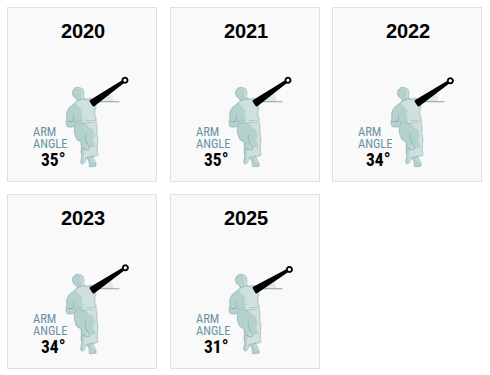
That change has affected how Alcantara’s pitches move, especially in terms of horizontal break to his arm side. Sandy’s four-seamer, sinker, and changeup have all picked up extra arm-side run this season. While Alcantara has always been arm-side dominant, this slight change could explain a lot of his reduced ability to locate those pitches where he wants.
Perhaps in part due to this, or maybe something else, Alcantara has been working down in the zone more this season than ever before. Nearly 53% of his pitches this season have been located low, about seven points more than his 2023 season. Those have primarily come at the expense of pitches located high, especially four-seamers. Whereas about two-thirds of Alcantara’s four-seamers were previously located up, this season only about 48% have been.
The blue shaded areas in the visuals below make this shift clear, especially to left-handed batters:
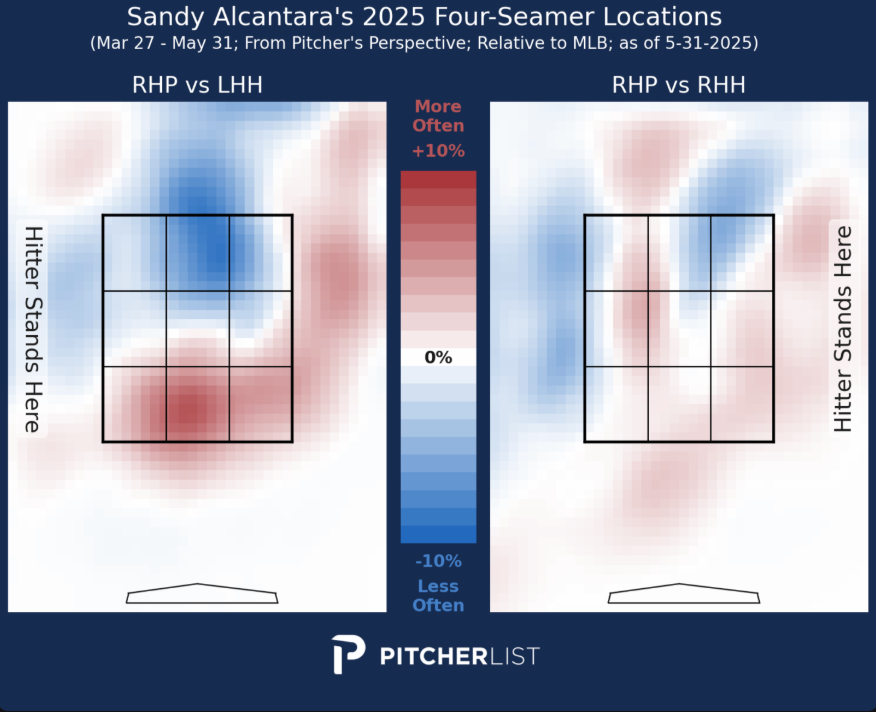
Along the same lines, his ability to get his four-seamers to his glove side (i.e., away from right-handed batters) has also been affected by the additional run on his four-seamer.
Light at the End of the Tunnel
Readers paying close attention will have noticed that I purposefully cut off the date ranges for the stats I’ve cited in this article at the end of May. That’s because Alcantara has looked much more like himself since the beginning of June.
In four starts this month, Alcantara has a 2.74 ERA and 3.20 FIP over 23 innings. Importantly, he’s only allowed two homers (0.78 per 9 innings) and five walks (5.4%), while striking out 19 (20.4%). If you peek back at the very first table in this article, you’ll see that those marks are more in line with the Sandy we all know and love.
While it’s a small sample size to be sure, it’s also true that this success coincides with much improved PLV and location grades on Alcantara’s slider and changeup. This month, his changeup has a 5.23 PLV and 100 location grade. His slider has been even better, with 5.52 PLV and 116 plvLoc+. He’s located better than 43% of his pitches at the edges of the zone, his called ball rate is back down around 32%, and only 21% of his pitches have come when he’s behind in the count. At the same time, Alcantara has thrown almost 59% of his four-seamers, including 57% to left-handed batters, up in the zone over his last four starts.
Those are all things he was struggling to do earlier this season. Sometimes it just takes a little time for pitchers to find their footing after returning from an elbow injury. Sandy Alcantara might be returning to form.
Feature image by Michael Packard (@CollectingPack on Twitter) | Photo by Kyle Ross/Icon Sportswire
