





Heading into 2025, Tanner Bibee was in elite company. Only four pitchers posted back-to-back 3.0 or higher fWAR seasons and were 27 years old or younger: Logan Gilbert, Logan Webb, George Kirby, and Bibee. Of that group, Bibee had the second-highest strikeout rate at 26.3%. Bibee looked to be heading towards the world of aces: a young, adaptable pitcher without an extensive injury history was highly intriguing. The Guardians thought so too, locking him up with a five-year, $48.5M extension in March.
Things haven’t exactly gone according to plan for Bibee. The 3.86 ERA doesn’t look horrible, but everything else looks like a significant step back; regression to a level we haven’t seen from Bibee at the big league level.
His FIP is 13th-worst among qualified starters, driven by a sharp increase in home runs allowed. Most notably, it’s the strikeout rate that’s evaporated. Bibee’s six percent year-over-year decrease is the seventh-largest among starters.
Guarding Against Righties
His arsenal underwent significant changes in the offseason, and the slow start also led to more in-season changes. Across the board, the great pitcher is still in there: there isn’t a dramatic velocity or stuff change, the new mix hasn’t quite clicked yet. Bibee was exceptional against righties last year and average against lefties, and while the performance against lefties has maintained, righties are seeing a lot more success this year.
Bibee’s most significant changes are swapping fastball usage for a sinker and transitioning his slider to a sweeper.
In theory, the sinker improves performance against righties, giving them a pitch that moves in on their hands rather than a poor fastball. In practice, the four-seam fastball has maintained its results while the other fastballs (cutter and sinker) have underperformed.
His four-seam fastball lost an inch of ride and gained an inch of run, likely due to increased sinker usage. This gives Bibee a poor 0.3-degree height-adjusted VAA, just the sixth percentile. Regardless, Bibee looks to elevate his fastball, even if it isn’t a whiff-inducing pitch.
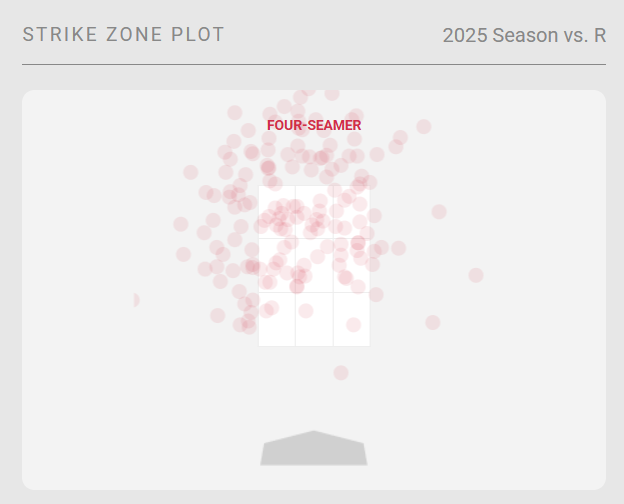
Righties have just a 22.8% whiff rate and 22.2% chase rate against the fastball, both figures well below average. In the pitch plot, there aren’t many pitches around the edge of the zone. There are few poor decisions against the fastball, with most swings in the zone resulting in contact. However, the results have largely worked out for Bibee. The fastball has just a .265 average against and a 41.2% ICR, which are better than the average big league fastball.
About half of Bibee’s fastball usage vs. righties is now the sinker, which he throws aggressively in the zone. This is not a whiff-inducing pitch like the fastball and boasts a strong 25.0% ICR. It earns a lot of called strikes, driving a 30.7% CSW%. Even though it is frequently in the zone, hitters only swing 44.3% of the time. That’s not just out of them watching early count pitches waiting for a fastball—they also watching strike three well.
Bibee’s sinker has earned a looking strikeout 16.1% of the time, third-best in baseball for same-handed matchups, as he executes the backdoor location to perfection.
When hitters put the bat on the sinker, the results are unlucky. Despite the solid ICR, righties are hitting .269 on the pitch, fueled by a .333 BABIP. The Guardians have the sixth-best infield defense in baseball by Outs Above Average, but that hasn’t helped. Of the 12 singles he’s surrendered, only four are well-earned base hits. Everything else is either an infield single or a bloop hit, certainly a byproduct of throwing a sinker, but it doesn’t suggest future performance will be poor.
On the other hand, his 85.7 mph cutter, a fastball by definition, has taken a large step back. Bibee introduced the cutter last year and boasted a 36.6% whiff rate and .138 average against, dominating against all hitters. This year, the whiff rate dropped by eight percent, and the average against is now .245.
Bibee dropped his cutter’s zone rate by seven percent against righties, now at 43.1%. Similar to the four-seam, pitches just off the plate and in the heart of the zone, but nothing right on the black.
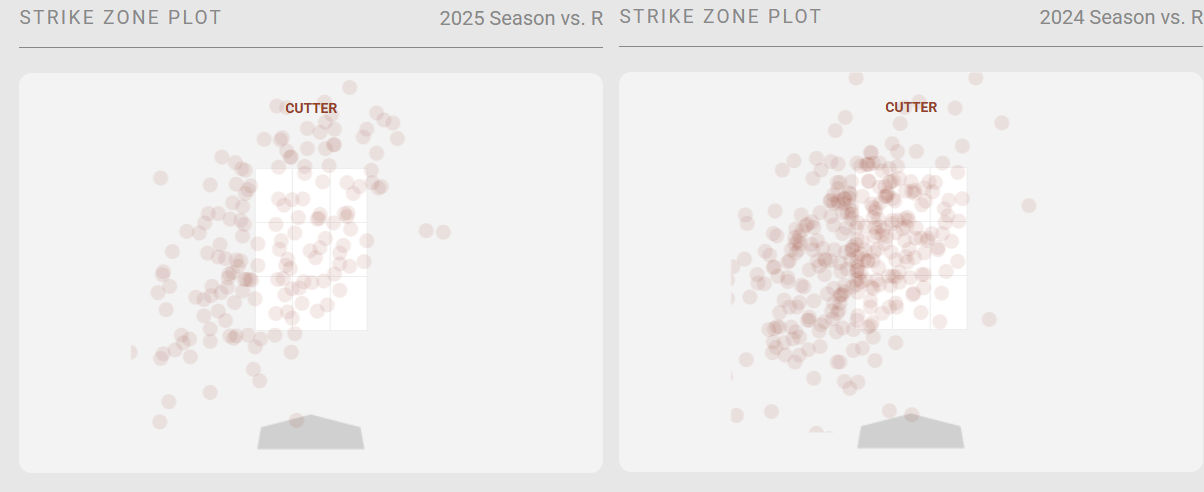
The result is more pitches for damage: Bibee has surrendered three home runs on the pitch, all center-cut location. By purely discipline, the pitch is performing unconventionally well.
The cutter has maintained a strong CSW% but is earning more called strikes and fewer whiffs despite the change in zone rate. Instead, Bibee has reformatted its usage: He is throwing significantly more cutters early in the count, potentially acknowledging that the pitch won’t earn whiffs in two-strike counts. Hitters are aware of the erratic location early in the count, too, exhibited by a drop in swing rate by 15%.
Bibee’s sweeper, which replaced the slider, has been generally effective once he moves off the fastballs. It has a 33.3% CSW%, which is 86th percentile, while limiting hard contact. Bibee can throw it early in the count for called strikes and bury it, too.
While the cutter might be one of the slowest pitches in its pitch classification, the sweeper is one of the hardest among starters at 83.3 mph. Bibee’s transition to the sinker drives the use of a sweeper over a traditional slider since they both have similar movement profiles at pitch release.
The final change to Bibee’s arsenal against righties is the failure of the changeup. Once his bread-and-butter, Bibee is failing to get on top of the pitch and is seeing disastrous results. The usage has dropped nine percentage points, making it clear that he’s avoiding it; however, the sub-20% CSW% and .400 average against hurt.
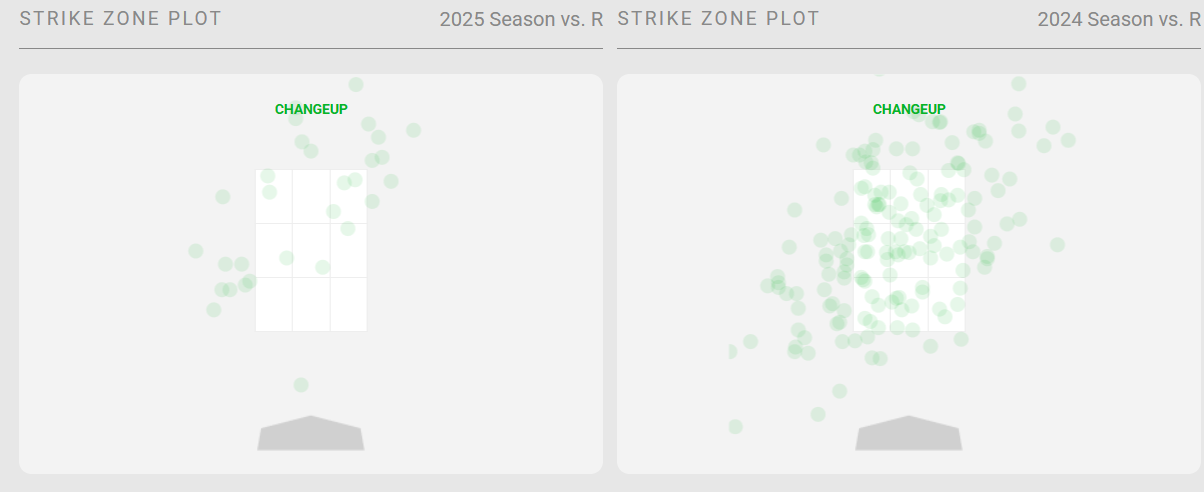
His hiLoc% has spiked by 20%, with over half of his changeups elevated. He’s always had a changeup that was left up relative to the rest of the league, but over 50% hiLoc is as bad as it gets. The damage hasn’t been truly horrendous due to the low usage, but it’s no longer a weapon in any capacity against righties.
Bibee also spins a curveball around four percent of the time to righties, another pitch that hurts the whiff rate. The curveball is primarily used as an occasional two-strike weapon, but Bibee throws it in the zone 45.7% of the time, well above the league average. Playing off a fastball that doesn’t succeed as an elevated pitch, putting the curveball at knee-level doesn’t work in a way that causes it to miss bats. Instead, a 30th-percentile putaway rate and .308 average against have only created more baserunners from situations where Bibee wants a strikeout.
Across the board, Bibee has lost command in the margins across his primary pitches to righties, devastating his whiff rates and swing rates. Only Nestor Cortes has seen a bigger drop-off in swing rate year-over-year, and Bibee’s six-pitch approach thrives on uncertain swings that lead to whiffs.
Business as Usual For Lefties?
Lefties have a .335 wOBA against Bibee this year, equal to the .336 figure from last year. There haven’t been as many changes to the arsenal against lefties, but many similar trends. Since most of this is likely command-based, they will exist regardless of which handed hitter stands at home plate.
Bibee’s four-seam lost a similar amount of whiffs against lefties, going from around a league-average 19.6% whiff rate to a minimal 7.1%. The result is more balls in play, and lefties are hitting .298 on the pitch, which, surprisingly, is down from last year. Generally speaking, you don’t want opposite-handed hitters doing anything to your fastball. It’s not great, but the ICR is below league average, which is really all he can ask for. Bibee has utilized the sinker slightly against lefties, and, even in a small sample, it’s been mashed.
His second offering to lefties, the changeup, is not being elevated nearly as much compared to his right-handed approach. The changeup is essential to dealing with left-handed hitters, and keeping it down keeps him alive. The pitch only has a 30.8% hiLoc%, up three points from last year but equal to where it was in 2023. Additionally, he’s throwing the changeup low 46.5% of the time, an improvement by almost seven points.
The zone and chase rates have deteriorated, but that hasn’t stopped his CSW% from improving to a 94th-percentile 37.1%. He can earn whiffs away, while stealing called strikes on the inner half too.
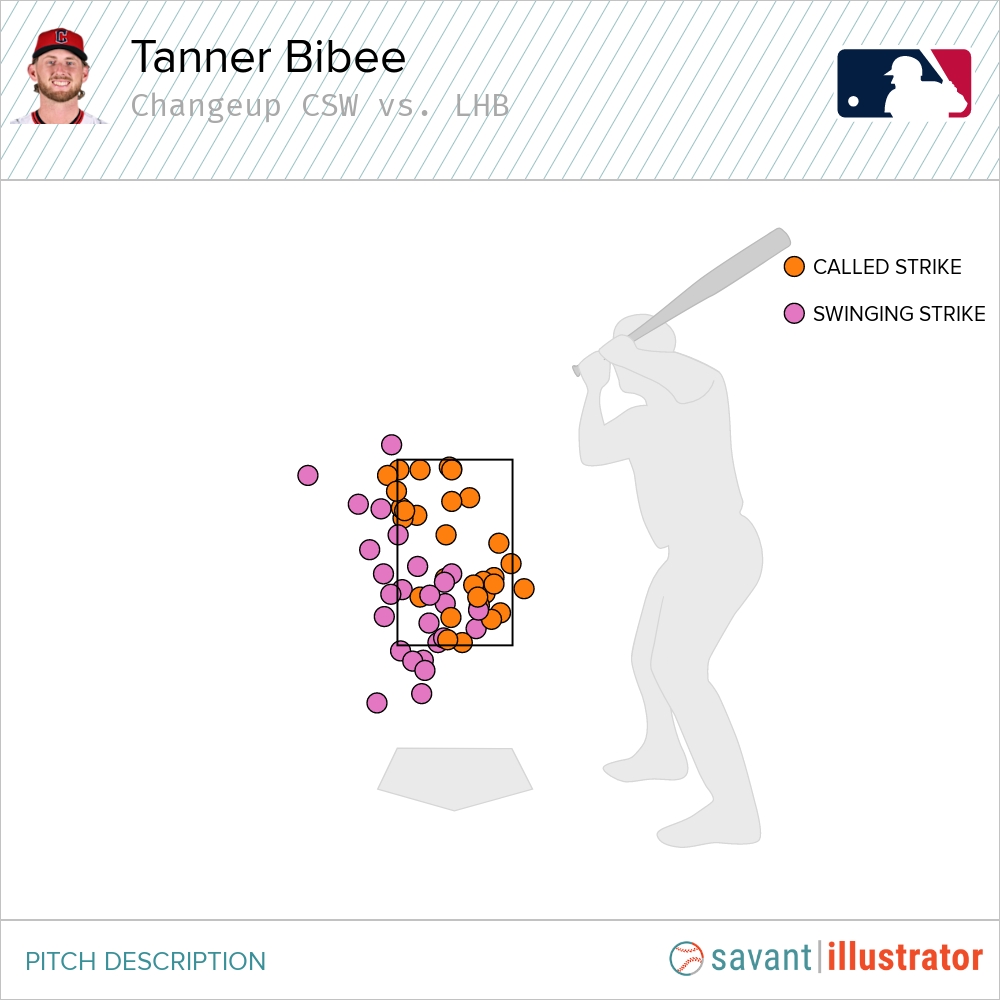
Despite the overall numbers saying he’s keeping the changeup down, the pitch is now returning a 52.4% flyball rate, up from 25.0% a year ago. That has led to a handful of home runs, but otherwise, the pitch has been business as usual.
Similarly, the cutter has lost a bit of performance, though it is still an effective pitch. It was unlikely to repeat a .105 average against and 26.1% ICR, and the increase to .238 and 33.3% is not the end of the world. Interestingly, Bibee has increased his zone rate on the cutter by 13%, boosting it from 49.4% to 62.5%. As you may recall, it fell seven percent against right-handed hitters. Bibee still has above-average called strike and swinging strike rates on the pitch, holding a 30.8% CSW%. This is a slight decrease from 2024, but still a strong figure. He’s challenging hitters in the zone and still getting rewarded.
Finally, his sweeper has surprising success against lefties. His old slider gave up a fair amount of damage, but the sweeper has been massive this year: 35.9% CSW%, 30% ICR, and .059 average against. That’s the best average on a sweeper against lefties in baseball (min. 100 thrown).
With a 53.3% zone rate, he’s earning whiffs in and out of the strike zone. He throws over half his sweepers early in the count, mainly as a pitch to keep hitters off balance.
Bibee’s approach to lefties has remained consistent. It isn’t overpowering in any way, but it has enough whiff and weak contact-inducing offerings to keep hitters off balance.
Are the Whiffs Coming Back?
This year has been quite unexpected for Bibee, but everything in the arsenal bar command still does its job when executed well. Bibee also seems aware that the command has evaporated, suggesting he’s still trying to find something mechanically. After a poor April, the ERA is still coming down, and he’s tinkering until it clicks.
In June, Bibee is moving as far away from the fastball as he can against righties. He’s briefly found something that works against righties and is slowly returning the whiffs.
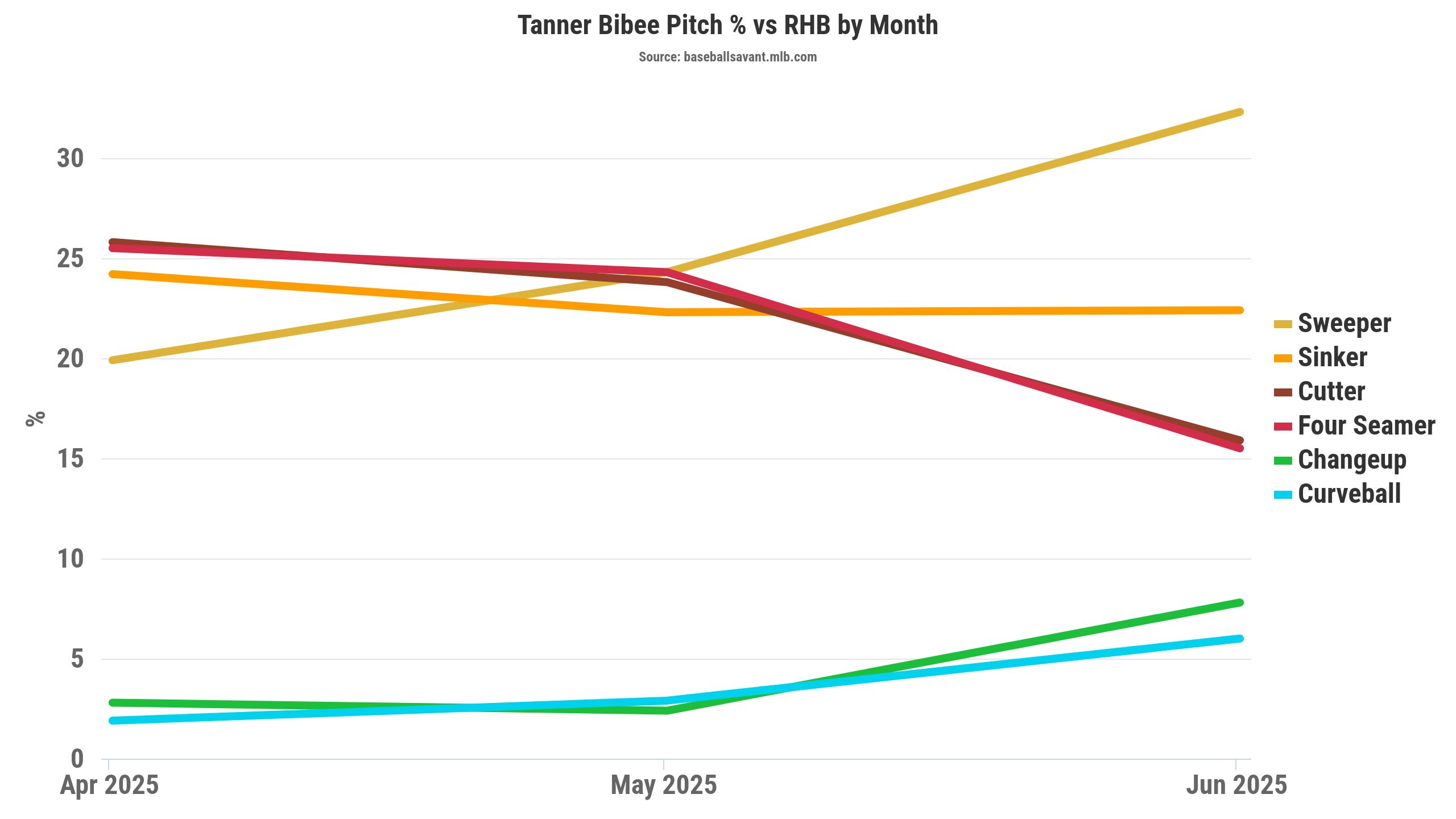
He’s leaning into all the soft stuff, and it’s paying dividends so far. At 32.3% usage, it has a 50.0% whiff rate and a .211 average against, all of which come at the expense of pitches in the zone. In his last game against the Athletics, he turned to the sweeper 33% for ten whiffs as he struck out double-digit hitters for the first time this season. If the sweeper can keep up its form, it gives Bibee time to continue to play with the other pitch types.
I don’t expect a crazy breakout from Bibee throughout the rest of the season, but everything in the profile suggests that he’s better than this, both in tinkering to figure out what works and the stuff itself. The Guardians shouldn’t worry about their big-money starter; he’s going to figure it out.
