





The Chicago Cubs built their playoff hopes on one of the National League’s deepest lineups and a rotation stocked with mid-rotation starters laden with additional upside. The bet, to date, hasn’t hit.
Chicago’s starters rank 27th in ERA, beset by injuries and underperformance. Cade Horton never got the chance to follow up on his second-place finish for Rookie of the Year, and Matthew Boyd’s meniscus-bound misfortune hit pause on two seasons of 3.00-ERA ball. While the Cubs wait for Justin Steele’s return, they are at the whims of Shota Imanaga’s home run rates and Ben Brown’s batted-ball luck.
Nobody has embodied this struggle as much as Edward Cabrera.
A former top-100 prospect with stuff made for Pitching Ninja, Cabrera has flirted with stardom throughout his Major League career. But in his first season in Chicago, things have once again gone awry. Cabrera has an ERA over 5.00 with the FIP to match. He’s striking out the fewest batters of his career, trading those outs for hits, and giving up an exorbitant amount of home runs. It’s a recipe for disaster, but Cabrera’s raw talent and a few potential fixes should give the Chicago faithful hope.
Cabrera’s Arsenal Isn’t Fully Optimized
Cabrera has the stuff of MLB The Show legends, offering two types of fastballs, two breaking balls, and a changeup averaging an outrageous 92.8 mph.
As a true pronator, though, Cabrera dances between the limitations of his arsenal and the fruits of his arm action. It isn’t easy to chuck one of the league’s hardest changeups with 1.5 feet of arm-side movement, and it’s unsurprisingly his bread and butter. I’m not sure I’d say he’s pulling the string with it, given the outlier velocity, but Cabrera throws it more often than any other pitch, especially against left-handed batters.
Right now, it’s not returning the requisite whiffs, or called strikes, or contact suppression we have come to expect. The causes may be twofold: a similarity to his sinker (3.5 mph, 0.8 inches iHB difference) and its heavy usage. Hitters leaning fastball aren’t off by all that much, as evidenced by an 88th-percentile foul ball rate and a modest ability to miss bats in the zone. When Cabrera is throwing it nearly a third of the time, there just aren’t many opportunities to surprise guys.
Subsequently, this pitch feels like a symptom of Cabrera’s struggles more than a problem. He can throw it to hitters of both handedness, and getting strikes at a 65% clip is good business.
Frankly, strike% tells a significant part of this story. Three of his five pitches have generated strikes at a significantly lower clip than last season, which culminates in the usual issues: fewer strikeouts, more baserunners, and a greater reliance on damage suppression, which isn’t Cabrera’s game.
Cabrera needs to strike guys out. The precision isn’t coming anytime soon, and with his capacity for velocity and movement, that fate is something Chicago will live with. His changeup and sinker are getting those requisite strikes, but his fastball never has. His usage has mostly declined over the years—bottoming out in 2025 before increasing a bit this season—and I’d argue it still hasn’t declined enough.
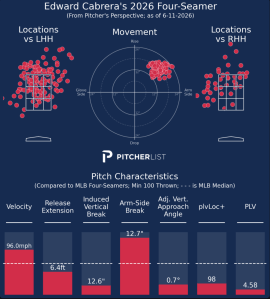
This is the dead-zoniest of dead zone fastballs, with 12.6 inches of iHB and iVB. The velocity is strong, but not truly exceptional, with below-average extension, HAVAA, and spin. Cabrera’s four-seamer refuses to miss bats in the zone, and in 2026, he’s not giving them many chances to do so. His zone% and strike% are both 4th-percentile marks, and throwing it up has funneled his fastball into vulnerable spots when it’s not sneaking over bats. It’s a problem pitch, and one that lacks the redeeming qualities for acceptable growing pains.
Elsewhere, Cabrera’s breakers might make or break his profile. I like the curveball a lot, as does PLV (5.04, 70th percentile). It allows him to find free real estate strikes early in the count while retaining promising whiff and putaway rates. The slider, meanwhile, has played into his struggles.
Cabrera’s pronation inherently limits the possibilities of his sliders. A sweeper isn’t an option, nor will his slider ever boast exceptional glove-side movement. But even within that paradigm, Cabrera’s slider has taken a step back, losing nearly two inches of horizontal movement. It seems like the downstream effects play into its usage, as Cabrera is hardly throwing it to lefties, perhaps making the rest of his arsenal a little easier to anticipate.
Improvement might come with an uptick in slider usage, but Cabrera’s feel for the pitch has waned in 2026. Both its zone rate and CSW% have fallen about nine points from last season, and it’s not getting the lucrative swings with two strikes. Without much potential for a new slider, it’s an offering that he needs to command better before it can alleviate the issues stemming from his fastball.
Softer Factors Could Be To Blame
I would hesitate to call Cabrera’s issue solely a matter of stuff. Pronators around the league have found success without a ton of glove-side movement, and a strong sinker should mitigate most of the weaknesses that come with his four-seamer.
Rather, Cabrera hasn’t been able to square the imperfections in his arsenal with suboptimal command. The former tends to buy breathing room for the latter. But Cabrera’s stuff isn’t quite as sharp as years past, partly due to his utilization, and the command isn’t good enough to compensate.
Part of these issues is likely mechanical.
Cubs Insider’s Evan Altman wrote before Cabrera’s last start that his lowered arm slot is indicative of mechanical woes. “That creates issues moving up the kinetic chain, eventually leading to the arm dropping down to be whippy,” Altman wrote. “Pitching requires both linear and rotational movements in concert, and Cabrera was getting a little too heavy into the latter.”
Altman’s article explains how the beginning of Cabrera’s delivery impacts his arm action and the issues it may cause. A different quirk caught my attention. As an athletic rotator, Cabrera generally misses horizontally, pulling breaking balls or losing fastballs armside. That isn’t uncommon, but Cabrera’s follow-throughs might provide a little insight into how he’s feeling. One trend that has popped up has been how force is manifesting as the pitch is thrown. We can trace his posture at the end of his delivery to the pitches he’s pulling toward the lefty batter’s box, particularly compared to when he is on time and more in sync with his linear movements toward the plate.
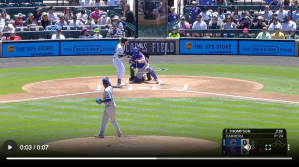
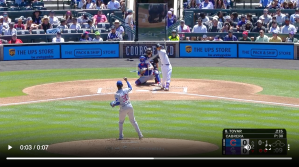
I won’t claim to be an expert on mechanics, but Cabrera has shown the ability to adjust within games (and, at times, plate appearances) to bear down and find the zone with a more controlled, linear delivery. It was much more apparent during his start in Colorado and noticeably less consistent in his return from the IL against the San Francisco Giants.
While that mechanical turbulence has a more direct impact on his command, Cabrera’s sequencing isn’t doing him any favors, either.
Five times this season, Cabrera has thrown at least 11 non-fastballs in a row, including stretches of 16 and 17 pitches against the San Diego Padres. There’s an argument to be made that throwing one of baseball’s hardest changeups mitigates the significance of the “off-speed” label, but the small sample of results hasn’t been favorable.
Naturally, each of those instances spanned multiple plate appearances. And in the at-bat that saw the final secondary pitch thrown, Cabrera allowed two 107-mph singles and a grand slam to Matt Chapman. Similarly, in the 10 plate appearances in which he’s thrown 6+ secondaries and no fastballs, he’s allowed as many walks as strikeouts (three) while giving up one hit on four balls in play (including an 111.9 mph out).
The sample sizes here are easy to disregard. Still, Cabrera seems to be losing feel for his heaters while falling in love with a changeup growing increasingly predictable. Paired with dangerously low fastball zone rates and the damage being done to his fastball, Cabrera may be falling into the traps of his own arsenal.
What’s Next in the Windy City?
As poorly as things have gone, the strengths in Cabrera’s profile remain intriguing.
Yes, we’ve done this dance before, and Cabrera seems almost ordained to frustrate fans who can see his potential. But the adjustments waiting for Cabrera all seem fairly attainable, and there is proof of concept that he can find success when healthy.
The optimism starts with that changeup. PLV still loves it, and there’s reason to believe the damage being done is more a matter of shortcomings elsewhere. He still has a unique movement profile, exceptional velocity, and enough command to use it for strikes. It may tunnel better with his sinker than the fastball, given the arm-side run, and it’s another excuse to ditch the four-seamer altogether.
The best version of Cabrera would reallocate his fastballs into more sinkers and sliders. He has far more command over the former, and its xwoBACON (.385) is far more manageable than the fastball (.461). Likewise, the slider has flashed in the past to hitters on both sides of the plate. Last season, it generated a 35.2% CSW% and a 4.3% barrel rate against lefties while throwing it 11.9% of the time. Forcing left-handed hitters to respect it again could open up the rest of his arsenal.
Hovering around that 10% mark to left-handed hitters would also lessen the load-bearing nature of his changeup. The off-speed pitch should still be featured heavily, but teetering on overuse means any semblance of doubt can have outsized returns. Cabrera has the opportunity to plant that seed while subtracting from his worst pitch, rather than his best.
I am hopeful that in due time, health and coaching will sort out Cabrera’s mechanical flaws. Not having to worry about maintaining the four-seamer could accelerate that process, too, and the benefits from improved command need not be explained.
There’s a world in which Cabrera is throwing one of the league’s best changeups with a good-but-not-great sinker and two platoon-neutral breaking balls. That sounds a lot closer to the playoff starter Chicago acquired, and Cabrera’s proximity to improvement should have Cubs fans holding out hope this summer.
