





It would be fair to argue that the Dodgers just got the best starting pitching performance across the first two games of a best-of-seven series in MLB history. Blake Snell and Yoshinobu Yamamoto marched into American Family Field, home of the #1-seed Milwaukee Brewers, and combined for 17 innings pitched, one run allowed, four hits allowed, and one walk allowed with 17 strikeouts. The Dodgers won both games by a score of 2-1 and 5-1, respectively, and head back to Los Angeles just two wins away from their second consecutive NL Pennant and their fifth in the past eight years.
In Game 1, Snell added to what’s becoming quite the October legacy by becoming just the 21st pitcher to ever record a game score of 90 or higher in a postseason start and the first Dodger to accomplish the feat. The only hiccup during his eight shutout innings was a third-inning single by Caleb Durbin; he struck out 10 and faced the minimum because Durbin was eventually doubled off. Yamamoto began Game 2 by surrendering a leadoff home run to Jackson Chourio and then went on to go the distance, striking out Andrew Vaughn to complete the effort. Snell and Yamamoto are two of the best pitchers in the world and are being paid as such, so it’s not a huge surprise they stepped up during their team’s most important games of the season. It’s the way they did it that warrants further discussion.
Snell has made a living on his fastball. It sits mid-high 90s, and he loves peppering the top of the zone with it thanks to a high arm angle. He throws it a lot, too, as it accounts for just under half the pitches he has ever thrown on a big-league mound. Something funny happened on Monday night in Milwaukee, though: Snell threw more changeups than he ever has in a start at the MLB level, regular season or postseason. The Brewers saw 38 changeups from him (all but three were to right-handers), topping his previous career-high of 37 from September 2023 when he was still with the Padres, and almost all 38 of them were absolutely filthy. The pitch registered an obscene 61% swing-and-miss rate in that outing, and only 44% of the swings it generated in the zone resulted in contact. Milwaukee put it in play five times, but only recorded an average exit velocity of 76 MPH. Somehow, the 14 whiffs Snell got with the changeup were not enough to match his career-high on that pitch…or even his season-high, as he got 15 on 34 changeups against the Reds back in Game 1 of the Wild Card Series.
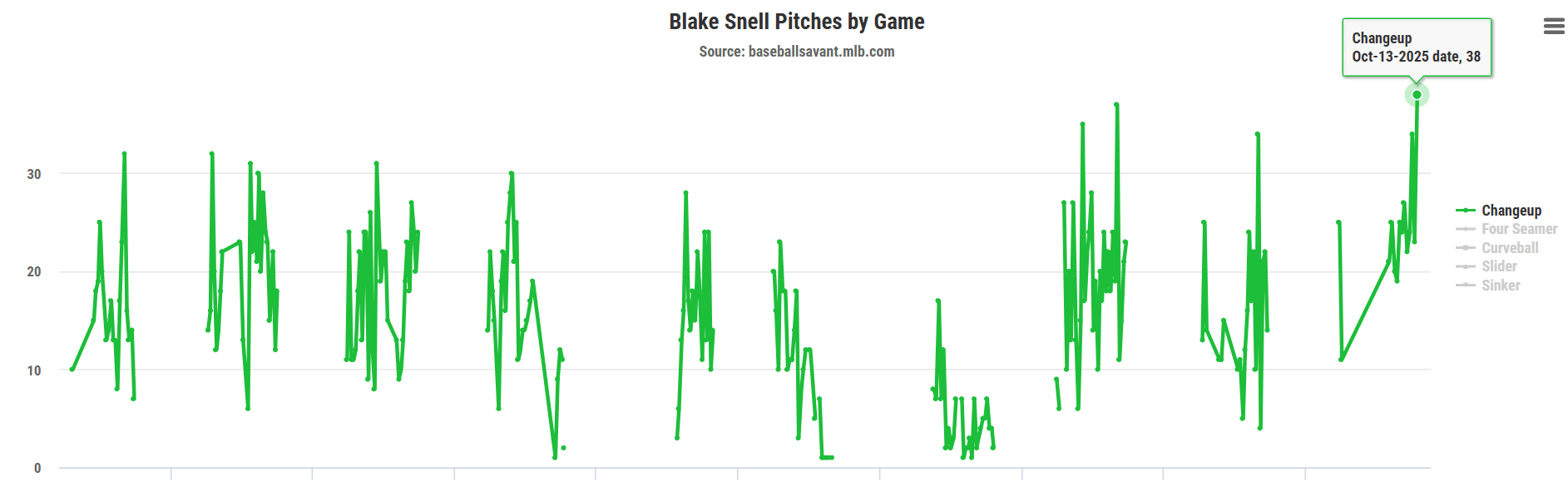
Blake Snell changeups thrown by start, MLB career, regular season & postseason (Statcast)
After such a development, then, isn’t it something that in Game 2, Yamamoto threw the second-most splitters he has ever thrown at the MLB level with 34, trailing only the 38 he threw in April 2024 in his fifth-ever start on this side of the Pacific. His arsenal is a tad more diverse than Snell’s, and the splitter was his go-to secondary against both sides of the plate behind his four-seamer this year, but it became his bread-and-butter on Tuesday, which marked only the ninth time in his career that he threw the splitter more than 30% of the time in a given start. Twenty of those 34 went to lefties, but both sides had trouble doing much with it in Game 2: It turned in a 40% whiff rate and was swung at a ton despite only being in the zone at its normal 32% clip. It was put in play nine times, but none of them fell for a hit, and eight never left the infield.
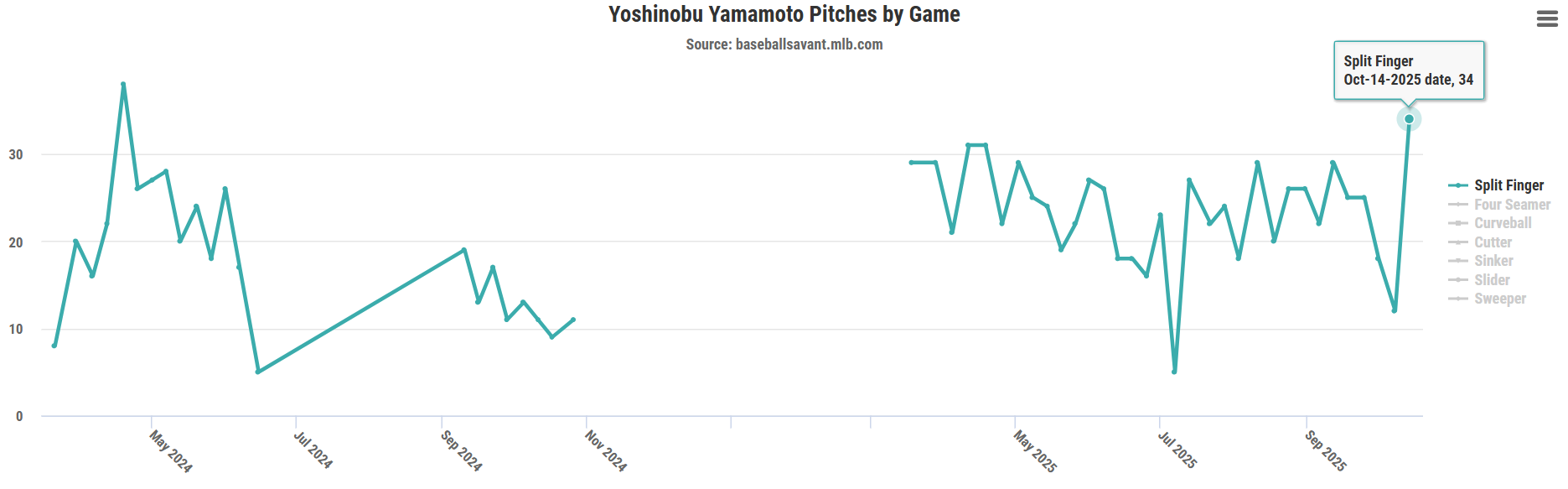
Yoshinobu Yamamoto splitters thrown by start, MLB career, regular season & postseason (Statcast)
Both starts were not only impressive on multiple levels – they were certified off-speed clinics from two arms that don’t usually rely on that type of pitch as much as they did. The fact that Snell and Yamamoto ventured toward unprecedented deployment frequency for a secondary pitch during road starts in the NLCS is extremely gutsy, but it paid off in a big way. By game score, each outing was inside the top eight in franchise postseason history, and if the Dodgers can bring home some hardware, these first two games in Milwaukee will be talked about as a focal point (Side note: Look at what Sandy Koufax did on three days’ rest in the 1965 World Series. Both were complete-game shutouts! Reminder that his career ended due to injury. Good thing teams don’t do this anymore).
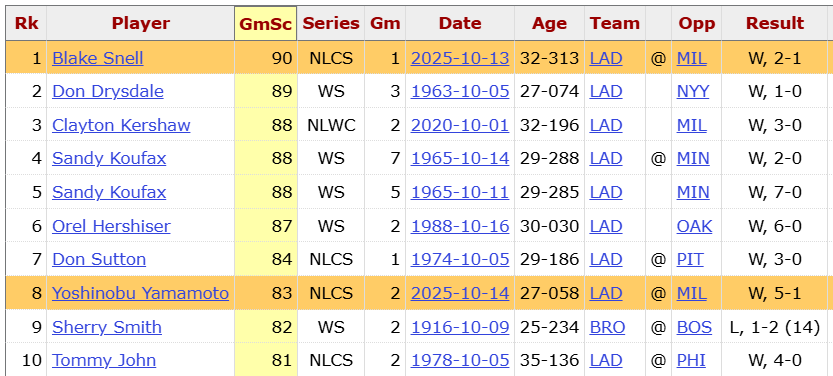
Top 10 postseason starts in L.A. Dodgers history by Game Score (Stathead)
What really makes this interesting, though, is the fact that the Brewers love to hit off-speed stuff. Only the Dodgers themselves, Blue Jays, and Cubs had a higher run value as a team against changeups and splitters in 2025. Chourio positively crushes them. Sal Frelick, Christian Yelich, and William Contreras weren’t fazed by them either. All those guys had a run value of +7 or better against these two pitch types during the regular season, and no one ranked lower than Brice Turang’s -2. Why would L.A.’s starters turn to their off-speed weapons so much against a lineup that jumps at the chance to hit them?
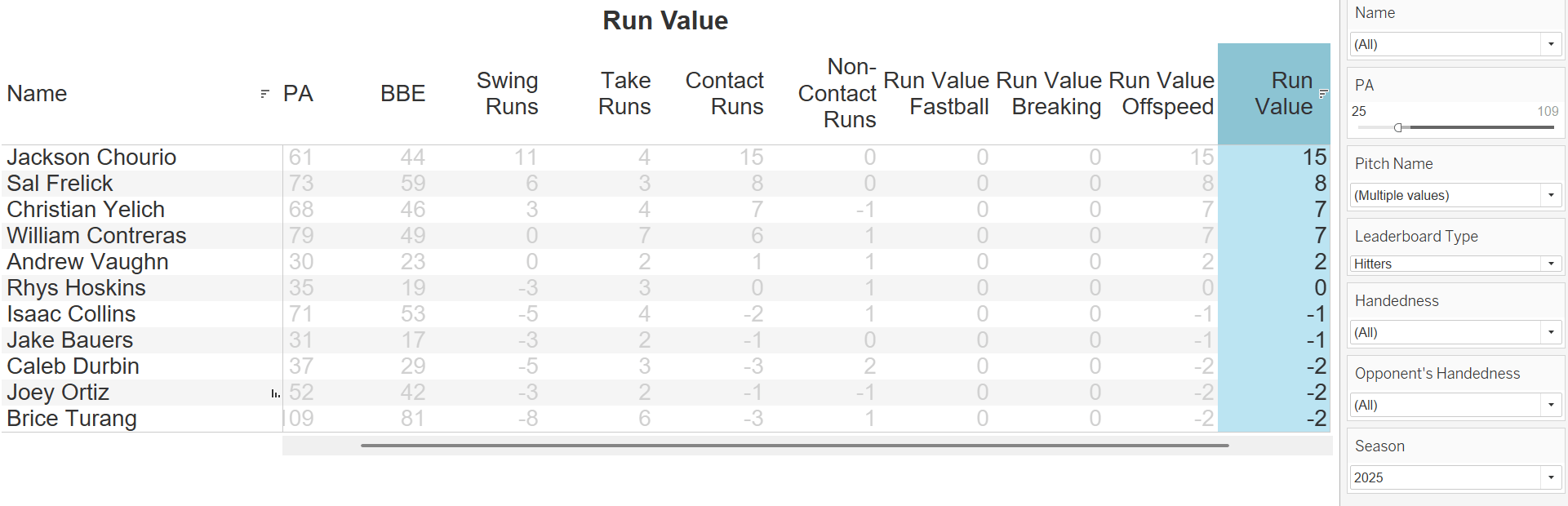
Brewers hitters run value vs changeups and splitters, 2025, min. 25 PA (Statcast)
Let’s start with Snell. We know he first pushed his changeup usage against the Reds in the wild card round, and they were, by comparison, quite ineffective against off-speed pitches this year. His seven innings of two-run ball with nine strikeouts from that start suggest it worked. The Brewers may have thought he would continue pitching to his opponent’s weakness, an assumption supported by Isaac Collins getting his first start of the postseason in Game 1. Collins, a right-handed hitter, flattens his swing considerably against elevated pitches, making him a better theoretical option to get on top of the high fastball that Snell throws so often.
Their swing decisions against Snell also indicate they were hunting his fastball. He was in the zone just over half the time with his changeup on Monday, and the Brewers swung 80% of the time when he threw it for a strike. That’s quite a lot, and when paired with their low 44% zone contact rate versus his changeup, it makes for a plausible theory that they were swinging out of their shoes, expecting fastball, and coming up empty because those perceived fastballs were changeups instead. Unpredictability clearly played some factor here, but if any pitcher is going to walk the tightrope of pitching to the other team’s strengths in the postseason, it makes sense that Snell should be one of them. His changeup isn’t terrific, according to the publicly available stuff models we have, but it works because of how well he locates it. Even for teams that hit a certain pitch type well, it’s hard to do much damage against pinpoint location, especially when the team in question doesn’t rely on slug. In Game 1, Snell’s changeup lived on the outer half with ease.
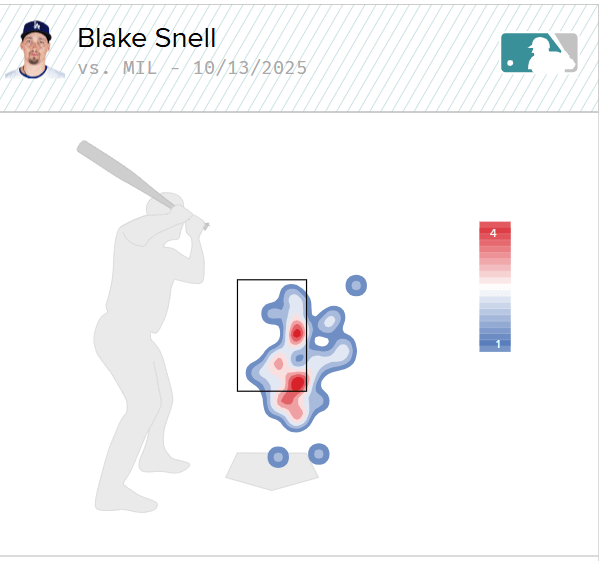
Blake Snell changeup location vs RHB, NLCS Game 1 (Statcast)
Like his teammate, Yamamoto also sacrificed some four-seamers for off-speed pitches in Game 2, but he notably increased his curveball usage on top of that. The curve was his third-most common pitch type to both lefties and righties during the regular season, being used on a nearly interchangeable basis with his sinker versus righties. However, it became his secondary pitch of choice against lefties and was thrown 27 times in total on Tuesday, the same number as his fastball. Fourteen MPH, 18 inches of induced vertical movement, and two feet of horizontal movement separate his splitter and his curveball, but he located the two pitches in a similar fashion to lefty hitters this year.
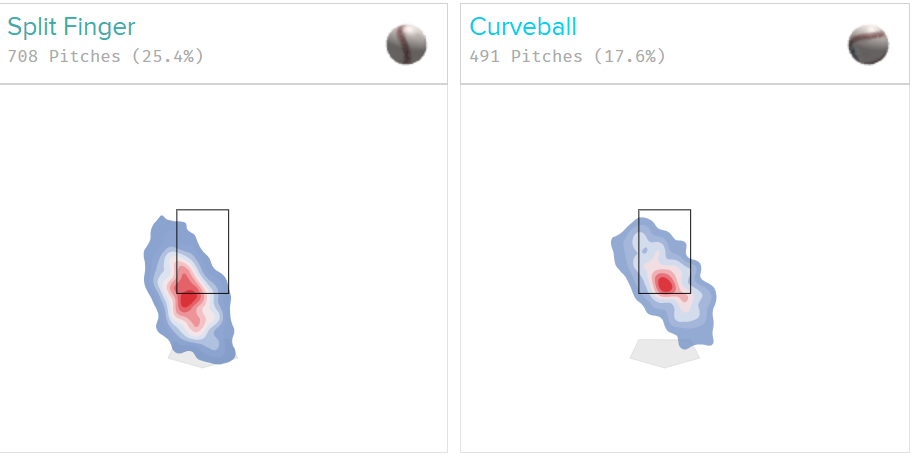
Yoshinobu Yamamoto splitter and curveball location to LHB, 2025 (Statcast)
There are signs that suggest the increased usage of both pitches made each other play up in Game 2, and it wouldn’t be a surprise if the Dodgers have proprietary metrics that say the combination of these two pitches in particular is an advantage against lefty hitters. Think about it – Yamamoto’s splitter was hardly in the zone on Tuesday and got plenty of chase and weak contact, as is the norm. He simply threw it a lot more than he usually does, against a team that should have wanted him to do just that. By contrast, he zoned 18 of his 27 curveballs (an even 2/3), which is a notable jump from his usual rate of about half. He stole eight called strikes with that curve in this start, and it was only put in play once while being fouled off nine times – the Brewers couldn’t see it well at all.
How was he repeatedly able to drop a high-70s breaking ball in the zone two-thirds of the time while the other team managed to hit it into fair territory just once? The splitter and curveball essentially served as a two-step plan for Yamamoto to generate the worst swing decisions possible: The former was chased after when it was rarely in the zone, and the latter kept getting taken despite frequently being in the zone. It’s not the most conventional pitch tunneling combination, if it even makes sense to call it that, but it made Milwaukee’s hitters appear as though they had no plan. Another factor that could be at play here is the sudden league-wide success of the high breaking ball, which Yamamoto was rewarded for throwing on an occasional basis.
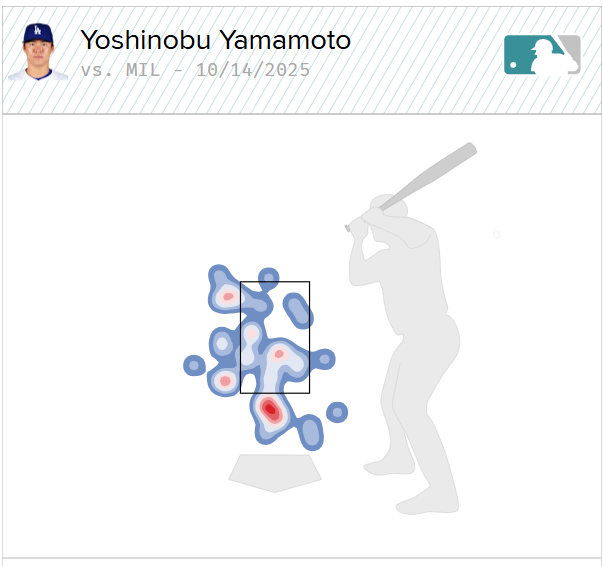
Yoshinobu Yamamoto splitter and curveball location to LHB, NLCS Game 2 (Statcast)
Pitching and hitting strategy in the postseason is impossible to fully wrap one’s head around because it invokes a chicken-and-egg-style debate. Will the pitcher pitch to his strengths or the opponent’s weaknesses? Will the hitter remain conscious of the pitcher’s weaknesses or prioritize his own strengths? In the first two games of the 2025 NLCS, the Dodgers threw more off-speed pitches at one of the best off-speed hitting teams in the game than they have all season, and didn’t flinch once. Thanks to Blake Snell catching them off guard to start, and Yoshinobu Yamamoto putting his pristine arsenal in a blender for all nine innings the next night, Los Angeles is in pole position for yet another NL pennant. Their next scheduled starter, Tyler Glasnow, does not throw a changeup or a splitter, but his fastball has more velocity than both Snell and Yamamoto. After that, they’ll start Shohei Ohtani in Game 4, whose rarely-used splitter might give itself a formal reintroduction at Dodger Stadium this week. Regardless of whether their rotation continues with this unorthodox strategy, it has hugely paid off so far, and a pitching staff that’s undeniably built for October will attempt to win this race over the next few days.
