






The skills or tools of baseball prospects are frequently graded on a 20-80 scale. At first, this may seem arbitrary, but apparently, it is fairly common. 50 is average. Each level is one standard deviation from the average. 40 is one standard deviation below, 60 is one above, 30 is two below, etc. These 3 standard deviations above and below capture 99.7% of what is below a normally distributed curve, that is why there is little need to go beyond 20-80. Sometimes tools will receive a “half” grade of 55 for example. You will sometimes also see the scale described as 2-8.
Batter Tool Breakdown
Fantasy-relevant batter tools are Hit, Game Power, Raw Power, and Speed. Different scouting organizations may use slightly different terminology, but they are self-evident. Each of these tools is frequently broken down into Present and Future value. Future tool grades represent how a player is expected to develop in that area. Present and Future grades can differ greatly for Hit and Game Power. However, Raw Power and Speed potentials are reached at relatively young ages so don’t often increase. In many cases, the Future Speed tool is slightly lower than the Present grade, as athleticism declines with age.
Below is how these tools are typically expected to translate into on-field stats.
| Tool | Objective Statistic |
|---|---|
| Hit | Batting Average/OBP |
| Game Power | ISO |
| Raw Power | Max EV |
| Speed | Sprint Speed |
There are other stats associated with these tools. Hit tool and Contact Rate. Game Power and Slugging%/HRs. Raw Power and HRs/Max HR distance. I thought that those included in the chart above made the most sense, however. And correlations typically backed this up.
Past Tool Grades
I was curious about how these tool grades manifested once prospects became established Big Leaguers. After all, we don’t get excited for a high tool grade in and of itself. We are excited about a strong hit tool resulting in a .310 average, or 70-grade Game Power becoming 40 HR seasons.
Compiling tool grades of former prospects was surprisingly difficult. It primarily involved manually entering grades from a combination of Fangraphs and MLB Pipeline. I was able to find grades dating back to 2013. Most, if not all, players were on Top 100 lists. Future and Raw Power grades were also less frequently listed, resulting in a smaller sample size for those.
As most hitting stats have stabilized after 1,000 PAs, I used that as a cutoff for including former prospects. For Present Hit, Game Power, and Speed tools 75 players were selected. For Future Hit and Game Power, 40 players were found. For Present Raw Power, 27 players were selected. Future Raw Power and Future Speed were too similar to their Present grades to be significant and, therefore, were not included in final results for simplicity.
MLB Correlations
I ran a correlation with each tool grade and various stats. The closer the coefficient is to positive or negative one, the stronger the correlation. A negative number indicates that a higher grade is correlated to a lower outcome stat, and vice versa. Generally, anything above .7 is considered a strong correlation, between .5-.7 moderate, and less than .5 is weak.
| AVG | ISO | BB% | K% | wRC+ | Sprint Speed | EV | Max EV | OBP | |
|---|---|---|---|---|---|---|---|---|---|
| RawPresent | 0.10 | 0.76 | 0.31 | 0.39 | 0.51 | -0.35 | 0.78 | 0.68 | 0.22 |
| GamePowerFuture | 0.27 | 0.64 | 0.30 | 0.25 | 0.54 | -0.31 | 0.65 | 0.60 | 0.30 |
| GamePowerPresent | -0.15 | 0.45 | 0.33 | 0.33 | 0.26 | -0.35 | 0.50 | 0.54 | 0.13 |
| HitFuture | 0.28 | -0.05 | -0.07 | -0.20 | 0.02 | -0.14 | 0.01 | -0.04 | 0.06 |
| HitPresent | 0.06 | -0.06 | -0.09 | -0.22 | -0.05 | -0.18 | 0.01 | 0.09 | -0.04 |
| SpeedPresent | 0.03 | -0.40 | -0.27 | -0.04 | -0.29 | 0.72 | -0.44 | -0.32 | -0.17 |
The most obvious example here is the strong correlation of .72 for the Speed Grade and Sprint Speed. One would certainly expect this.
What is most surprising to me is the weak correlation with the Hit grades to, well… everything. The Hit tool is somewhat abstract, but it can be best thought of as representing contact and plate discipline skills. It does correlate most strongly here with Avg and a lower K%, but even that is pretty weak. Guys who don’t strike out a lot have a better batting average. There is no connection here between walk% and Hit tool, however.
Power, both Game and Raw, definitely stand out here. They are moderately correlated with ISO, wRC+, Exit Velocity, and Max Exit Velocity. While intuitive, it is also interesting to note that players with more power tend to be slower. That is why it is so special when the rare power/speed combo is present.
Based on this, if your only plus offensive tool is Speed, you better be a very good defender. The negative correlation with ISO is even starker when the ability to stretch singles into doubles should increase one’s ISO somewhat.
MLB Translations
How have these bucket grades actually converted to big-league stats? Here I’ll focus on the impacts on the expected objective stats given in the above table.
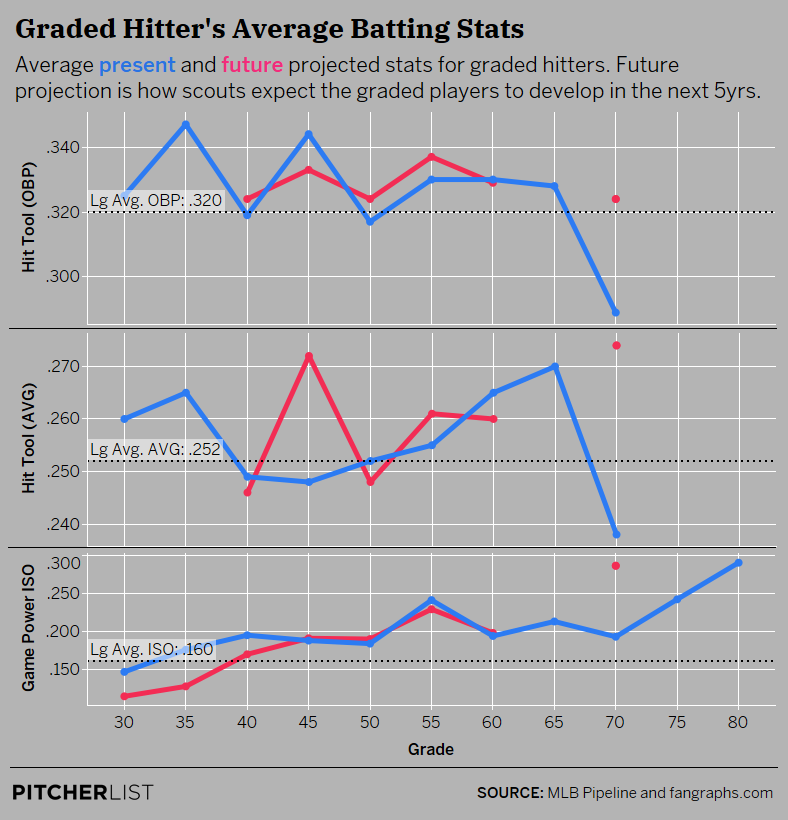
Data Visualization by @Kollauf on Twitter
Hit tool grades really have not shown us much in terms of batting average and OBP. In case you were wondering, removing that drop in BA and OBP at the 70 grade (ahem Byron Buxton) only changes the correlation coefficient for Present Hit to .09 and .00, respectively.
Given the above correlation, the Game Power grades definitely show an upward trend in ISOs.
I thought a table would suffice for Raw Power and Speed.
| Grade | Raw Power-Present (Max EV) | Speed-Present (Sprint Speed) |
|---|---|---|
| 20 | ||
| 25 | ||
| 30 | 25.3 | |
| 35 | ||
| 40 | 109.0 | 26.5 |
| 45 | 112.3 | 26.8 |
| 50 | 111.9 | 27.3 |
| 55 | 112.7 | 27.3 |
| 60 | 115.0 | 28.2 |
| 65 | 28.4 | |
| 70 | 117.6 | 28.3 |
| 75 | 29.1 | |
| 80 | 29.4 | |
| MLB Average | 27.0 |
Final Thoughts
I would’ve very much liked to have a larger sample size for this work, but it was not plausible at this time. It was a bit surprising to see how little the Hit tool translated into MLB results and how much Game and Raw Power did. Based on this it seems that a prospect with plus Power grades and just enough of a Hit tool is far more likely to have success than one with a plus Hit tool and average Power. Speed is a bonus, but a player needs much more to be successful at the plate. The all-encompassing wRC+ correlations back this up.
Photo by John Byrum/Icon Sportswire | Adapted by Michael Packard (@designsbypack on Twitter & IG)
