





Ty France isn’t supposed to be here right now. Not in the middle of the order, in the middle of a playoff race, in the middle of his most productive season since 2021.
Thirty-two-year-old right-right first basemen don’t age like that—at least not without significant changes.
Fortunately for the San Diego Padres, France has found the requisite adjustments to spurn the age curve. The results have been palpable, both for France and a Padres lineup that ranked dead last in offense at the All-Star break.
Now, sporting the best wRC+ of his career and attempting to surpass 20 homers for the first time, France has found meaningful plate appearances in the dog days of summer. The San Diego faithful can thank his batted-ball distribution and the swing decisions behind it for France’s summer-long renaissance.
A Pull-Side Story
France spent the last two seasons flirting with the replacement level. He logged wRC+ marks of 93 and 92, respectively, with the only driving force in his fWAR coming from a miraculous defensive turnaround. Perhaps the ability to claw back to relevance by any means necessary should’ve been taken as foreshadowing.
This time around, France’s improvements largely center on his propensity to do damage.
There are effectively two levers a declining hitter can pull to maximize power. The first is selling out for it, trading contact rates for exit velocity. France has done that, as evidenced by shrinking Z- and O-Contact rates with a sizable jump in K%. It’s hard to argue with the 82nd-percentile xwoBACON, 91st-percentile average exit velocity, and 86th-percentile ISO that came with it. He’s not sacrificing OBP, either, thanks to his .333 BABIP and .290 AVG (both 33-point improvements from last year).
Second, and more importantly, is the shift in spray angle.
France is hitting the ball harder this year, but his results are about actualizing the power that’s always been there. Max exit velocity (for all its flaws) shows that France has long had above-average power, and that this year (109.6 mph) is his least impressive posting since 2020. Conversely, France’s fly ball exit velocity of 94 mph is at the 90th percentile and nearly four ticks higher than his previous best.
When he’s getting the ball in the air, he is hitting it harder and pulling it more often. Both bode well for extra-base hits for the simple reason that the fences are shorter. As seen below, France is hitting far fewer balls to the opposite field, where they are more likely to die in the right-center gap. In aiming for the left-field pole, he’s letting his natural pop play up.
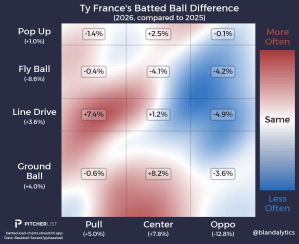
Similarly, batted-ball optimization is a recipe for outperforming expected statistics. Spray direction is notably absent from xSLG. All else equal, a hitter who can take defenses out of the equation by hitting balls off or over the wall is bound to have more success than someone getting stuck in the gaps. Field dimensions do a pretty good job of containing pesky fielders stealing our extra bases.
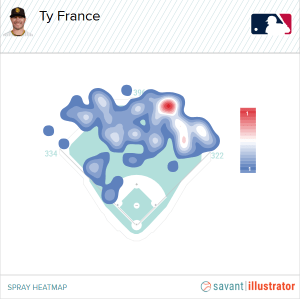
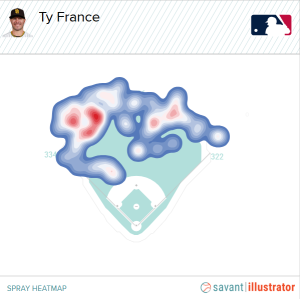
France’s best-hit balls illustrate this well. In 2025, he hit 84 pitches at least 95 mph, with at least 10° of launch angle. His propensity to go the opposite way allowed him to hit .549 with a .657 wOBA.
This year, France is pulling those pitches much more frequently. Despite 24 fewer swings, he’s found 10 more home runs, a .586 average, and an elite .888 wOBA. He’s getting more out of his best work, and in a sport defined by punishing mistakes, making the most of those opportunities is crucial.
Not Getting Ty-ed Up
To an extent, France is selling out for power. But he’s trading contact without sacrificing the plate discipline that allows him to remain potent.
For example, his newfound ability to pull isn’t a symbiote driving every swing decision. His Pull% is up from 30.9% to 37.9%. It’s a massive jump, but 37.9% is still just the 24th-percentile this season. He’s pulling ground balls less often than his peers and reshaping his pull air rate at the same time—jumping from 13.2% to 19% keeps him far from the league average, but in the more favorable direction.
Subsequently, pulling more in the air without significant gains on the ground seems like a matter of swing decisions.
Rather than trying to pull everything, France is reclaiming the inside part of the plate, turning and burning without abandoning the rest of his approach.
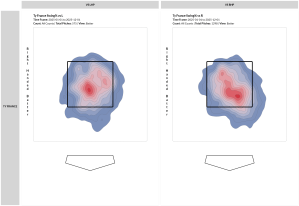
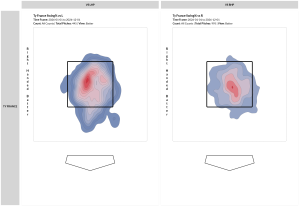
In gearing his swing decisions for the inside pitch, France has done a better job of laying off soft stuff low-and-away, eliminating one of his weakest areas (the other being high fastballs). Spitting on those pitches more frequently has natural downstream effects, one of which is that he isn’t rolling over to the second base.
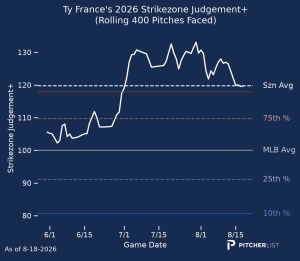
It isn’t all that surprising that France is now executing on pitches on the inner two-thirds of the plate. His Z-O-Swing% has also improved, as has his production on non-ground balls. I’m surprised to see his SEAGER nearly cut in half year-over-year, but it’s another trade-off that has worked in his favor. He may be leaving some punishable pitches on the table, but compensating by giving his batted balls a much better chance of success has borne fruit.
Pulling Levers
Ultimately, France’s changes have remade his short-term outlook and fundamentally changed the Padres’ playoff outlook. Jake Cronenworth and Jackson Merrill struggling should have ended San Diego’s chances of beating right-handed pitching. Instead, France’s 144 wRC+ against same-handed pitchers has eliminated the need for a platoon and allowed Craig Stammen to allocate more responsibility to a first baseman who signed as a minor league free agent this offseason.
To France’s credit, he’s taken the opportunity in stride and kept the defensive gains that likely caught teams’ attention in 2025. Returning to form as a complete player, he’s posted 2.3 fWAR and likely bought himself more time in the big leagues.
It’s a remarkable run, but it isn’t necessarily sustainable.
France pressed all the right buttons to save his career. However, some buttons can only be pressed once. Losing more Z-Contact would place him below the league average, and I’m not convinced the age curve or his good-but-not-great exit velocities bode well for raw power holding up its end of the bargain. It’s only going to get harder to sustain his uptick in bat speed, too.
Likewise, France can only do so much more to optimize his batted ball distribution, even with below-average pull rates. I’m hesitant to suggest he do more to exaggerate his pull air rate, given the consequences it could have on his approach, and eventually, pitchers are going to punch back.
Right-right first basemen still don’t age well, and France doesn’t have much of a carrying tool. It’s not a profile I’d want to bet on in 2027. But for a Padres team in the thick of a playoff race, that’s a problem for another winter and another CBA. He’s the lynchpin of this lineup, and his pull-side intentions have already pushed San Diego past its early-season turbulence.
