





I have loved seeing fantasy leagues get a little more creative in recent years. I am hardly the most experienced dynasty manager at Pitcher List, and plenty of readers have likely been doing this longer than I have, but one shift I keep coming back to is the move away from batting average as a core scoring category. Long before fantasy fully caught up, the broader baseball world had already started to treat batting average as an incomplete way to measure offensive value. OPS may feel like the natural replacement on the surface, but more leagues seem to be landing on on-base percentage instead. For dynasty managers, that change can open up a much more complete way to evaluate hitters.
That wrinkle matters even more when prospects enter the conversation. OBP leagues reward plate discipline, swing decisions, and a hitter’s ability to grind out value even when the batting average is not eye-popping. That means certain prospects can carry a lot more fantasy appeal in this format than they would in a traditional batting average league. With that in mind, let’s look at a few underrated prospects whose value gets a real boost in OBP formats
INF Pedro Ramírez, Chicago Cubs
Venezuelan native Pedro Ramírez is not a prospect I hear much about, primarily because he does not fit the traditional fantasy mold. He is not built around huge raw power, and he may never be the type of bat that carries a roster in slugging categories, but there is a lot to like here for deeper dynasty formats. Ramírez is already in Triple-A at age 22, and he has opened 2026 by hitting .311/.367/.667 with four home runs and three steals in his first 49 plate appearances for Iowa. That is a small sample, of course, but it also comes after a 2025 season in which he hit .280/.346/.386 with eight home runs, 28 steals, and just 85 strikeouts in 563 plate appearances at Double-A Knoxville.
What makes Ramírez especially interesting for OBP leagues is that the profile is a little more nuanced than the surface stats suggest. He is a switch-hitter with good bat-to-ball skills, but not always in a way that leads to obvious fantasy value. He makes plenty of contact, but the issue had often been that it led to poor contact. This year, though, he is pulling the ball more and getting it in the air to that side 29.4% of the time. That is helping him get the most out of his power, and his 107.9 mph EV90 ranks in the 94th percentile among Triple-A hitters. When I see one of the level’s lowest whiff rates, one of its lowest chase rates, loud contact, and speed, I think there is something here for dynasty managers.
Pedro Ramírez had 8 homers in 129 games last season.
The @Cubs‘ No. 9 prospect goes yard for the 4th time in 11 games for the @IowaCubs. pic.twitter.com/XIf307a73A
— MLB Pipeline (@MLBPipeline) April 8, 2026
The pop is probably never going to be the carrying tool, but if Ramírez can keep getting on base at a respectable clip while offering speed and multi-position infield value, there is a path to sneaky fantasy relevance. His 28 stolen bases in 2025 stand out, and they matter more in OBP formats because a player does not need to hit for a huge average to create value if he can reach base, run, and avoid empty at-bats. Prospect Savant also shows he spent 59 games at second base and 68 at third base last year, then has already logged time at both spots again in 2026, which only helps his path to usefulness.
The upside here is not star-level fantasy production. Ramírez looks more like the kind of player who could settle in as a useful table-setter or versatile lineup piece than a category winner. In OBP leagues, those players can matter more than they do in standard formats, especially when they bring speed and contact skills to the table. He is a deeper name, but one worth following closely if the Triple-A on-base gains hold.
1B Abimelec Ortiz, Washington Nationals
Abimelec Ortiz is the kind of deep-league first base prospect who can sneak up on dynasty managers, especially in OBP formats. The Florida SouthWestern product does not come with the defensive versatility or loud all-around profile that usually drives prospect hype, but he does have a clearer path than many bat-first names. Ortiz is already in Triple-A, he turns 24 this season, and a rebuilding Nationals club should have every reason to see what it has in him if he keeps this solid start rolling.
Ortiz is a Statcast darling, with a .464 expected on-base percentage through 45 plate appearances this season. Four of his eight hits so far have gone for extra bases, including a no-doubt homer this week. He is making a strong first impression after joining the Nationals from the Texas Rangers organization.
first big fly of 2026 for abimelec ortiz 💥 pic.twitter.com/9xPMGvvJ6E
— Nationals Player Development (@Nats_PlayerDev) April 8, 2026
The biggest red flag here is not hard to find. Ortiz has been too passive early in 2026, and that is where the profile gets tricky for fantasy managers trying to separate patience from passivity. As you noted, his overall swing rate and zone-swing rate are both among the weakest marks at the level, and that creates some concern even in an OBP league. A hitter can only do so much damage if he is letting too many hittable pitches pass by. That said, I would still put more weight on the 2025 version of Ortiz than the ultra-small-sample version we have seen so far this year. In 2025, he was far more willing to attack pitches in the zone, posting a 73.1% zone-swing rate while making above-average contact at an 85.9% clip. That player is much easier to buy into than one simply taking his way into deep counts.
What makes Ortiz interesting for this specific format is that the improved chase rate from last year to now is not nothing. Even if it currently comes with too much passivity overall, better swing decisions can still be a real foundation for OBP leagues as he finds that middle ground. The box score has been excellent to open 2026, and that matters because a productive start combined with a thin organizational runway at first base can speed up relevance in a hurry. There is still risk here, especially because true first basemen have less margin for error than almost any other prospect demographic, but Ortiz is trending in a wildly positive direction. In deeper dynasty leagues, he is the kind of name worth at least tracking before the broader market catches up.
UTL Kahlil Watson, Cleveland Guardians
On the PBR circuit in Virginia, Kahlil Watson was one of those players I kept hearing more experienced evaluators bring up. The Chase City native was a standout on both the football field and the diamond before the Miami Marlins selected him 16th overall in the 2021 MLB Draft. The road since then has been anything but linear, but after flirting with a 20/20 season in 2025, Watson entered 2026 with real momentum. If he keeps this early progress going, his stock is not going to stay underrated much longer.
I will admit there is some recency bias in putting Watson here. The Triple-A box score looked strong, as he posted a .255/.358/.477 line with eight home runs in 176 plate appearances, but that production outpaced the underlying expected numbers and came with chase and whiff rates that sat firmly in the lower quartile for the level. There is still plenty of swing-and-miss here, too. Watson owns a 31.1% strikeout rate so far in 2026, along with a 14.1% swinging-strike rate. Still, the encouraging part for OBP leagues is that the plate-discipline gains appear real. His walk rate has climbed, and his chase rate has dropped from 33.3% in 2025 to 22.7% in 2026. Through his first 45 plate appearances, Watson has drawn 10 walks against 14 strikeouts.
The surface line does not look great yet, as he is hitting .200/.378/.286, but the expected .210/.390/.416 line paints a much more encouraging picture. That matters in OBP formats, where Watson does not need to be a batting-average anchor to offer value. If the improved approach holds and the quality of contact stabilizes, he has the on-base skills and stolen-base upside to become a much more intriguing dynasty target than traditional formats might suggest.
INF Mikey Romero, Boston Red Sox
Is this finally the year for Mikey Romero? The 2022 first-round pick feels like a classic post-hype prospect entering his age-22 season, and he has opened 2026 in Triple-A for the first time. As a 22-year-old middle infielder at Worcester, SoxProspects currently pegs him as a late-2026 ETA type rather than the organizational headliner he once looked like.
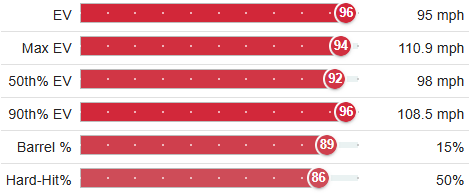
That might actually work in his favor. Romero no longer has to carry the same spotlight in a loaded Boston system, and sometimes that matters for young hitters trying to settle into who they are. The raw power has never really been the problem. Even in a flawed 2025 season, when his 27% strikeout rate across Double-A and Triple-A raised plenty of concerns, Romero still hit 17 home runs and showed the kind of damage ability that keeps evaluators interested. His first taste of Triple-A was rough from a process standpoint, but the quality of contact still stood out. Among Triple-A hitters who saw at least 700 pitches in 2025, Romero ranked in the 95th percentile in barrel rate at 14% and the 90th percentile in hard-hit rate at 47.1%.
Mikey Romero has come out swinging in Triple-A to start 2026:
9 Games – 43 PA
.342/.395/.553/.948
1 HR
5 2B
11.6 K%
4.7 BB%.
144 wRC+99th percentile Max EV so far. 98th percentile EV. 88th percentile xwOBA. 9-game hitting streak to start the year. pic.twitter.com/nIKsenoBgg
— Tyler Milliken (@tylermilliken_) April 8, 2026
That is what makes this early 2026 stretch so interesting for OBP leagues. The power indicators are still there, but now the underlying swing decisions and contact ability look more encouraging too. It is only a 43-plate-appearance sample, so nobody should declare the breakout complete yet. Still, an 11.6% strikeout rate would be a massive step forward for Romero, and the improved whiff and swinging-strike marks suggest this may be more than just a hot week. If dynasty managers held through the frustrating parts of his development, this is exactly the kind of early-season shift they wanted to see.
There is still risk here. Romero has spent much of his pro career battling strikeout issues, and there is not a perfectly clean path to playing time in Boston even if the big-league club has stumbled early. But this profile is suddenly much more interesting in OBP formats than it was a year ago. If the plate-discipline gains hold while the impact contact remains intact, Romero could start changing both his fantasy outlook and his real-life standing in the organization in a hurry. He is no longer just a former first-rounder trying to reclaim relevance. He looks like a legitimate post-hype name worth tracking.
