





The Cardinals’ Matthew Liberatore has had an okay season by the results alone, but the underlying metrics indicate he’s been on the lucky side. His 4.50 ERA is over a run lower than his xERA (5.81), and FIP (5.84), and notably lower than his xFIP (4.92) and SIERA (5.02). He’s striking out hitters at a notably lower rate than he did last season (14.6% K% in 2026, 18.8% in 2025), and is walking more hitters as well (8.2% BB% in 2026, 6.2% in 2025).
Despite these poor underlying metrics, there’s still a better pitcher in there, and the Cardinals could unlock him with some tweaks to his approach.
The Arsenal
While Liberatore doesn’t have elite stuff as a starter, he does have some weapons, and his arsenal has improved over the years. His fastball has the second-best velocity (94.4 mph) of his career (94.9 mph in 2024 when he was primarily a reliever) and the best stuff+ (88) of his career. While it’s still 12% worse than the league average fastball, it’s still a pitch he can utilize.
Liberatore also features a sinker with a 94 stuff+, but it is very deadzone. His sinker is 1.6 mph faster than the average lefty sinker, and is more of a traditional two-seam fastball in that it has 7.6 inches more ride and 2.7 inches less run than the average lefty sinker.
Liberatore features two breaking pitches that are notably above average by stuff+. His slider (112 stuff+) is 1.5 mph faster than the average lefty slider without sacrificing any movement. His curveball has an exceptional 127 stuff+ thanks to a ridiculous additional 8 inches of drop than the average lefty curveball. In this case, the stuff+ is misleading because his curveball only averages 77.9 mph (lefty average is 79.3 mph), and doesn’t have the velocity to generate whiffs consistently.
The last pitch Liberatore will feature consistently is his changeup, which, similarly to his sinker, has more ride than the average lefty sinker. Liberatore’s changeup has the best stuff+ of his career (88), and averages 88.4 mph (league average is 84.6 mph), giving it just a 6 mph difference from his four-seam fastball.
Liberatore has loosely experimented with a cutter (2% usage) and splitter (1% usage) this season, but he doesn’t use them enough to consider them core pieces of his arsenal.
Pitch Usage
Liberatore relies primarily on his slider when facing lefties, throwing the pitch 51% of the time. If he’s not throwing the slider, he’s most likely throwing one of his two fastballs, utilizing his four-seamer and sinker 28% and 16% of the time, respectively, versus lefties. He’s rarely used his curveball (4%) and hasn’t thrown a left on left change-up all season.
Against righties, Liberatore primarily relies on his four-seamer (37%) and mixes in his secondary stuff, using his change-up (22%), slider (17%), and curveball (13%) a notable amount. He’ll mix in his sinker 7% of the time to righties as well to try to induce groundballs.
The Solution
Liberatore’s stuff isn’t exceptional, but it isn’t bad. However, his pitch location is something to further investigate. Below is a heatmap of his pitch location against each-handed batter from the pitcher’s view.
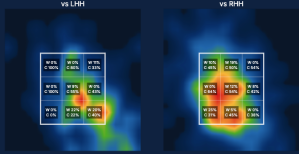
Most of his pitches to lefties are either middle-middle or low and away. Against righties, everything is primarily away, either in the middle of the zone or low and away.
Liberatore should embrace the Blake Snell Blueprint—and pitch up with his fastball(s) and play everything off of that. He tries to do this against righties, locating his fastball up and away consistently, but against lefties, it’s primarily in that low and away location (see the image below).
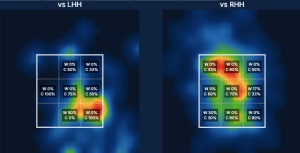
The primary change to lefties should be to get his four-seamer up in the zone, and move his sinker location against lefties from low and in, to middle-in (off the plate running into lefties’ hands ideally) and up-and-in. This change embraces the ride on his sinker, and could lead to more pop-ups and avoid the low-and-in pitch lefties crush. Liberatore has struggled against lefties this season (.451 wOBA, .707 SLG), and these two changes are a starting point for him. Right now, lefties can key in on one part of the plate. His four-seam and slider make up 77% of his pitches to lefties, and they end up in the same location. He doesn’t need to stop throwing fastballs here entirely, as it could help set up sliders further off the plate to get chase—but he needs to mix up his locations.
Against righties, I’d like to see him work his four-seam fastball low and inside. This sets up a backfoot slider that is probably his best putaway pitch against righties. If Liberatore’s throwing everything outside, though, hitters will be able to spit on sliders low and inside since the deception isn’t there.
The last change I’d like to see Liberatore make is to only use the curveball as a pitch to steal a strike. As mentioned earlier, it doesn’t have the velocity to generate whiffs. Despite this, he still uses it when he’s ahead in the count 18% of the time.

Understandably, he uses the fastball and slider the most in these situations, but it’s a waste to use a pitch that doesn’t have a lot of whiff potential as his third option. Burying the change-up would be a better option for me, and would work low and in (below the plate) to lefties and low and away to righties.
Final Thoughts
Liberatore’s stuff isn’t Blake Snells, but that blueprint could still apply. Is there a front-of-the-rotation pitcher in Matthew Liberatore? I don’t think so with his current arsenal, but there’s definitely a solid pitcher in there that can be unlocked with location changes and slight usage tweaks (specifically with the curveball).
Graphic made by Aaron Polcare
