Hello and welcome to Pitcher List’s latest series: Using PLA to Evaluate Pitchers! Every week, I will examine various pitchers and break them down using PLA. There will be various themes and topics each week, which will range from topics such as waiver wire picks, to buy or sell, to awards races, to lefties/righties only, etc. I hope to mix it up as much as possible to keep you all on your toes.
Now, you might be asking, what is PLA?
PLA is an ERA estimator that was created in tandem with Pitch Level Value, which we refer to as PLV. PLV is essentially an all-encompassing stat that measures individual pitches and rates them on a 0-10 scale. The elements that factor into PLV include velocity, movement, release point, location, count, and handedness of the batter. We have an excellent primer on this by the one and only Nick Pollack that you can find right here! PLA takes this 0-10 score and translates it to an estimated ERA, which makes it easier to understand and more useful for those looking for help with their fantasy teams.
It’s important to note that PLA isn’t necessarily a catch-all estimator, just as xERA, FIP, SIERA, and pCRA aren’t either. These stats ultimately still measure outcomes, which are largely dependent on how a player is executing that day. ERA estimators are not crystal balls; however, they can provide some insight if taken with a grain of salt. For the purpose of this series, we are going to use PLA as the main factor to evaluate pitchers (hence the series title), but again, no stat is perfect, especially in the complex world of pitching.
Also, stay tuned for other PLV evaluation article series, such as one that will look at individual pitches and another that will use Process+ to evaluate hitters!
Today I thought it would be fun to talk about guys making big turns in their careers this year. Whether that be arms returning from injury, arms that finally got the chance or pitchers who changed roles. Here are some guys who fit the bill who are fun to talk about.
Janson Junk – 2.68 PLA.
Last week I talked about control freaks, guys who had really low walk rates. Now unfortunately, that only included qualified starters, because otherwise, Janson Junk would be the cover boy for that article… Well he gets it this time so yay!
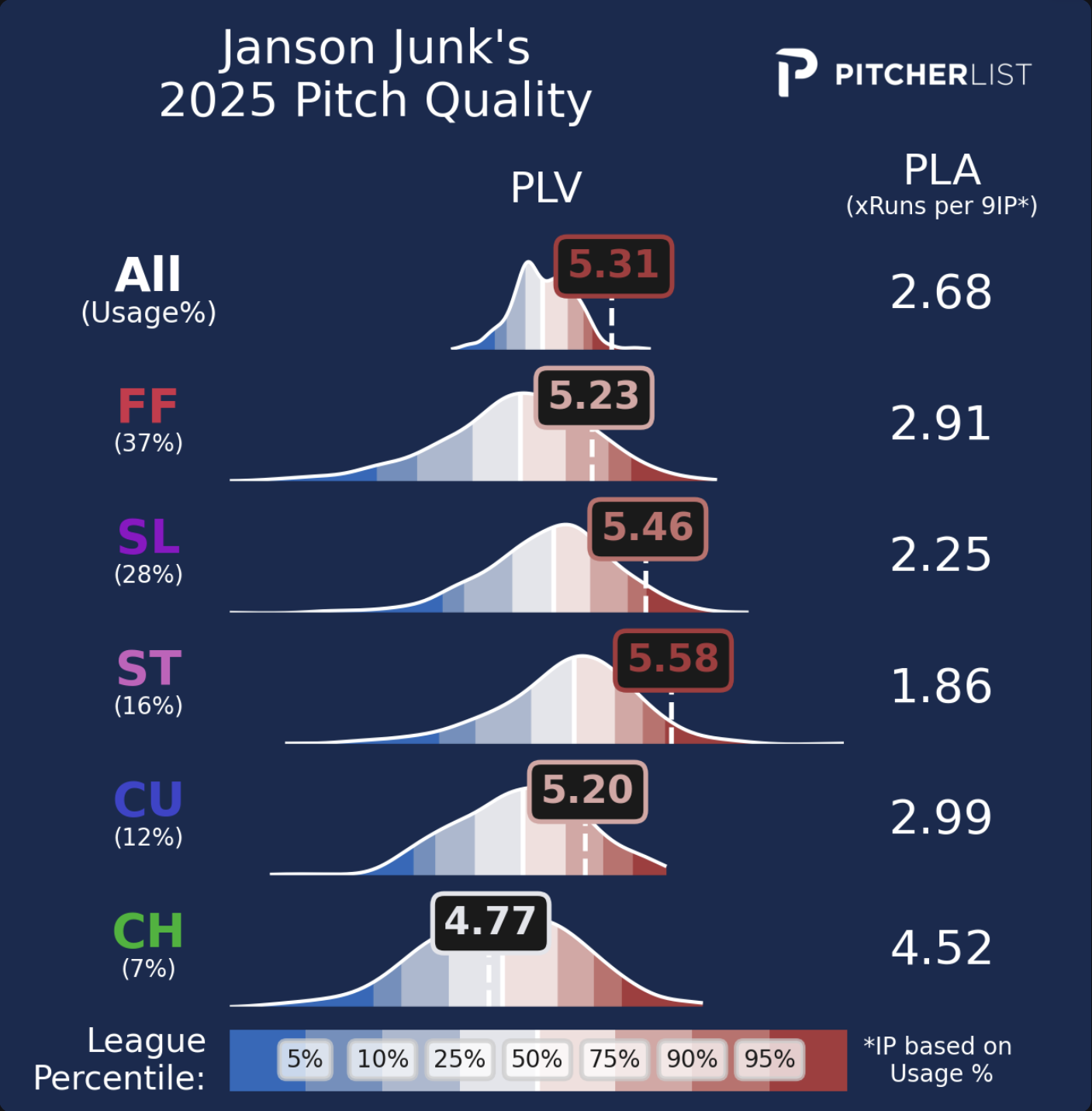
Junk as I mentioned before is a strike-thrower. It doesn’t always work out for pitchers like this, but Junk has found a bit of a groove. He throws a four-seamer as his primary pitch, and it’s been really working for him. It grades out well due to its vertical movement and consistent location in the strike zone. Again, it’s not a pitch that will blow you away, but it’s pretty cool to see that it grades out better than plenty of the four-seamers that you probably see getting praised left and right, with Paul Skenes as an example. And yes, we know Junk’s fastball isn’t that of Skenes, but it’s interesting to see how well the model grades a heater from Junk.
Per PLA, it’s Junk’s pitches in the slider family that are really worth writing home about. His slider is his second-most-used pitch, seeing action against righties and lefties. While it hasn’t gotten the swings and misses of other sliders, the velocity, movement, and location of the pitch all signal that this could change. It’s a good slider. Miraculously, the sweeper is just a touch better per PLV, though you might not see this when looking at whiff and called strike rates. The secret to his success here is that he locates the pitch outside a lot, which works well when facing righties.
Junk rounds out his arsenal with a pretty high velocity curveball, all things considered, which grades out well due to Junk’s ability to locate the pitch down. He also has a changeup that he rarely throws, as it grades out poorly and doesn’t play off the fastball particularly well.
Janson Junk is a bit of a surprise breakout this year, as he has ridden his excellent control and command to decent success. PLA shows that perhaps, even more success is on the way.
Spencer Strider – 4.80 PLA
Ouch! Things have not gone well for Spencer Strider following the elbow procedure that sidelined him for last season.
Strider came onto the scene in 2022 and immediately looked like the future best pitcher in the world. The next season, he mostly delivered. While the ERA was a bit too high, it seemed like it was going to come down the next year. That next year didn’t happen due to the injury. Now he’s come back, and as you can see, things have been pretty rough.
A lot of his stats are a bit inflated due to a recent disaster start against his nemesis organization in the Mets, but he’s still struggled in a lot of ways.
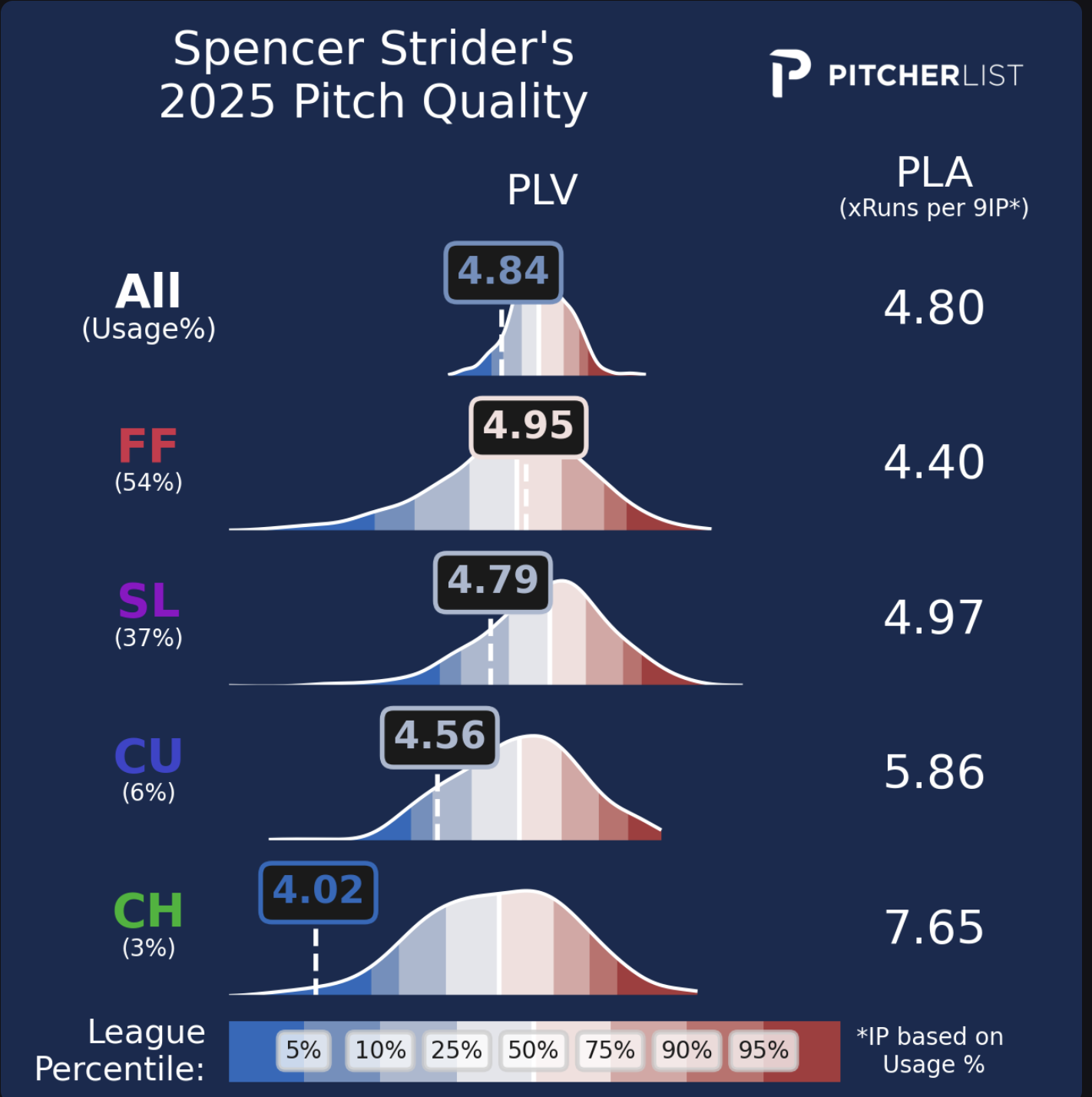
Strider is, of course, known as a fastball/slider guy. The bread and butter of the game’s elite pitchers. The problem for Strider is that he doesn’t have those working. In 2023, Strider’s four-seamer was a 100th percentile pitch per PLV. In 2025, it’s now dead-average, sitting in the 50th percentile. This drop can be seen in his stuff metrics, with the average velocity dropping 2 mph and his vertical movement going from great to just around average. As for the slider, PLV hasn’t always been the highest on the pitch, but its grade in 2025 is the lowest in his years as a starter.
We’ve seen Strider incorporate a curveball and changeup into his arsenal, with those being viewed as the key pieces to him improving on the areas he struggled with. Unfortunately for Strider, there just isn’t much to like about these pitches. They have abysmal strike rates and PLV grades them out well below average.
Spencer Strider was arguably the best pitcher in baseball a couple of years ago, but following Tommy John surgery, he’s looked like a bit of a shell of what he once was. Here’s to hoping he turns it around.
It’s been a while since we checked on Shane Baz… So how is he doing? Unfortunately, not great.
Yeah, it’s been a rough one for Baz. He was the top pitching prospect in all of baseball when he debuted in 2021 and looked the part in his first few starts. Unfortunately, after going down with an injury in 2022, he’s struggled to find his feel for his pitches, which has resulted in him shelving the slider that many thought would be the pitch that would cement him as an upper-echelon ace.
Baz still has some of the magic in his four-seamer. It sits at a higher velocity than in his 2022 season, though he did lose about an inch of vertical movement, which can be partially attributed to games not being at Tropicana Field, which has conditions that allow for pitches to get better intended movement. The curve is Baz’s main secondary, and it’s been good, though it feels like with its high velocity and spinrate, it could be even more successful, though a large part of that comes down to location, which he’s struggled with.
Baz added a cutter a few starts into the season, and it’s been pretty good. It’s a bit of an evolution on his slider, but with more velocity and less movement. He’s been throwing it at the top of the zone a lot, confounding batters. It’s still a work in progress, but it has been promising to see Baz incorporate it with the four-seamer and curveball.
Baz also has a changeup he occasionally uses to varying degrees of success. It’s not amazing but for a fourth pitch, it’s certainly not a bad option to help confuse batters even more.
It hasn’t been easy for Shane Baz, but per PLA, he probably should be getting better results than he has been.

Eury Perez – 4.17 PLA
It’s our third pitcher in a row who, at one point, looked like the future of the position, but has struggled a bit after coming off an elbow procedure.
I will say that Perez has seen a bit more success than the others, with basic stats that are respectable. However, per PLA, his real-life ERA could come down a bit.
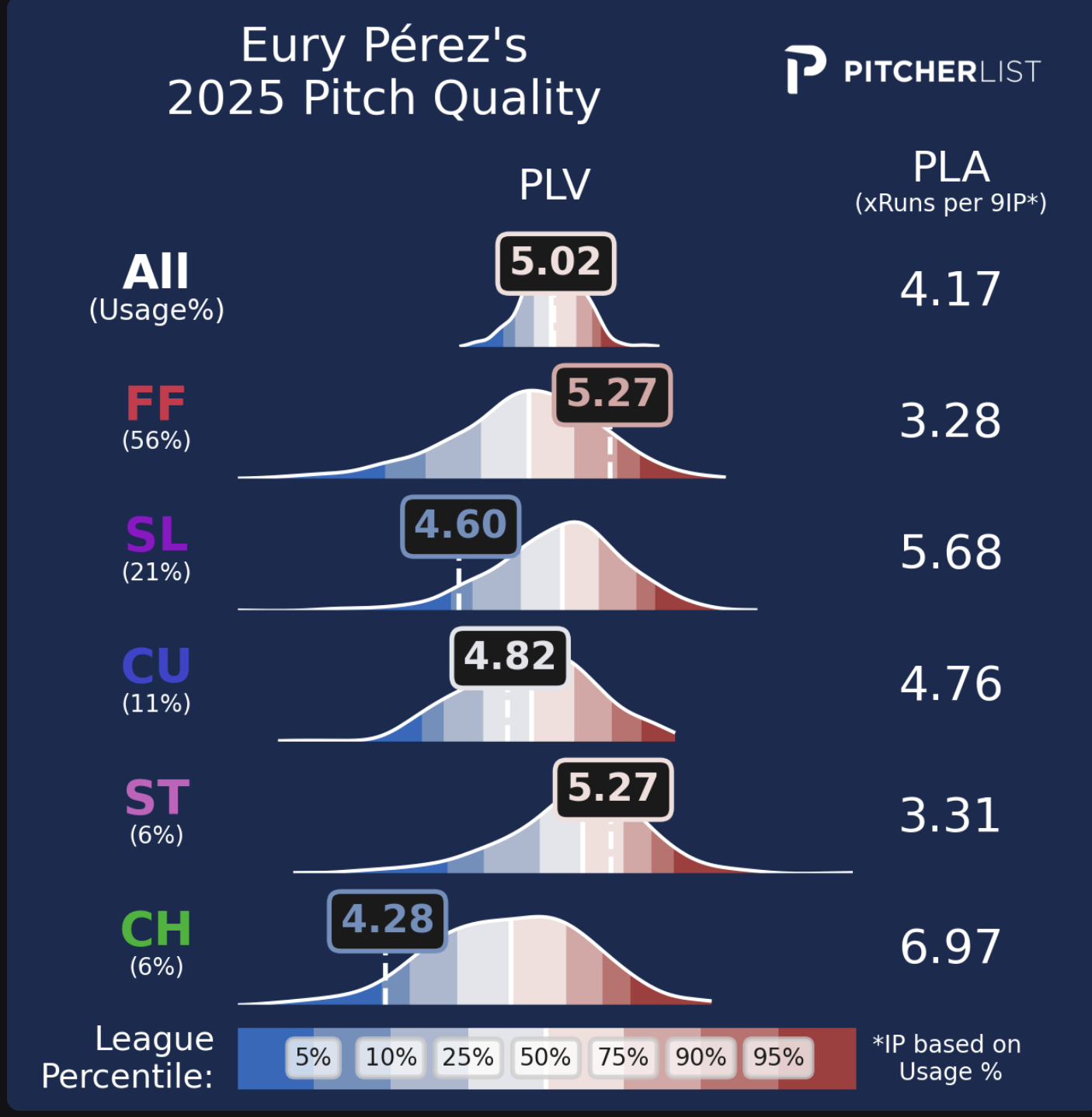
Let’s start with his fastball. It’s elite. He throws it at about 87mph with great vertical movement and at a flat attack angle. The reason PLV isn’t *crazy* about the pitch (it still grades it highly) is because his location is a bit all over the place, with a bit too many middle-middle pitches thrown. Still though, it’s a ridiculously fast four-seamer with a great shape, which lays a great foundation moving forward.
Similar to some of the other young pitchers in the game, Perez struggles a bit with the secondaries. His slider gets some whiffs, but isn’t consistent with location, which docks plenty of points per PLV. His curveball is similar, as it doesn’t grade out very well due to location. Rounding out the arsenal are the classic Miami Marlins high-velocity changeup and a sweeper that honestly, has the potential to be one of his best pitches.
Like many of his contemporaries, Perez has a very high-quality fastball that is the driver of any success he will see. If he wants to take that next step though, he has to polish his secondaries.
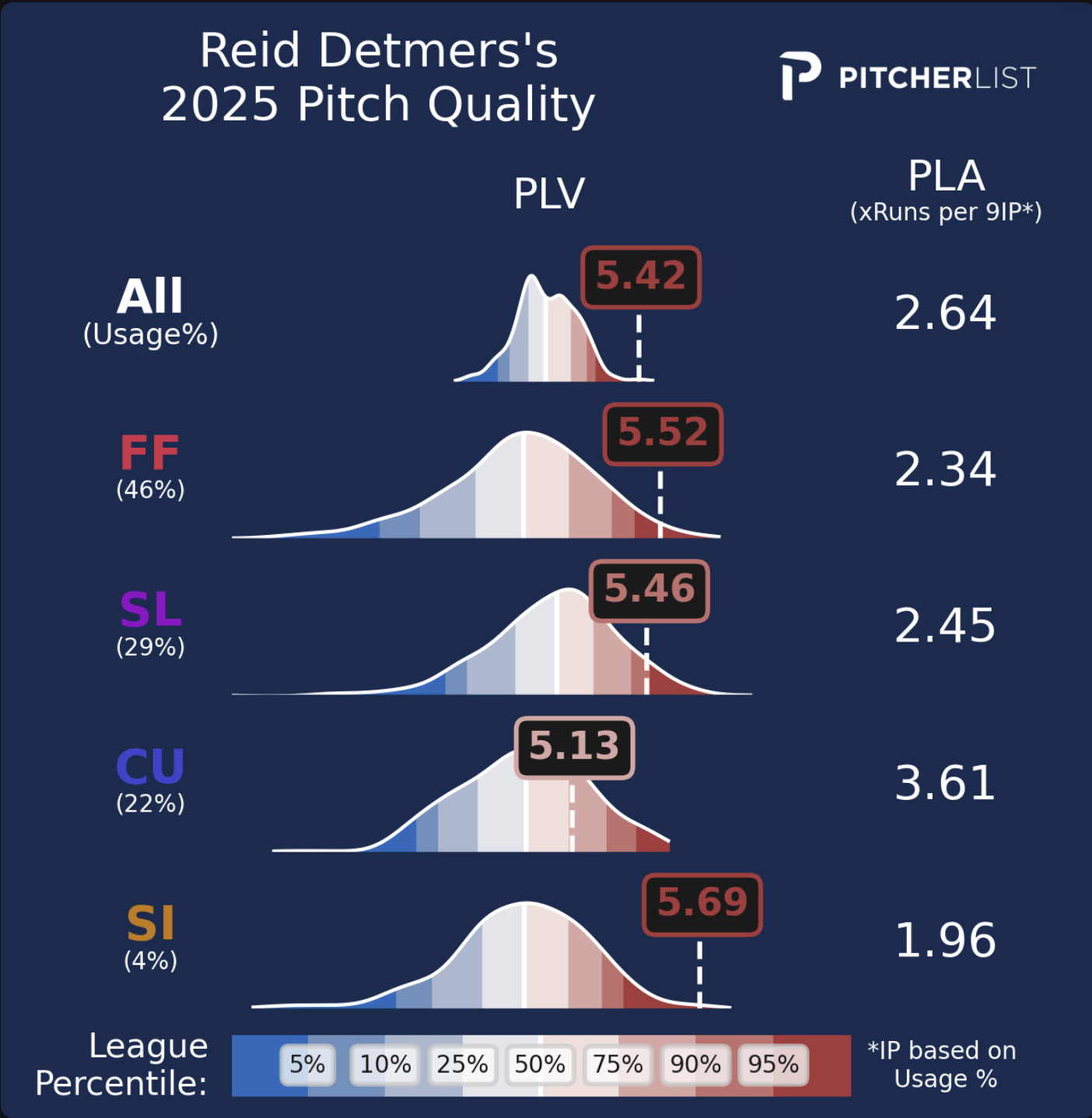
Reid Detmers – 2.64 PLA
Now for a couple of fun reliever picks. Our first is Reid Detmers, who has been moved from the role of starter where he struggled to find consistency, into the position as the main set-up guy for the Angels. Ignore the ERA being meh for a second, because Detmers has been really, really good in this role.
Detmers, who famously had a no-hitter against the Rays in 2022, has really thrived as a bullpen arm. His PLV grades on his pitches have went up significantly, largely because we’ve seen a velocity boost with many of them. His four-seamer already had great vertical movement, but adding two extra miles per hour of velocity has been a game-changer. Same can be seen on his slider, which has seen more drop in addition to more velocity, which he has gotten from being in the relief role. Interestingly, his big, loopy curveball for strikes has lost some velocity, but PLV grades it in line with the marks of years prior. To round things out, Detmers sometimes throws a sinker, which PLV grades really highly.
Detmers is an example of a guy who got put in a new role and thrived. He’s gone from a AAAA starter to the Angels’ future closer. What an awesome arc, let’s see if he can continue to get better.
Louis Varland – 2.74 PLA
Twins fans… Look away!
The Louis Varland trade came as a shock to many, as he was the team’s future closer and they had several years of control. Instead, they decided to trade their local product North of the border where he is now the Jays’ likely future closer.
You may remember Varland as a member of the Twins’ rotation. He had potential there, but really struggled to put it together. He moved to the bullpen and immediately he has shown signs of being an elite reliever.
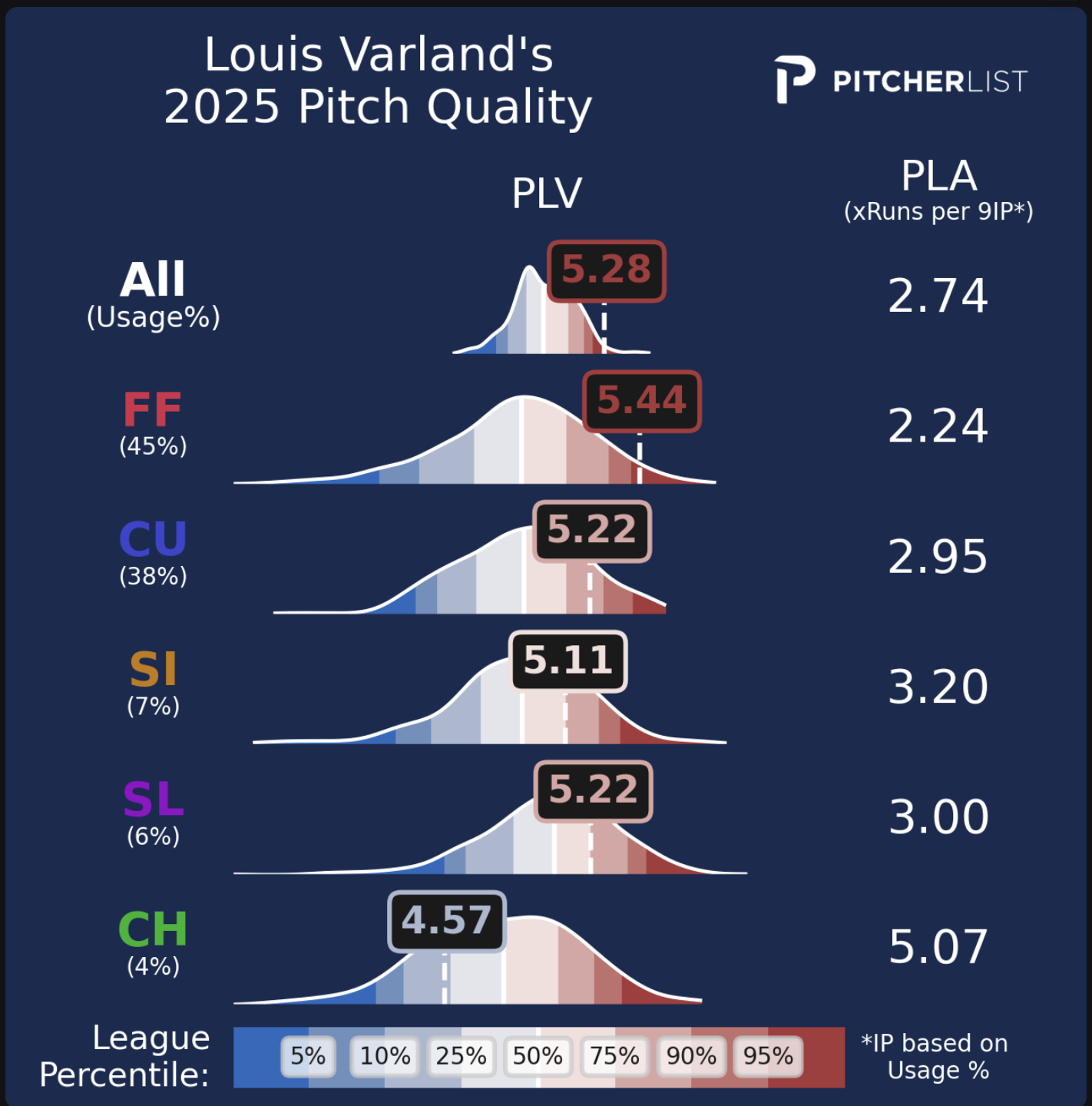
Varland always had a lot of potential with his fastball. It was a high-velocity pitch with 7 feet of extension. He’s added velocity in the relief role, which has made the pitch explode results-wise. He pairs the heater with a demon curveball, which is one of the fastest in the Majors. It was already fast when he was in the starting role, but now he’s fully unleashed it, which makes it pretty close to untouchable.
Varland rounds out his arsenal with a sinker, slider, and changeup, all three of which have elite velocity compared to their contemporaries.
Louis Varland was a major acquisition for the Blue Jays, and PLA shows that he should deliver on all that was promised.