





Hello and welcome back to using PLA to evaluate pitchers! This series uses PLA, along with other run expectancy metrics, to break down results and better understand the process behind them.
This week, I will be taking a look at a few starting pitchers en route to a top two finish in their respective league’s Cy Young award race. For some more details on PLA and what goes into PLV scores, be sure to check out Nick Pollack and Kyle Bland’s breakdown here.
Cam Schlittler
In his sophomore season, Cam Schlittler has broken out as one of the league’s premier young starters, boasting a sub-2 ERA and 228 strikeouts with two more starts to go. The budding ace has improved upon an already-impressive 2025 debut and appears primed to take home his first Cy Young award at season’s end.
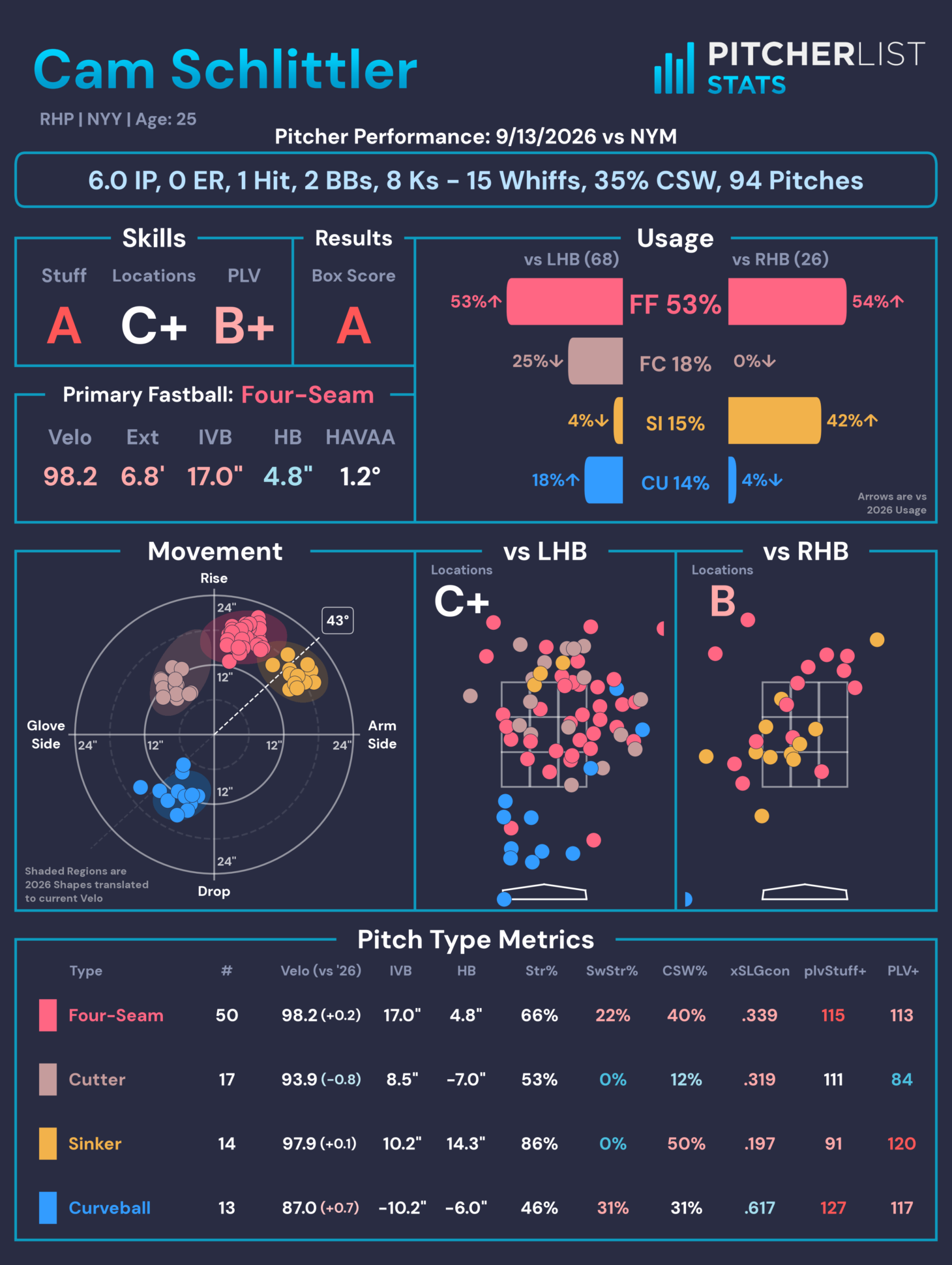
In his most recent start, Schilttler pounded the zone with three entirely unique fastball shapes to generate eight strikeouts to just one hit in 6.0 IP. His curveball, a breakout pitch in the second half, got chases below the zone and functions as a great secondary pitch, thanks to its high velocity and ~47 inches of drop, roughly three feet more than his four-seam.
This has been Schlittler’s arsenal most of the season, bypassing his command concerns by simply throwing strikes with three plus fastballs and developing a strong breaking pitch to boot. The result has been a ridiculous 25.5% K-BB rate and above-average 2.97 PLA.
Schlittler’s tendency to throw his curveball below the zone and two-seam elevated hurt his overall PLA scores but work with his high-octane pitch mix. With these traits intact, he is well positioned to finish the season strong and continue blossoming as one of the league’s premier young starters.
Dylan Cease
Dylan Cease has thrived in his first season over the border, quickly becoming Toronto’s ace and bouncing back from a disappointing 2025 season. While he missed some time at the end of Spring with a brief 15-day IL stint, Cease has made 28 starts with respectable volume and excellent results.
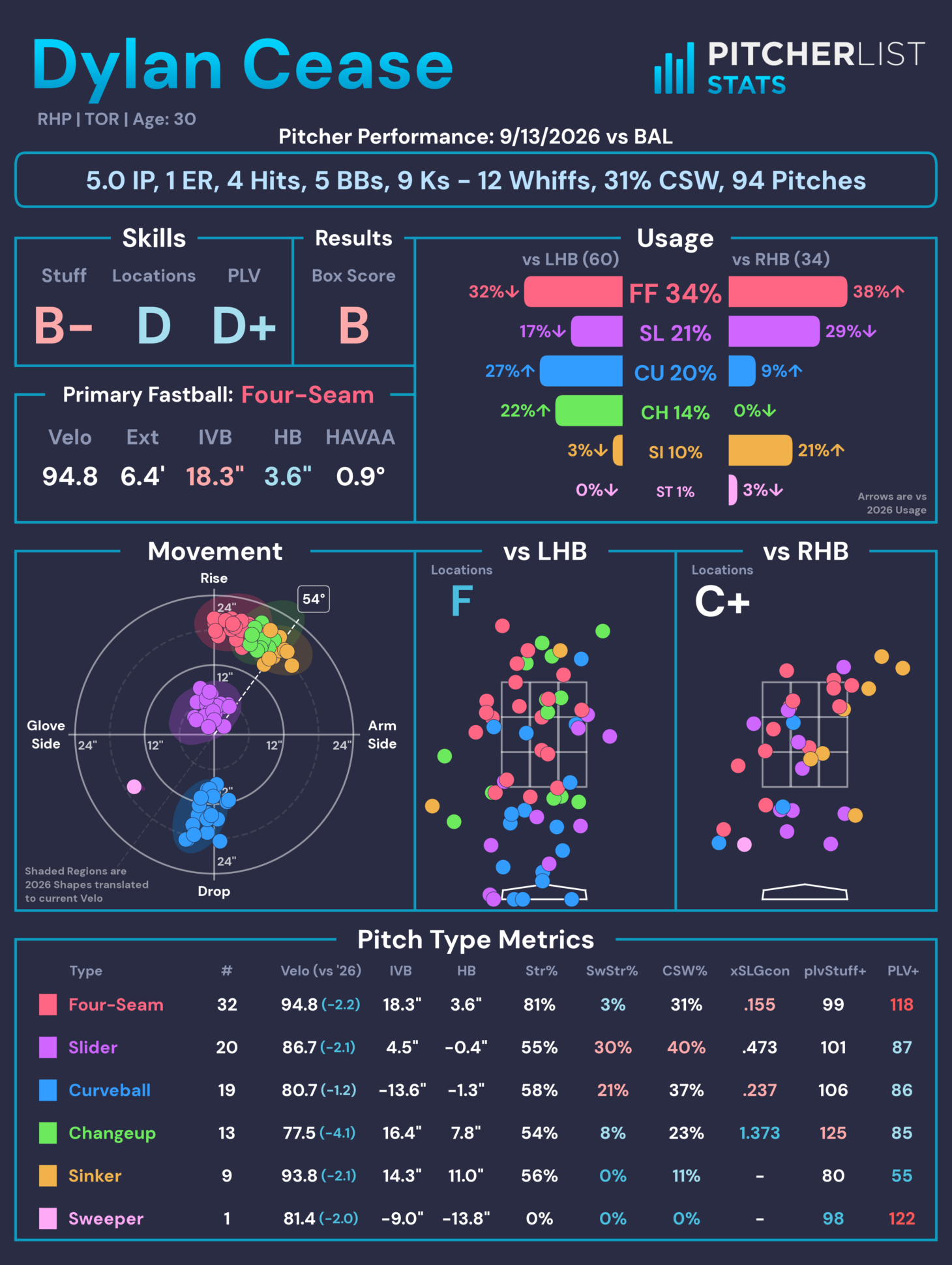
In his most recent outing, Cease struggled with command, but still managed nine strikeouts in 5.0 IP and only one earned run allowed. Despite five walks and significantly diminished velocity, Cease’s four-seam/slider/curveball ladder got enough strikes to earn Cease the W and continue his streak of >=5.0 IP outings since May 24th against Pittsburgh.
Historically struggling against lefties, Cease developed an effective changeup this season, sharing a devastatingly similar shape to his four-seam with a ~20 mph velocity gap. Lefties are now hitting just .161 against Cease this season, with his changeup (4 RV, 48.8% whiff rate, .169 SLG) a big reason why.
Still, Cease’s bullet slider has remained his most effective weapon. Its 25 Run Value is easily the league’s best for a non-fastball, contributing to a ridiculous 35.3% strikeout rate and elite 85.6 mph average exit velocity overall.
Cease’s only concern has remained controlling his nasty north/south arsenal, and a 10.8% walk rate on the season is possibly his only negative attribute. While the command has looked shakier in his last few outings, Cease remains a bonafide ace and will look to continue making his 7-year, $210 million contract look like a bargain for the Blue Jays in 2027.
Jacob Misiorowski
In a slightly more competitive NL Cy Young race, Jacob Misiorowski appears to be the frontrunner as one of the most talented young pitchers the sport of baseball has seen. Having made 27 starts in 2026, Misiorowski’s average fastball velocity of 100.6 mph and extension of roughly seven and a half feet are an entirely unique combination for a starting pitcher, contributing to his league-leading 38.3% strikeout rate and pristine 2.39 PLA.
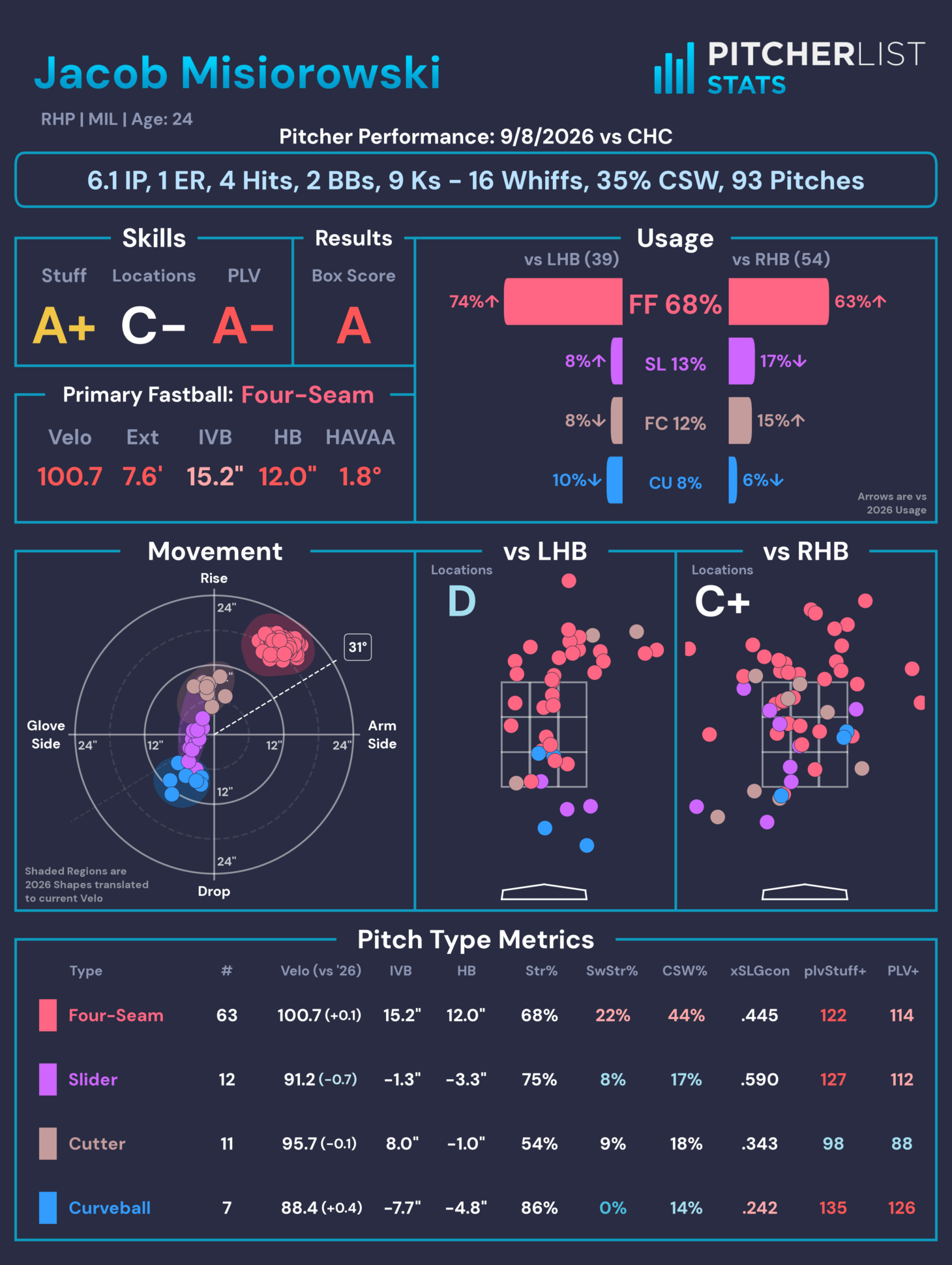
While his volume has been limited in the second-half, Misiorowski’s last start saw his four seam continue to dominate hitters at the top of the zone. Also, his ability to throw secondaries for strikes has further developed this season, elevating a poor 11.0% walk rate in 2025 to a far more sustainable 6.7% in 2026. A trio of secondaries, featuring elite traits in their own right, gives him the arsenal of a fairly traditional starter, although his four-seam remains his best offering and anything but traditional.
Misiorowski’s 2.39 PLA is one of the league’s best, reflecting his elite whiffability (19.0% swinging strike rate) and much improved strike throwing. While his volume remains lesser than that of other Cy Young candidates, Misiorowski’s 1-of-1 skillset and elite results make him possibly the league’s best starter when on the mound.
Cristopher Sánchez
Cristopher Sánchez has also had an impressive 2026 season, leading an elite Phillies rotation in innings and ERA. While trailing Misiorowski in ERA, Sánchez’s 25 more IP present an interesting conundrum for Cy Young award voters.
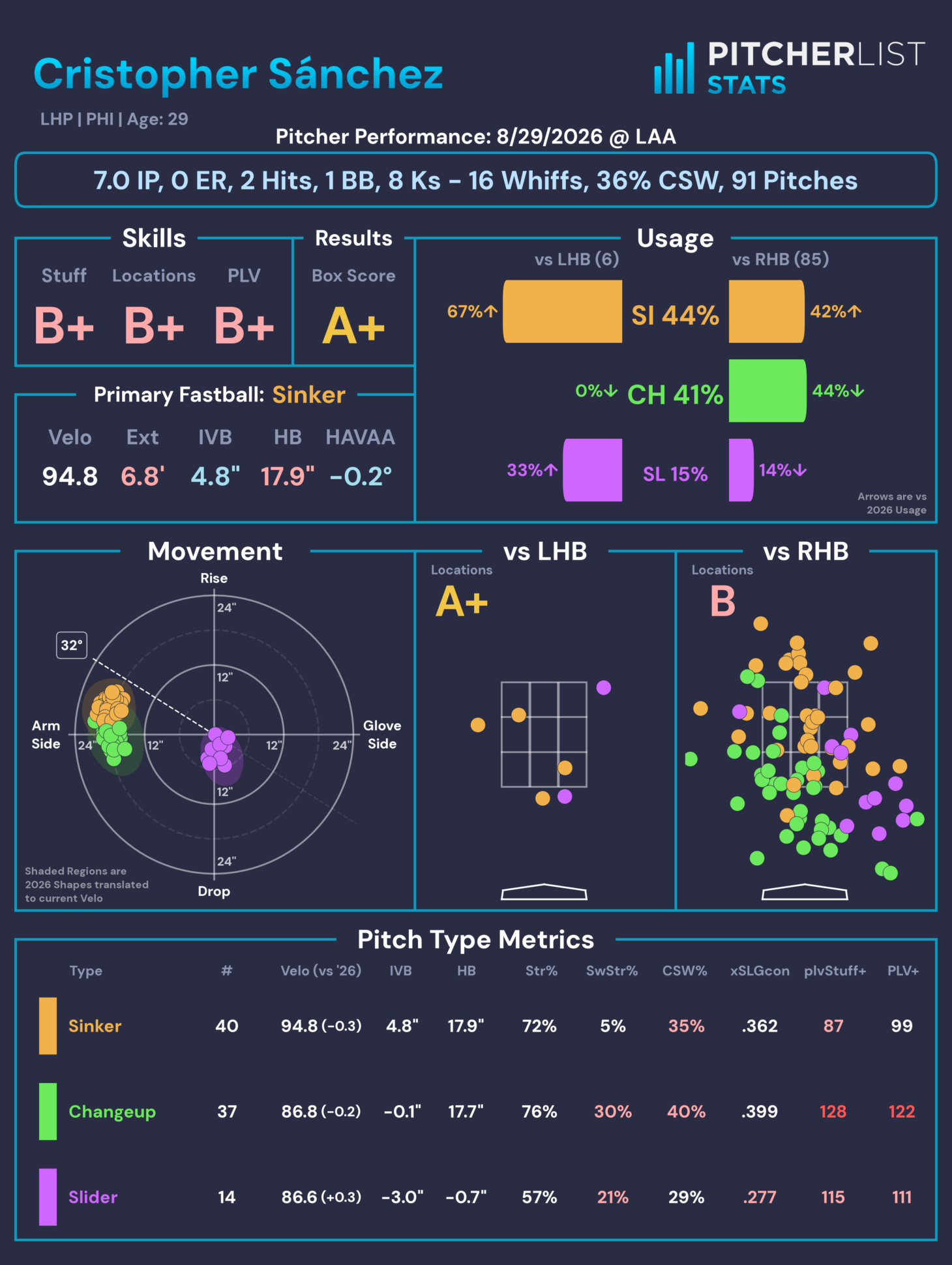
In one of his more recent starts, Sánchez dominated a meager Angels offense for seven innings. Facing almost entirely right-handed batters, his sinker/changeup pairing did the bulk of the heavy lifting, while his much improved bullet slider had strong results as well. Operating with just a three-pitch mix, Sánchez’s elite command and ability to induce ground balls has given him plenty of volume.
While his last couple outings have a bit shakier, Sánchez has gone at least six innings in each of his last six starts. Damage seems to build when Sánchez misses over the heart of the zone, with better lineups punishing his typical ground-ball dominant mix for extra bases. Still, limiting waste pitches and remaining in-zone has allowed Sánchez to accumulate innings despite the occasional loud contact.
Sánchez’s unique method of dominance relies on his command remaining sharp and velocity staying above-average. Even with a shallower arsenal than the typical starter, his comfortability with all three pitches has become a strength capable of toppling elite lineups when on. Look for Sánchez to finish the season strong and match Jesús Luzardo and Zack Wheeler in possibly the league’s strongest playoff rotation.
