





Hello and welcome back to using PLA to evaluate pitchers! This series uses PLA, along with other run expectancy metrics, to break down results and better understand the process behind them.
This week, I will be taking a look at a few starters working their way through the 2026 season. For some more details on PLA and what goes into PLV scores, be sure to check out Nick Pollack and Kyle Bland’s breakdown here.
Freddy Peralta has had a tumultuous beginning to his Mets career, pitching to his worst ERA/FIP since 2019 in his age-23 season. Now 30, the 2025 All-Star has yet to see his swing-and-miss stuff translate to consistent results in Queens.
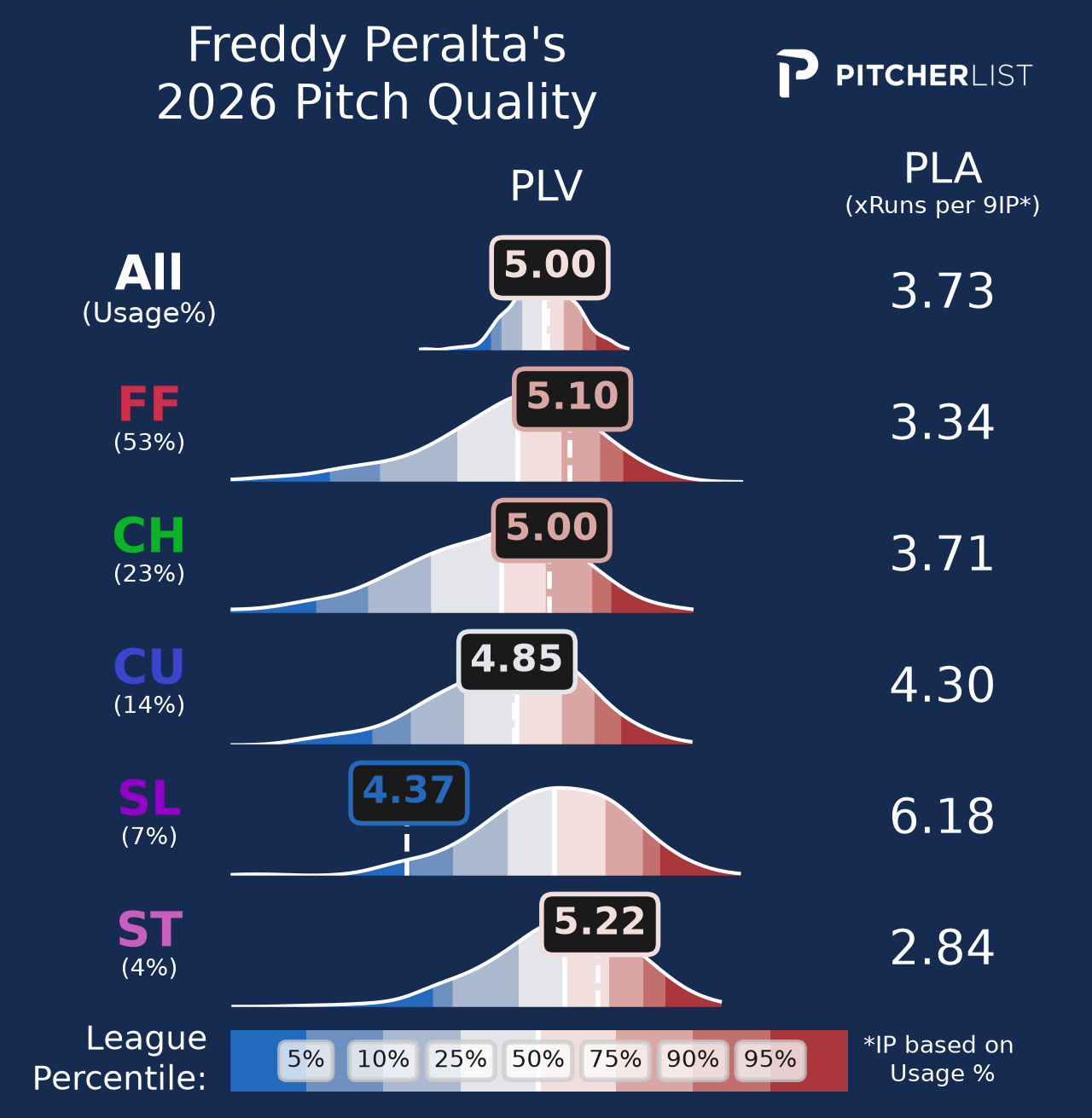
Peralta’s stuff has generally taken a step back in 2026 as well, regressing from a 2.89 PLA in 2025 to 3.50 in 2026 thanks to some undesirable changes to his arsenal (compared to 2025):
- FF – identical 5.10 PLV, +2.7 iHB (arm-side break), -0.8 mph (94.0 average in 2026) – his best pitch, similarly decent to 2025
- CH – 5.00 PLV up from 4.85 in 2025, +1.4 iHB and -1.2 iVB (more movement), -1.6 mph – arguably his best pitch in 2025 thanks to elite separation from four-seam at similar velocity, gone from 9 Run Value to -4 in 2026 – execution?
- CU/SL/ST – PLV down across the board, hit harder and thrown in far worse locations – 8 Breaking Run Value in 2025 down to -4 in 2026
These steps back have culminated in a disappointing year for Peralta thus far, as the revamped Mets pitching lab has struggled to produce effective results. Pitchers like David Peterson, now traded to the Cubs, Kodai Senga, and Nolan McLean (who will be looked at later in this article!) are additional examples of starters with past success who have hit roadblocks this season with the Mets.
For Peralta, he still remains a talented starter, despite the underwhelming results. His downtick in strikeouts has fortunately been met with fewer walks, albeit with some more loud contact to boot. Look for Peralta to refine his breaking ball command and rediscover his plus changeup down the stretch in 2026.
Michael King has continued to be effective in 2026, pitching to a 3.55 ERA through his first 17 starts as the Padres’ best starter, alongside…Walker Buehler? Regardless, the Padres’ beleaguered rotation has benefitted greatly from King’s consistency, thanks to a strong arsenal and elite command.
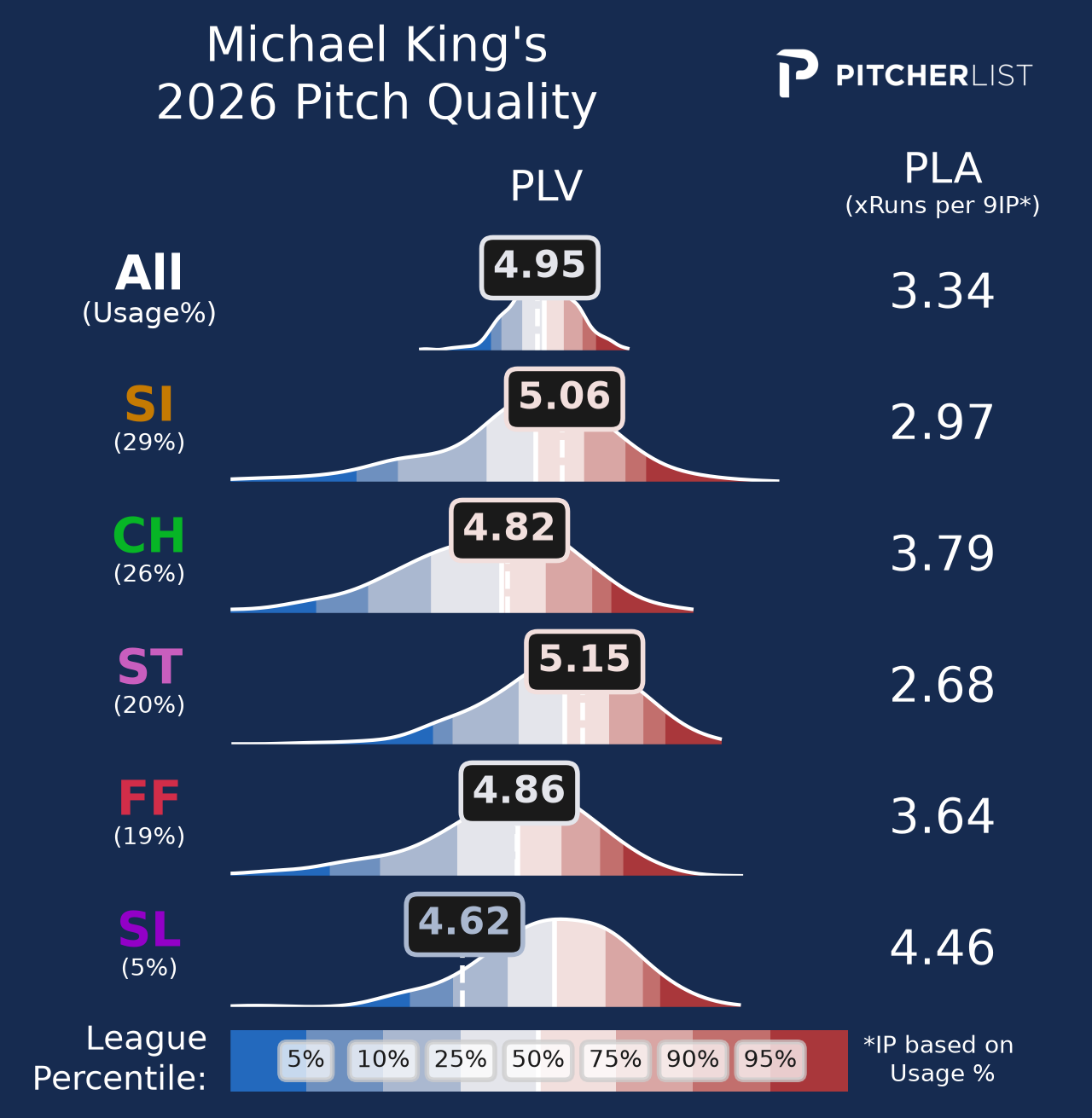
King has had a fairly consistent arsenal since converting back to a starter at the end of 2023 and joining the Padres in 2024. While some peripherals have taken a step back in his age-31 season, King’s plus results have come down to a unique combination of generating weak contact and ground balls. His bowling ball sinker and funky changeup form the heart of his arsenal, sharing almost identical movement with a ~7 mph difference; this creates a method for generating called strikes with his sinker (24.7% in 2026) and whiffs on his changeup (29.1%), which he combines with a decent four-seam/slider/sweeper for a plus arsenal.
Still, King’s ERA estimators like xFIP (4.36) and SIERA (4.42) project below-average results. His east-west approach has become susceptible to walks in the past (9.8% walk rate in 2026, career high), and a career-low 20.9% strikeout rate is not exactly a desirable trend. His highest PLA since 2021 is also a slight concern, likely due to his declining velocity hurting his sinker results and breaking ball shapes. This does present some concern for King taking a step back from his consistently well-above-average results, although he still appears in good shape for now.
King has had a tough schedule so far in 2026, facing the Dodgers twice, the Braves, and the Brewers, as the National League is having one of its strongest seasons ever. Because of this, I’d say King’s ERA estimators are a little more pessimistic than they probably should be. King’s health and effectiveness are crucial to the Padres keeping pace in the NL West; look for King to keep up the consistency in the second half.
After breaking onto the Major League level with a 2.06 ERA over eight starts in 2025, Nolan McLean has taken a step back in 2026, generating wildly inconsistent results despite elite stuff and strong peripherals.
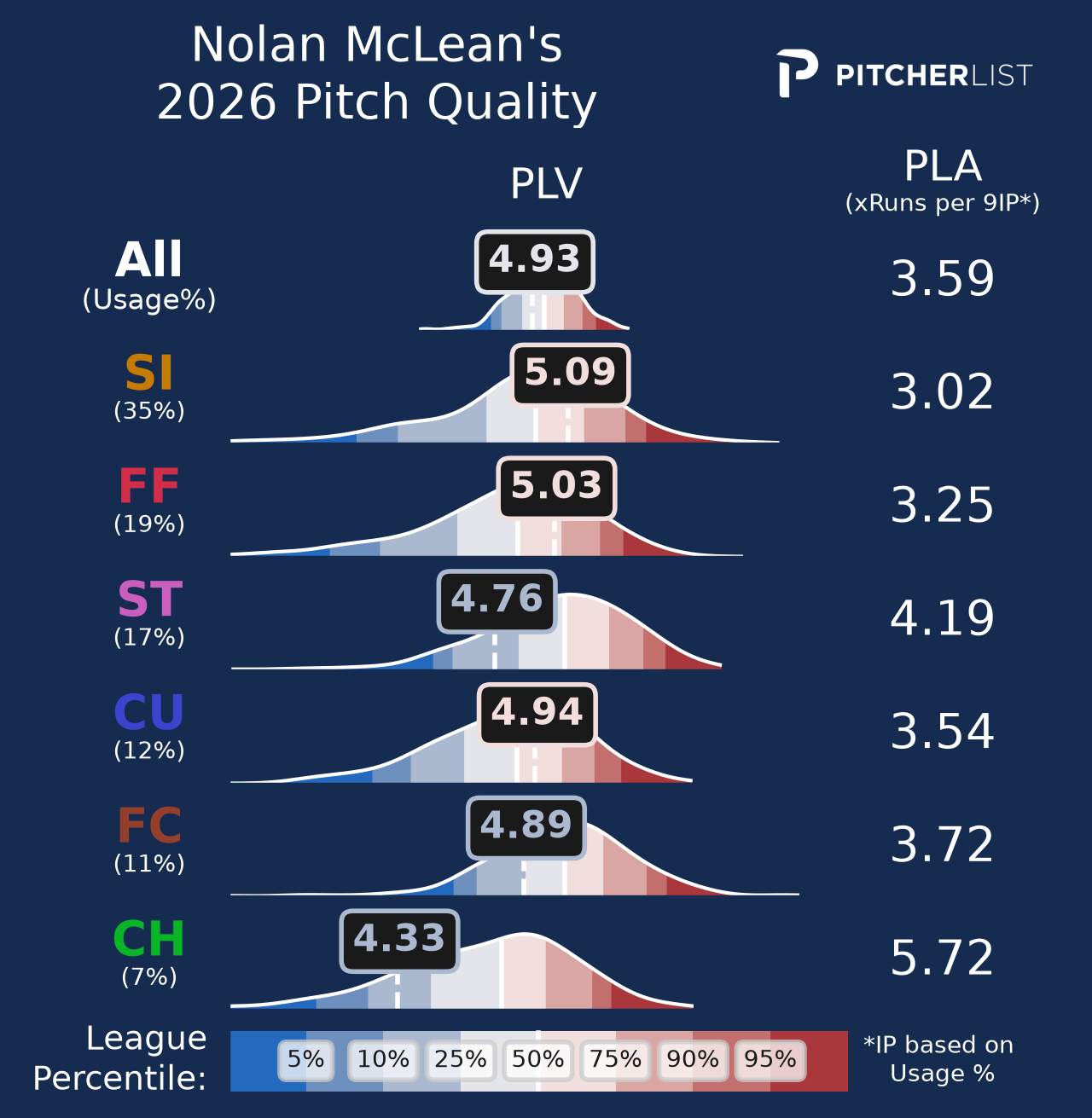
McLean’s notoriously nasty stuff is not generally liked by PLV in 2026, generally due to bizarre usage trends and loud contact when forced to be thrown in-zone. Like Peralta, it’s worth going through his pitches individually and doing a few comparisons to 2025 to find what has and hasn’t worked in McLean’s short Major League career.
- SI/FF – good offerings, strong results that have definitely gotten a little lucky (sinker especially) – decent shapes that do better when his secondaries do better
- FC – why is he throwing this as much as his CU? Decent enough shape but thrown high too often, .483 BAA/.897 SLG, should bridge to his sweeper for glove-side chases/set up low chases on his CU
- ST/CU – two elite shapes, sweeper thrown for called strikes (and never chased) and curveball exclusively for chases/two strikes – mix it up a bit? Please throw more curveballs
- CH – disliked by PLV (4.33) due to 15.4% mistake rate and only 4.8% called strike rate – seems difficult to command with outlier movement (-3.1 iVB at 32° arm slot) and plus velocity (88.1 mph), big separation from fastballs, good pitch when executed!
With such a vast arsenal, it’s expected for McLean to need time to adjust to the Majors and figure out what works. Still, after such a promising debut in 2025 and a strong start to 2026, the recent swoon has been difficult to watch. A May 19th disaster against the Nationals was the start, and although McLean has had some solid starts since then, a June 24th start against the Cubs was another step in the wrong direction.
McLean’s ERA estimators like xFIP (3.40) and SIERA (3.45) certainly recognize the potential in McLean’s elite strikeout and ground ball rate, and a second-half rebound is certainly possible. While McLean has yet to pitch in a full Major League season, he’s totaled at least 25 starts between the minors and majors in each of the last three seasons. Look for McLean to get back on track and hopefully lead the Mets’ rotation to a stronger second half as well.
