





Hello and welcome back to using PLA to evaluate pitchers! This series uses PLA, along with other run expectancy metrics, to break down results and better understand the process behind them.
This week, I will be taking a look at a few starters working their way through the 2026 season. For some more details on PLA and what goes into PLV scores, be sure to check out Nick Pollack and Kyle Bland’s breakdown here.
Michael Soroka
Michael Soroka has impressed through his first 11 starts, tossing 61.0 innings with a career-best 18.0 K-BB% and 2.85 FIP. Soroka signed a one-year deal with the Diamondbacks this past offseason with a mutual option for 2027, and has looked like a bargain thus far as their most valuable starter.
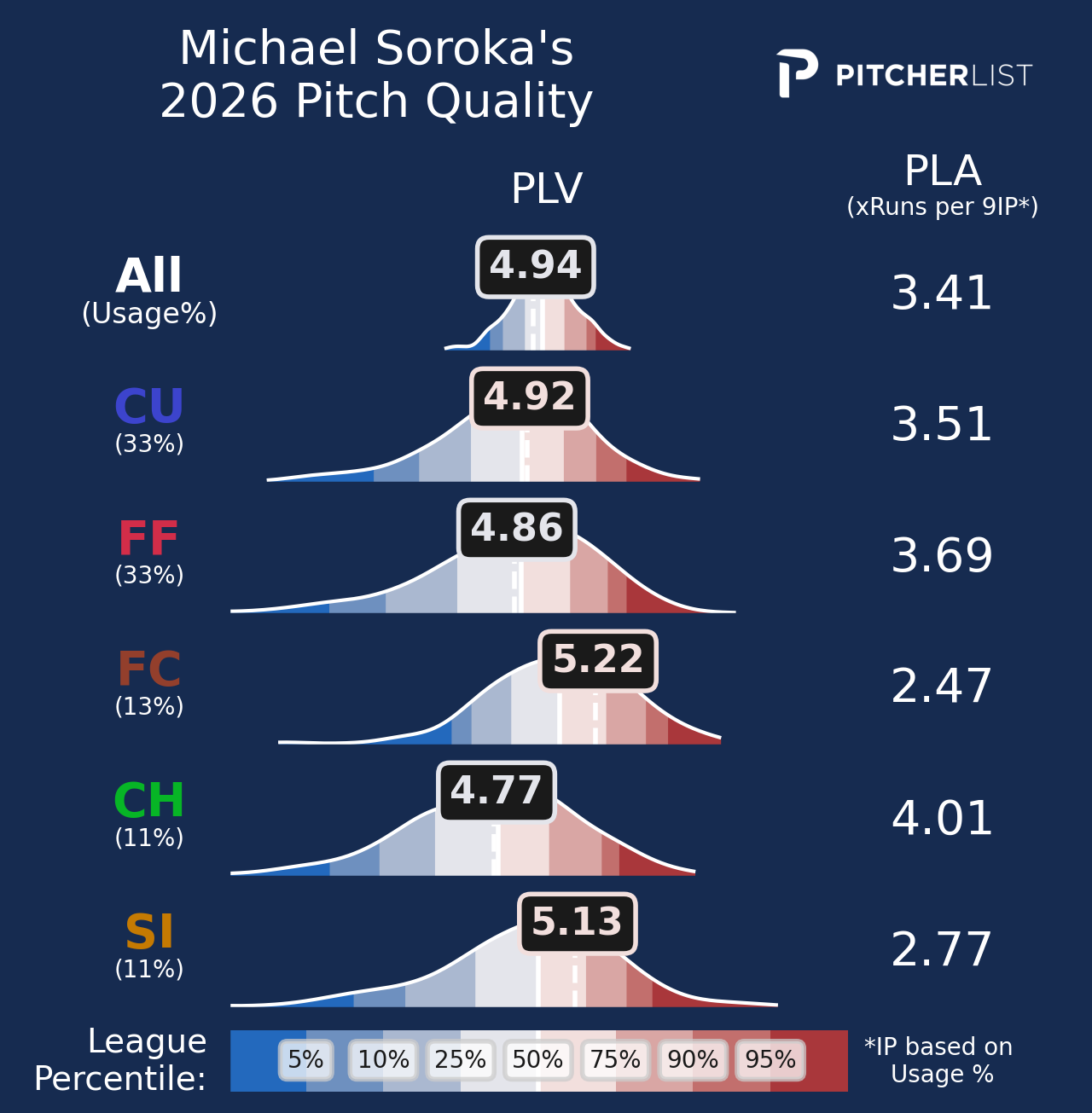
Soroka has especially dominated righties in 2026, using his unique slurve nearly 40% of the time and a strong cutter/four-seam/sinker trio otherwise. Soroka introduces a changeup against lefties and instead leads with his four-seam, which grades out about average and gets hit hard.
Most of Soroka’s success has derived from his slurve/sinker pairing, especially against righties; both pitches have a .251 and .194 wOBA against, respectively, and generate whiffs and ground balls. Strong command of his arsenal overall has also given him ways of managing lefties, and a career-best 5.5% walk rate has helped limit damage overall.
This culminates in a 3.41 PLA overall; fairly average, as Soroka’s entire arsenal grades out around average for their respective pitch types. His above-average ERA and FIP are likely to come down a bit as his 6.6% home run to fly ball rate regresses closer to career norms, but a.318 BABIP is also slightly higher than normal. This, as well as a far-improved walk rate, leaves some room for Soroka to hopefully see fewer baserunners as home runs likely come back. Look for Soroka to retain his sharp command and impressive comeback season in the rotation down the stretch in 2026.
Shota Imanaga
After an electrifying debut season in 2024, Shota Imanaga has taken a step back in his last two seasons, pitching to a below-average 4.37 ERA/4.41 FIP through his first 12 starts in 2026. Still, he’s averaged nearly 6 IP/start, induced more whiffs than ever, and underperformed most ERA estimators, including a big discrepancy from a strong 2.94 PLA.
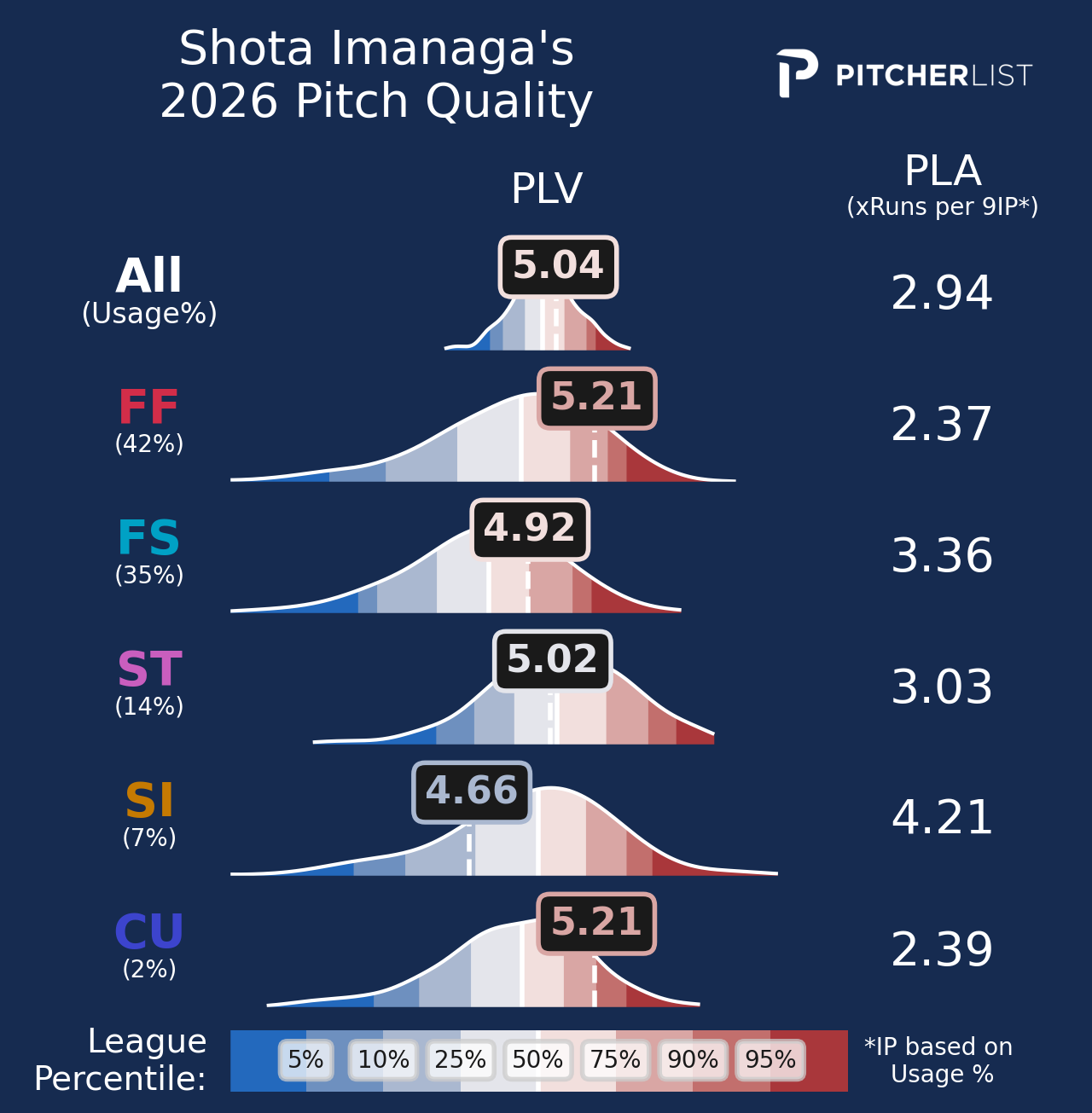
Imanaga’s arsenal has revolved around his splitter, and it has remained one of the league’s most valuable offspeed pitches in 2026. This has given Imanaga reverse splits, going four-seam/splitter ~85% of the time against righties and generating a .298 wOBA against. Imanaga goes four-seam/sweeper 75% of the time against lefties, mixing in a sinker and the split otherwise, and has allowed a .327 wOBA against.
In 2025, Imanaga lost some velocity across the board due to a lower-half injury, and his arsenal paid the price; his extreme fly ball approach allowed far more hard contact and generated fewer whiffs. After getting his velocity back up so far in 2026, Imanaga has generated more strikeouts than ever, while his elite ~4% walk rate from 2024-25 has risen to 6.3% in 2026. More of these baserunners have been scoring as well, with a 71.9% strand rate falling below the 80-82% of his last couple of seasons.
This, along with a career-high 14.8% home run to fly ball rate, has inflated Imanaga’s ERA, despite a strong PLA (2.94) and other ERA estimators like xFIP (3.77) and SIERA (3.59). While it would be difficult to replicate his remarkable 2024 debut season, Imanaga has shown himself capable of dominating any given night, despite a few rough outings recently. Imanaga will look to bounce back in his next start, currently projected to be at home against the Athletics.
Dustin May
Dustin May has had a fairly rocky debut in the Cardinals’ rotation before an impressive May 27th start in Milwaukee, holding one of the league’s best offenses to just two hits over seven innings with no walks and 9 strikeouts. May has reestablished his elite velocity and deep arsenal in 2026, and just needs to find the next level of consistency throughout the remaining 2/3 of the regular season.
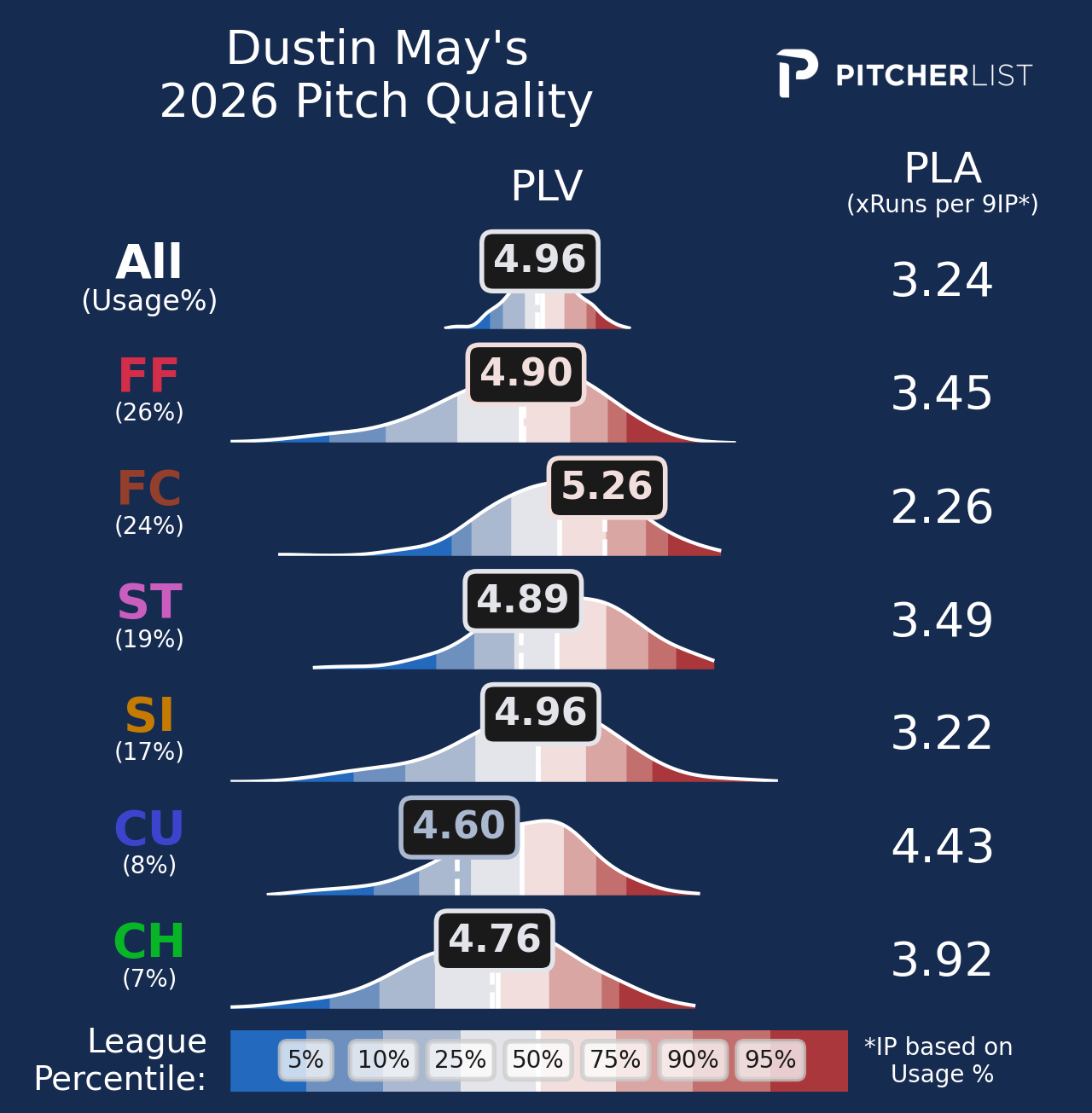
After a disastrous streak of injuries throughout the early 2020’s, May struggled throughout a largely healthy 2025 season, split between Boston and Los Angeles. Still, a season of health earned him a one-year, $12.5 million contract with the Cardinals with a $20 million mutual option for 2027, and a few changes to his arsenal have led May to his best results in a while:
- CH/CU back, mostly against lefties; not great results yet, but gives him six pitches!
- Still 40% SI but more FF/FC against righties, less ST; all 3 fastballs have been doing much better, thanks to ~1.5 mph uptick from 2025
- Way more FC overall; 4 run value leads arsenal, has been big for strikes (73.1% strike rate) and 0 home runs
Still, a few problems stick out. His breaking balls, now a sweeper and curveball, have generated a -6 run value after his sweeper was quite literally his only positive pitch in 2025. His sweeper still has a strong 35.4% whiff rate and .296 SLG, but his curveball has been crushed and hasn’t generated consistent swing-and-miss. Both pitches, as well as his spotty changeup, have been inhibited by generally poor command, missing over the heart of the plate quite frequently.
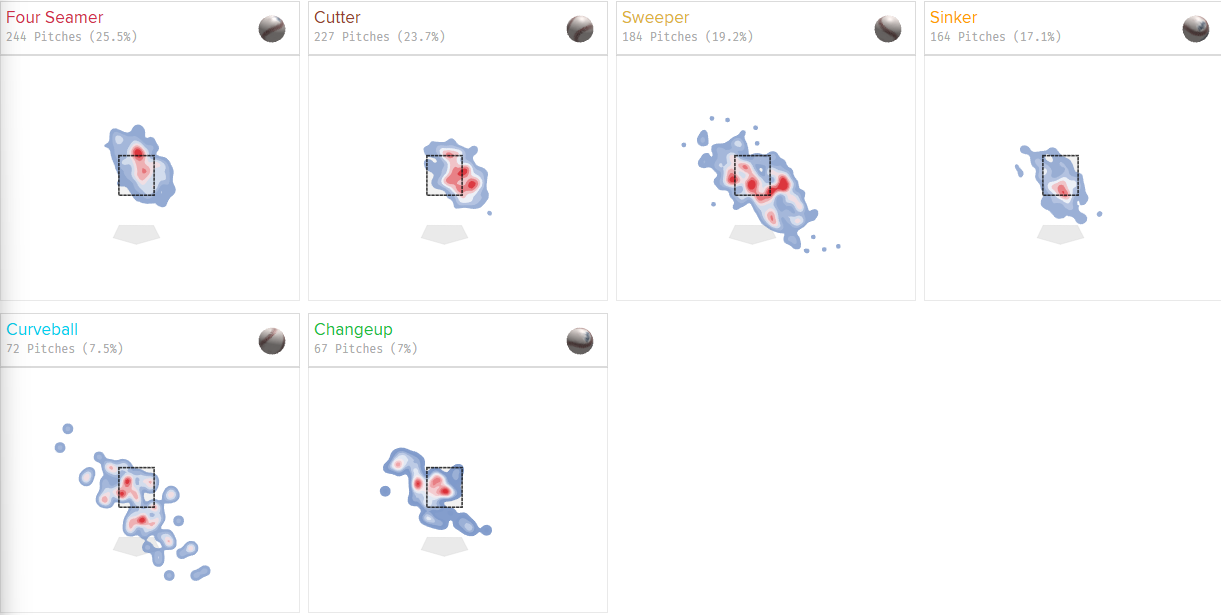
While his cutter has been exceptionally located gloveside, as well as his four-seam and sinker at the top and bottom of the zone, his other three offerings have not. This has lowered their PLV to all being below-average, despite plus movement and velocity. May has generated a 3.25 PLA so far; still below his early career seasons, but a step in the right direction.
May’s 4.57 ERA is well above that of his 3.55 FIP, but his xFIP (4.05) and SIERA (4.03) split the difference. May’s struggles against lefties have been a persistent issue these last couple of seasons, but some real strides made towards his arsenal and handling of righties have brought May a little closer to consistency. Look for May to remain healthy and continue fighting for plus results throughout 2026.
