





Top-tier speed is a dangerous weapon on a baseball diamond. In the field, it allows players to get to balls that lesser athletes would never even have a chance to make a play on. In the batter’s box, that speed puts consistent pressure on the pitcher and defense since any ball in play has less margin for error, and if the speedster reaches, he’s a serious threat on the basepaths.
As a looming threat if they reach base, it’s vitally important for elite runners to make good swing decisions. In this piece, we’ll be analyzing those decisions using PLV’s Decision Value. If you’re unfamiliar, PLV considers every single pitch’s placement, movement, and other metrics, and assigns it an overall grade. We can then use those grades to determine whether a hitter is making good swing choices and attacking pitches that he can turn into offensive production. We can also break this down further by looking at pitches both in (zDV) and out (oDV) of the strike zone. For a more in-depth explainer, check out the intro to this piece.
Like many metrics, Decision Value is graded on a scale where 100 represents the league average. Every 15 points above or below 100 is one standard deviation.
You can support Pitcher List and get access to full leaderboards for Decision Value and other PLV statistics by joining PL Pro.
Trea Turner, Philadelphia Phillies (104 Decision Value)
Quick trivia question! Which position player leads the National League in fWAR? The placement of the question is probably a dead giveaway, but yes, Trea Turner tops the NL fWAR leaderboard.
It’s been yet another quietly excellent season for Turner. The Phillies’ star shortstop is hitting .305/.356/.458 with 15 home runs, 36 stolen bases, and 6.7 fWAR. On the Decision Value front, Turner is sporting a 104 mark. While that’s nowhere near the top of the league, it does mark the first time he’s made above league-average swing choices since 2021.
Turner’s good Decision Value grade is particularly impressive because he’s rather aggressive at the plate. During his time in D.C. he was notably passive, but he’s upped the aggression as he’s aged, and it’s clearly paying off with his results. This year, Turner has swung at 51.3% of pitches he’s seen, a rate that falls in the 75th percentile among big league batters, and he’s been effective at selecting his pitches no matter the location.
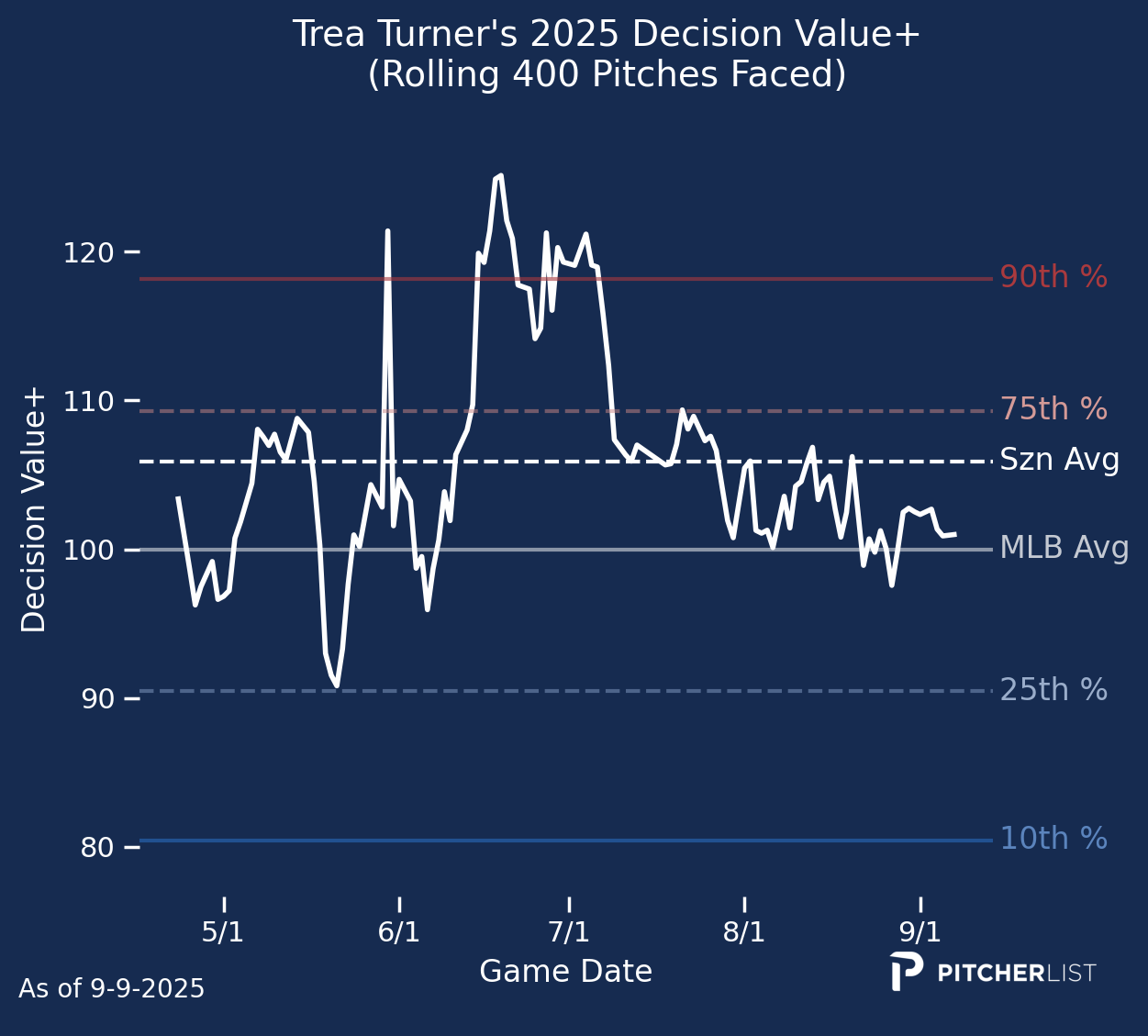
Turner has really excelled in the strike zone this season. PLV gives him a 114 zDV, a mark nearly a full standard deviation above the average hitter. What’s most notable, though, is that despite chasing pitches out of the zone frequently, he’s largely limited his chases to pitches he can still do some damage to, according to PLV. His 99 oDV is one of the better marks you’ll see for a hitter with a 25th percentile chase rate.
Bobby Witt Jr., Kansas City Royals (96 Decision Value)
If you look up “five-tool player” in the baseball dictionary, you’ll find a photo of Witt. When you’re playing MLB The Show and create a player with a 99 rating in every attribute, you’re essentially creating Witt. He brings so many great skills to the table, but perhaps the most elite offering he has is his sprint speed. Witt’s 30.2 ft/s sprint speed ties him for the second fastest running speed in the sport, trailing Turner by just 0.1 ft/s.
Maybe the only part of Witt’s game that isn’t among the league’s best is his Decision Value. He clocks in with a 96 Decision Value on the season, and it’s remained rather steady throughout his four-year career, bouncing from a low of 89 as a rookie to a high of 97 as a sophomore.
Witt’s propensity to sit near league average isn’t just limited to his full-season stats. If we look at his rolling results throughout the season, there are surprisingly few peaks and valleys.
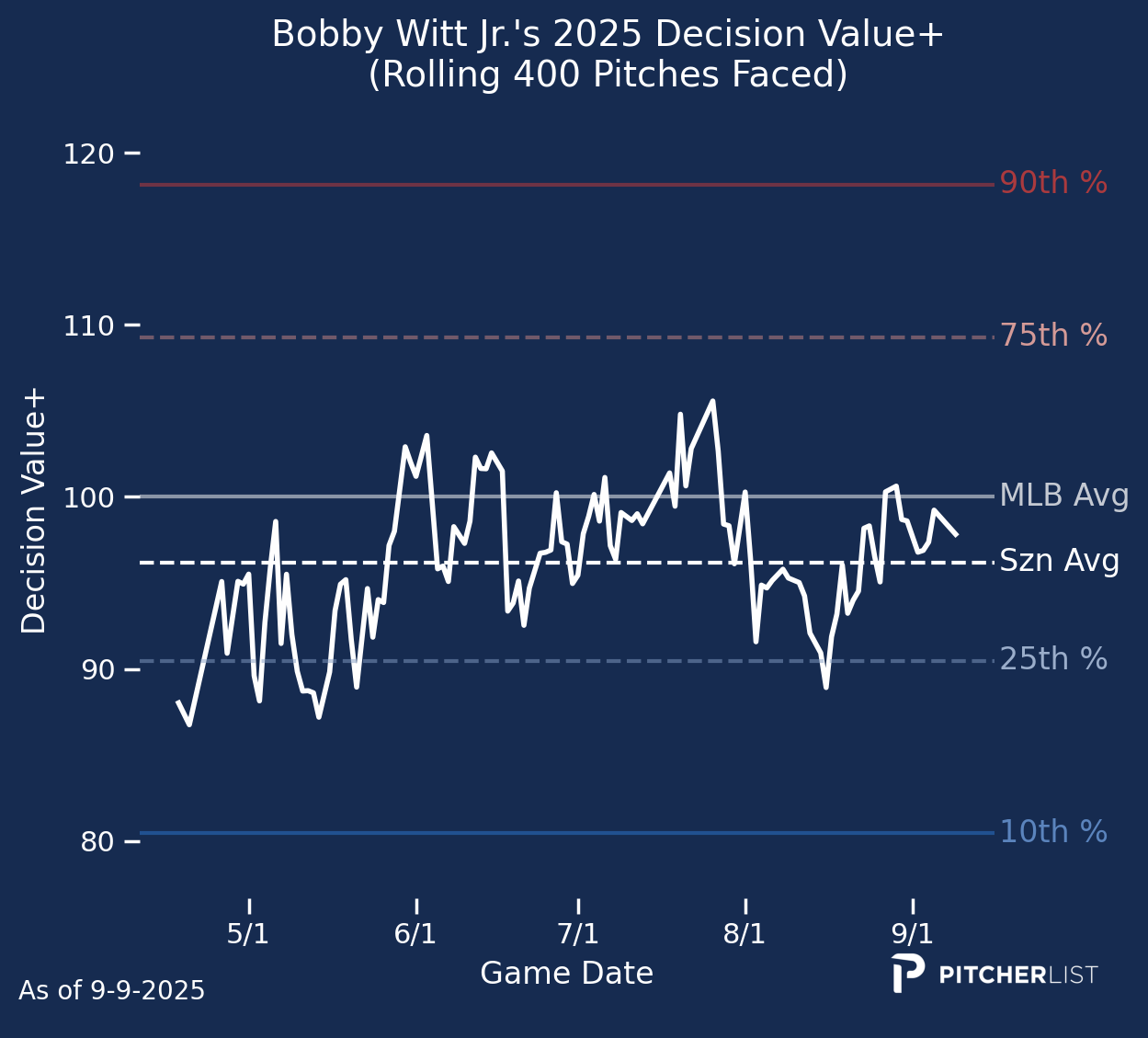
Witt is a rather aggressive hitter. He offers at 50.9% of the pithes he sees, a clip that falls in the 72nd percentile of qualified hitters. That swing profile has led Witt to good PLV results in the zone (112 zDV), but poor results out of it (91 oDV).
You could nitpick Witt’s 30.6% chase rate, but it’s hard to be too upset with anything the 25-year-old superstar is doing. To be fair, it’d probably be hard not to swing at everything when his contact results are so good – each of his xBA, xSLG, and xwOBA ranks in the 90th+ percentile.
Victor Scott II, St. Louis Cardinals (109 Decision Value)
While Scott is almost exactly as fast as the two guys we’ve already covered in this article, unlike the others, speed is Scott’s only calling card. Through his first 576 playing appearances, Scott’s slashing just .209/.284/.299 with seven home runs and 37 stolen bases. Those numbers come out to just a 68 wRC+, a number low enough that Scott’s future as a big league regular is in serious question.
Scott may not be excelling in the batter’s box, but his swing decisions aren’t to blame for his lackluster results. After posting a Decision Value just slightly below league average as a rookie (98), he’s bettered his pitch selection as a sophomore and moved his Decision Value up to a very respectable 109.
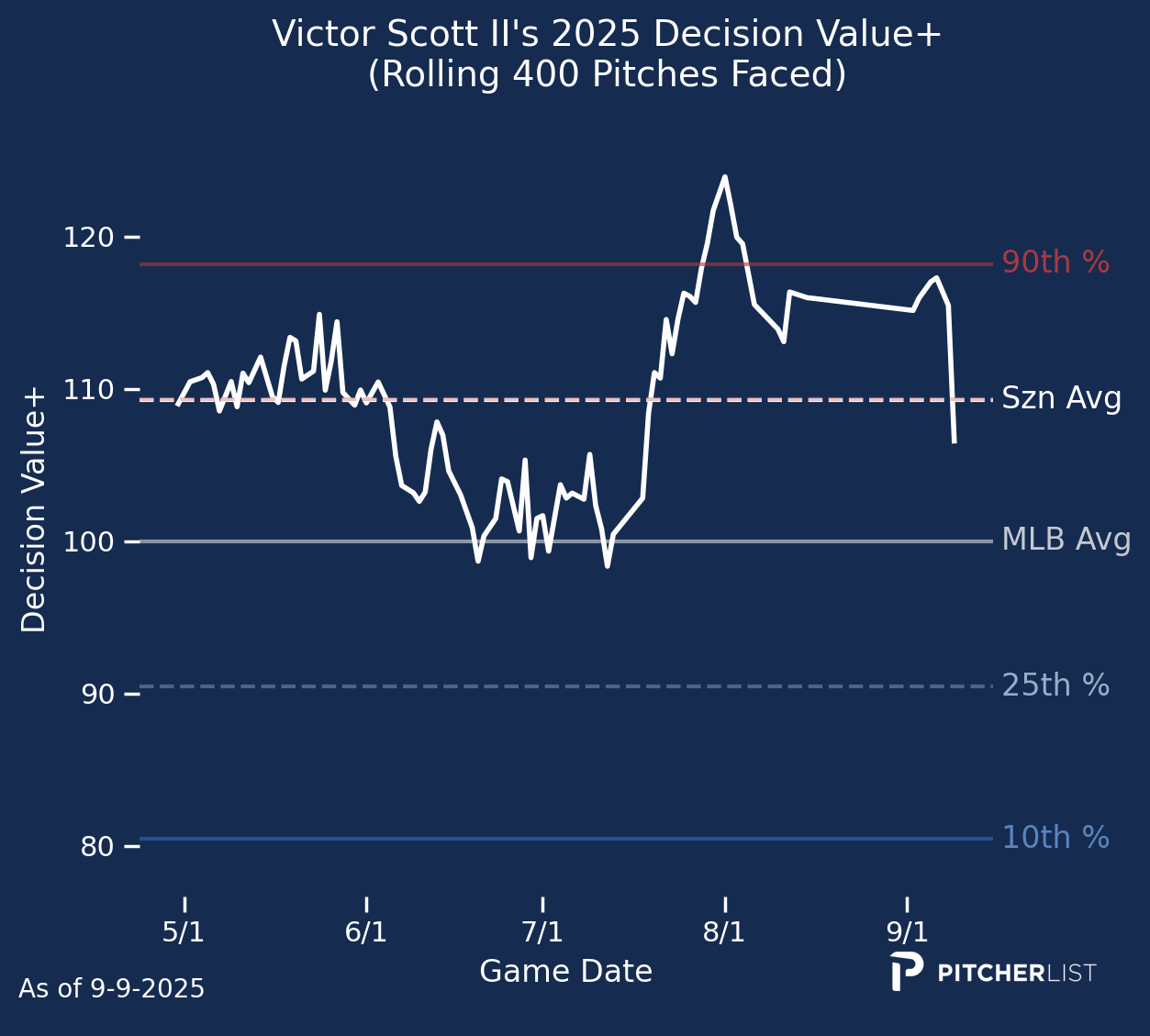
In his second year facing big league pitching, Scott’s shown more patience in the batter’s box. He’s dropped his swing rate a couple of points, but the bigger change has come on pitches outside of the strike zone. He chased pitches out of the strike zone at a 29.3% clip as a rookie, but has slashed those wasteful swings to just 23.8% in his second season.
Byron Buxton, Minnesota Twins (98 Decision Value)
When you think of speed, Buxton is probably one of the first players that comes to mind. Even as he’s entered his 30s and dealt with numerous major injuries, Buxton still sits near the top of the sprint speed leaderboard. After years of taking precaution on the basepaths, he’s once again upped his aggression and has swiped 22 bags this season, although his stolen base total becomes a bit of an afterthought when you see his .274/.334/.563 slash line. It’s his second straight season with a 141 wRC+.
Although Buxton’s offensive production may be 41 percent better than a league-average hitter, his swing decisions are not. We have swing decision data going back to 2020, and in every full season since, Buxton has been within 8 points of league average. It’s not a category he stands out in, but he’s thrived at the dish regardless.
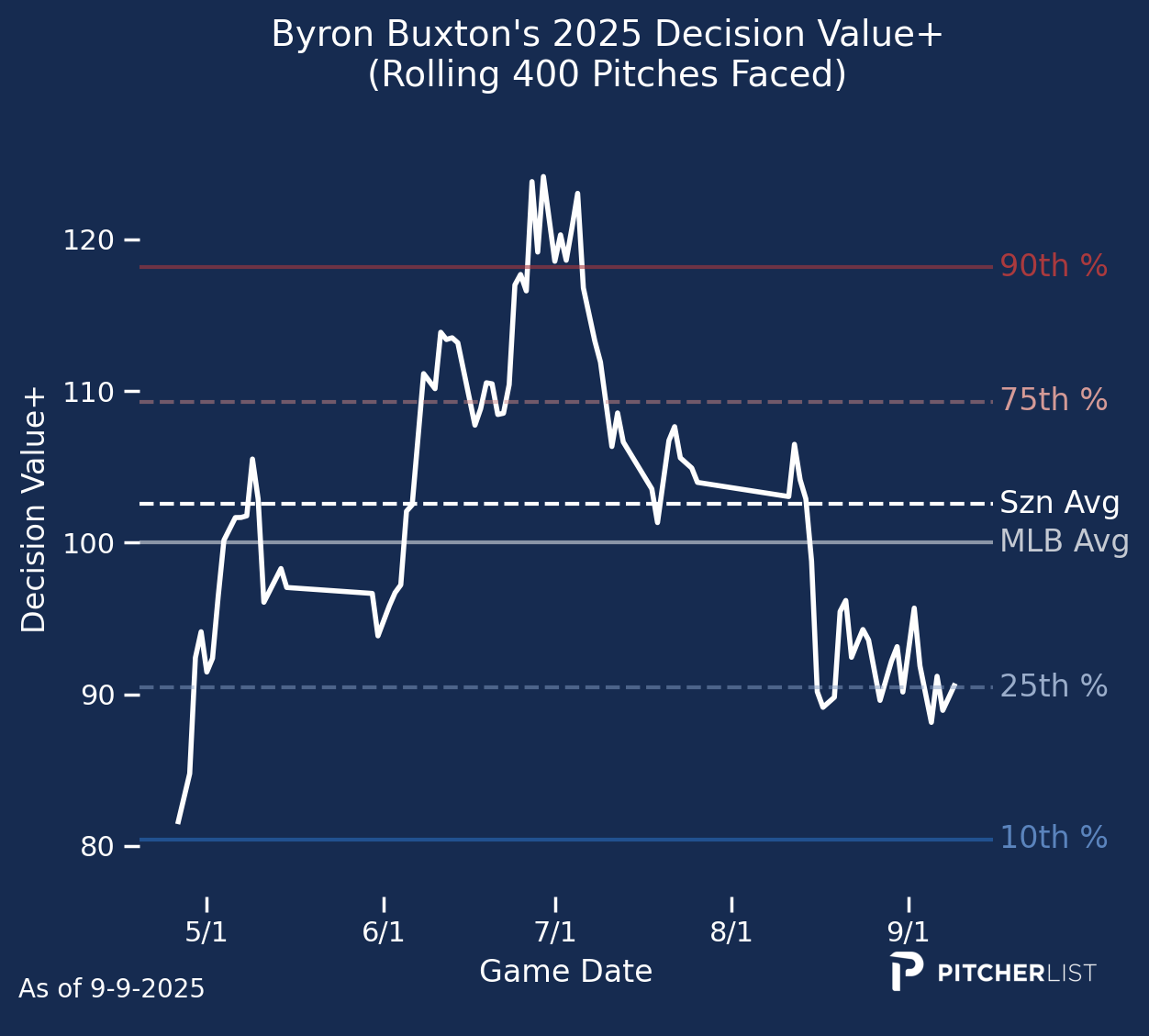
As you can see, Buxton’s swing decisions have been a roller coaster in 2025. He started the year just barely above the 10th percentile before climbing all the way near the top of the league by the middle of the summer. Unsurprisingly, his production at the plate lines up incredibly well with his Decision Value. He started slow with a 101 wRC+ in March and April and shot up to a 192 and 136 in June and July, respectively.
Adapted by Kurt Wasemiller (@kurt_player02 on Instagram & Threads, @kuwasemiller.bksy.social on BlueSky)
