





Countless things contribute to the outcome of a plate appearance, but one of the most important things a hitter can do is make good swing decisions. We’ve been measuring those all year long in this series using PLV’s Decision Value.
If you’re unfamiliar, Decision Value is one of our very own metrics here at Pitcher List and helps us measure a hitter’s ability to recognize which pitches he should and shouldn’t attack. It’s similar to plate discipline metrics, but it goes deeper than they do. If a batter takes a nasty slider that dots the corner of the strike zone in a 0-0 count, that’s a good take. A great pitch with precise placement is not going to produce good outcomes on contact very often. In that scenario, the batter is better suited to take that pitch and fall behind in the count 0-1 rather than making weak contact for an easy out.
That scenario is a prime example of what Decision Value is measuring. It’s more than whether a hitter can recognize the strike zone. It’s whether he can correctly identify the pitches that he has a good chance of turning into favorable contact. We can also break this down further by looking at pitches both in (zDV) and out (oDV) of the strike zone.
Like many metrics, Decision Value is graded on a scale where 100 represents the league average. Every 15 points above or below 100 is one standard deviation.
In this article, we’re honing in on the players with the highest contact rates in the league. We already know that they can get their bat on any pitch that comes their way, but does that mean they make worse swing choices since they can fall back on that elite contact ability? Let’s dive in and find out.
You can support Pitcher List and get access to full leaderboards for Decision Value and other PLV statistics by joining PL Pro.
Luis Arraez, San Diego Padres — 87 Decision Value
Arraez is the contact hitter in baseball these days. His name has become synonymous with bat-to-ball skills, but he doesn’t do it with good swing decisions. Arraez clocks in with just an 87 Decision value, making him nearly an entire standard deviation worse than a league-average hitter. It hasn’t always been that way, though.
This is the third straight year in which Arraez has tumbled in his swing choices. After posting back-to-back strong seasons with a 106 Decision Value in 2021 and 2022, he has taken an annual step back in his pitch recognition in each of the subsequent years.
Arraez’s poor swing choices are pretty obvious even if you’re not using our PLV statistics. His 34.5% chase rate falls in the 12th percentile of hitters, but he doesn’t keep that aggression on pitches in the strike zone. His swing rate on strikes is 63%, four percentage points below the league average rate.
A drop in overall production has come with these worsening swing choices. Arraez established himself as a .300+ hitter in his peak seasons, but his drop in Decision Value and a rising chase rate have seen his batting average fall to a career-worst .283 mark in 2025. Overall, his 99 wRC+ rates him just about league average, but it’s a far cry from his 130 wRC+ across 1,200+ plate appearances in 2022 and 2023.
Arraez is just 28 years old, so I’m not ready to write him off as not being able to return to that peak performance we’ve seen from him previously, but to get back to that production level, he’ll need to make some serious swing decision improvements. To close with some good news, not only is Arraez still doing an excellent job of getting the bat to the ball, but he’s still excelling in a couple of key contact quality metrics. His 36.3% LA Sweet-Spot% is good for the 71st percentile of qualified hitters, and even more impressively, his 42.6% Squared-Up% is the best in baseball.
Steven Kwan, Cleveland Guardians — 106 Decision Value
If Arraez isn’t the name that pops into your head when you think about a contact hitter, then it must surely be Kwan. The Guardians’ left fielder is one of the premier contact bats in the game, but unlike Arraez, Kwan’s done it with good Decision Values throughout his entire career. Kwan’s 106 Decision Value in 2025 is a career low, though, and actually marks a step back for the Gold Glove winner. After posting a 108 Decision Value in his rookie campaign, he boosted it to 114 in 2023 and 115 in 2024. He has about a month left to right the ship and continue his upward trajectory, but he’s currently mired in a swing choice slump.
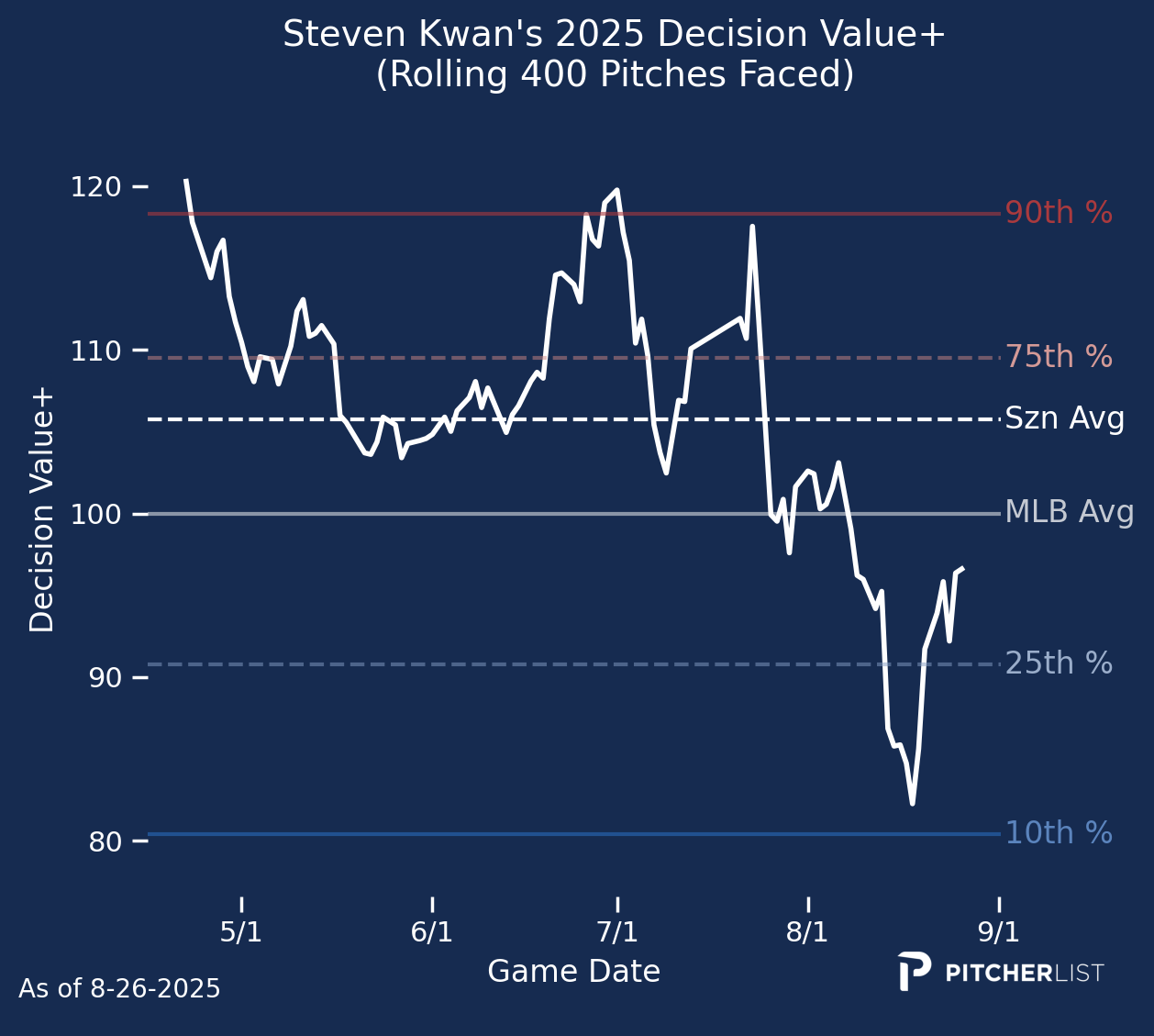
Although Kwan has an elite ability to make contact on almost any pitch, he’s rather selective in his approach at the plate. Patience is the name of Kwan’s game. He swings at just 41.5% of the pitches he sees, a rate that falls in the 10th percentile of hitters. He’s particularly good at laying off of pitches outside of the strike zone — his 23.9% O-Sw% is 85th percentile. His ability to lay off those outside pitches earns him a 105 oDV.
Like Arraez, Kwan has incredible bat control. When he gets a good pitch to hit, he’s not going to blast it out of the park very often, but he’s almost always going to get good wood on it. His 38.4% LA Sweet-Spot% and 38.3% Squared-Up% rank in the 86th and 98th percentile of qualified hitters, respectively.
Jacob Wilson, Athletics — 98 Decision Value
With an impressive rookie season, Wilson is making a case to be the new face of contact hitters. Through his first 99 games, Wilson’s slashing .311/.353/.450 with 12 home runs and five stolen bases. His 91.1% contact rate trails only the two hitters listed before him in this article.
Wilson has exceptional contact ability, and it’s led to success despite his willingness to chase pitches out of the strike zone. His 34.3% chase rate falls in just the 15th percentile of MLB hitters, and that’s earned him a poor 92 oDV. Pitches in the strike zone are a different story, though. Wilson is much more selective there, and despite having a well-above-average swing rate overall, he actually swings at strikes at a rate just a tick below average. PLV thinks he’s done a great job with his in-zone swing decisions, and his Decision Runs Heatmap shows that in-zone and out-of-zone disparity quite well.
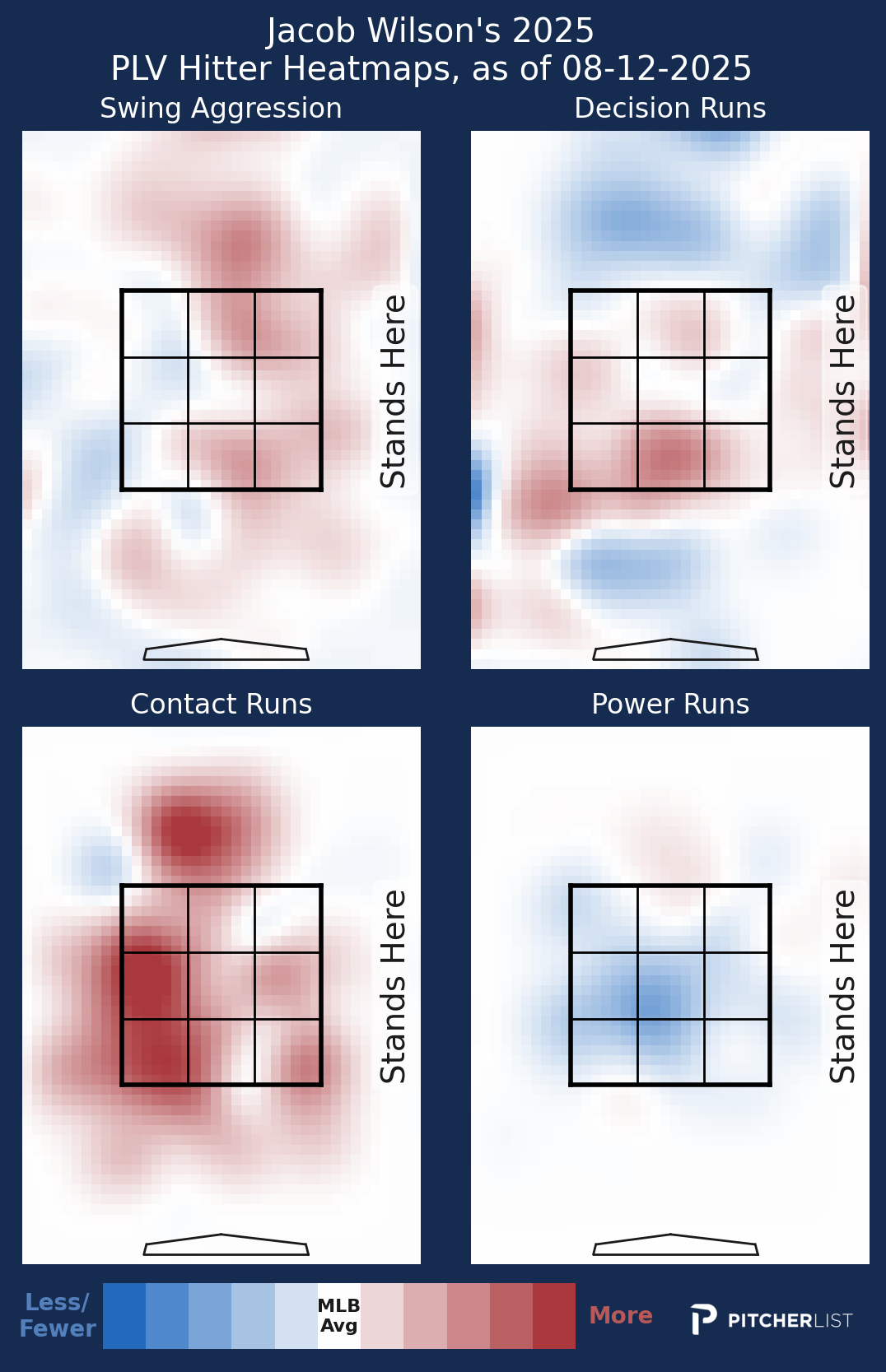
Wilson seems to be having issues with his strike zone judgment, but that’s not atypical for a rookie, even one with the contact ability of Wilson. If he can hone in on the zone as he ages, the sky’s the limit for the A’s All-Star rookie.
Xavier Edwards, Miami Marlins — 106 Decision Value
The Marlins traded away Arraez last year, but replaced him with a contact bat that’s nearly as good. Edwards has quietly turned into a solid contributor, slashing a combined .302/.365/.385 with 54 stolen bases over 827 plate appearances in 2024 and 2025, and he’s done it with above-average swing decisions, too.
One thing that sets Edwards apart from his contact ability brethren is that he doesn’t chase much out of the zone. In fact, his swing profile stays near league average pretty much across the board, so while he’s great at making contact when he needs to, he’s not forcing swings simply to put the ball in play. His Decision Value follows this trend and is slightly above average both in (106 zDV) and out (104 oDV) of the strike zone.
It’s nice to see a young contact-oriented hitter not rely too much on over-aggression at the plate. Edwards’ 9.1% walk rate over the last two years is one of the better marks among contact-first bats, and that’s especially important for a player like Edwards who derives so much value from his prowess on the basepaths.
Sal Frelick, Milwaukee Brewers — 96 Decision Value
The Brewers are one of the best teams in baseball at making swing choices, so Frelick posting a below-average number is somewhat surprising, but the way he’s doing it is very Brewers-eque. Milwaukee preaches patience to its young hitters, and Frelick has taken that advice to heart. He swings at a 43.8% clip, falling in the 16th percentile of hitters. That passivity at the plate doesn’t necessarily mean that he’s laying off bad pitches to hit, though.
Although he doesn’t swing often, Frelick’s chase rate is only 58th percentile, so he still offers at pitches out of the zone more frequently than you’d expect for a hitter with so much patience. That’s led to just a slightly-above-average 104 oDV. In the zone, Frelick’s patience hurts him. His zone swing rate is 8.5 percentage points below the league average number, so he’s watched a lot of called strikes go by, and PLV doesn’t love that, giving him a very poor 80 oDV.
Despite the less-than-ideal Decision Value profile, Frelick is turning in the best season of his career. He’s hitting .297/.360/.409 with nine home runs and 18 stolen bases. With his contact-oriented approach, none of his Statcast expected statistics are stellar. He’s outperformed each of his xBA, xSLG, and xwOBA numbers by a good margin. Those statistics aren’t predictive, so we can’t say that he’s due for a serious regression, but a career-best season with mediocre Decision Value and contact quality does raise some eyebrows.
Adapted by Kurt Wasemiller (@kurt_player02 on Instagram & Threads, @kuwasemiller.bksy.social on BlueSky)
