





At the peak of his powers, former New York Mets ace Jacob deGrom owned the afternoon slate. Like the Kryptonian himself, Sunshine Superman seemed to grow stronger when Mother Nature was at her kindest, making every matinee a must-watch.
As a Met, deGrom pitched 412.2 innings during day games. He allowed just 92 earned runs.
I’ve found that same set-your-clock consistency with Detroit Tigers rookie Kevin McGonigle. He’s yet to cement himself among the game’s elite, but on getaway day, you might as well start planning a 2050 trip to Cooperstown. McGonigle is hitting .388 through his first 13 day games. It’s a meaningless split, prone to small-sample variance and all the warnings that come with causation and correlation. We’ve all watched enough baseball to know that it won’t last forever. But on a random Thursday afternoon, charmed by Jason Benetti, it’s hard not to feel like you’re watching something special.
McGonigle Looks Like the Next Great Contact Hitter
I won’t quibble with the league-wide consensus that Konnor Griffin was baseball’s top prospect. He’s probably a better shortstop than his American League counterpart, has the age and athleticism advantage, and is dripping in raw upside. With that said, the shape of both prospects’ production shouldn’t be a surprise.
McGonigle’s bat-to-ball skills jump off the screen. His ability to foul off pitches has made him a nuisance, especially paired with a 97th-percentile putaway rate. McGonigle is still walking more than he’s striking out, and he’s doing so sustainably.
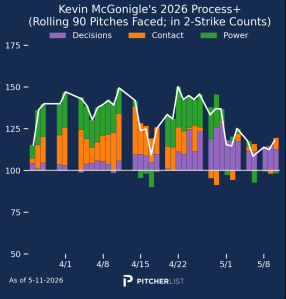
McGonigle doesn’t swing and miss. He doesn’t chase, and he’s offering at 69.5% of pitches in the zone, 70th among 242 qualifiers and ahead of strike zone savants like Juan Soto and Max Muncy. His low swing rate (42.4%, 19th percentile) is more a matter of his plate discipline than problematic passivity, given that his zone and called strike rate are around league average.
Thus far, PLV views his bat-to-ball skills favorably (110 Contact+). However, his 70-grade approach has significant gravity. McGonigle’s 129 Decision Value+ ranks sixth in all of baseball, and the confluence of those tools radiates throughout his game.
For one, McGonigle is running hot on his peripherals and batted ball luck. His average (.300) is far ahead of its expected counterpart, and his .341 BABIP is nearly equidistant from the .300 mark we come to expect from his xBABIP. McGonigle is hitting a ton of line drives, too, which might prove to be unsustainable. Might McGonigle be different than the mortals bound for regression?
I think his nuance makes that possible, specifically because of how much of McGonigle’s approach feels intentional. In his first six weeks of action, McGonigle has adjusted to teams flooding him with various pitch types, hoping to poke holes in his game. Even while giving back some early-season contact wins against breaking balls, he’s remained above water against every pitch type. On an RV/100 basis, only the six slurves he’s seen have produced negative value. No pitch has generated a whiff rate above 25%.
Perhaps even more important is his batted ball data. We know McGonigle isn’t selling out for power. He’s not a 30-homer guy, and he is trading his ground balls for line drives. Yet, among the 129 players with 100+ batted balls, McGonigle ranks 24th in pull air%. Doing that while only pulling at a 36th-percentile rate is impressive. It’s indicative of barrel control and the ability to turn losses into draws. Those marginal runs add up over the course of the season and eventually earn one the title of “professional hitter.”
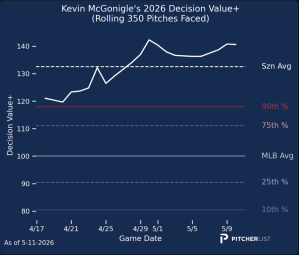
McGonigle’s preternatural ability to make the most of what pitchers give him has turned his above-average hit tool into something greater, creating some of the good fortune he’s enjoyed and adding more stability to his profile. Variance comes for us all, but I’m happy to bank on McGonigle looking the part when adversity hits.
McGonigle Will Impact How I Approach Hitters
It’s not breaking new ground to suggest that one’s hit tool is more than their contact rate or batting average. When a prospect’s high contact rate comes from a low swing rate, we express caution. When a top prospect flames out, it’s often their whiff rate against velocity or breaking balls that tells the story.
Folding in approach to evaluating a prospect’s hit tool is necessary (if not paramount). It may be helpful to view it similarly to how FanGraphs rates prospects’ pop, which on their player cards is separated into raw power and game power. This obviously delineates between power potential and the ability to actualize it. When looking at The Board, the site’s prospect hub, we see the hit tool split into pitch selection and bat control, which do most of the heavy lifting in explaining their grades.
McGonigle is doing his part to leave his 55/65 hit tool (given 60s for pitch selection and bat control) in the dust. Moving forward, though, the intersection of bat-to-ball skills and intangibles may be best simplified like power: raw bat-to-ball skills and the ability to turn that into positive results.
Neither Jacob Wilson nor Steven Kwan was ranked quite as highly as McGonigle, but both were top-100 prospects who took different paths to their contact-first approach. Wilson is floundering in his second full season because his contact has enabled rampant aggression. Sometimes, you’re only as good as the pitches you swing at. Wilson is swinging at everything, hitting everything, and getting lesser results as pitchers avoid the zone with two strikes. Conversely, Kwan has whiffed less than any qualified hitter in baseball. He’s also taken more called strikes than anyone else.
McGonigle is a more refined prospect because he is dictating the terms of engagement. He’s going to turn whatever he gets into a positive result for himself. Doing so at 51.8% clip would have ranked second in baseball behind just Soto in 2025. Kwan and Wilson ranked 145th and 205th, respectively. Nobody is doubting their ability to limit whiffs. But like the Spencer Joneses of the world, physical tools only tell half the story.
Separating the hit tool into those buckets is a simple way to sort through the guys who are making the most of their contact without over indexing on power.
McGonigle’s nuance gives him staying power, and it may be worth prioritizing those skills, especially when the contact already projects as league average. Moving forward, I am also interested in how PLV data can help tell the future. The predictiveness of Decision Value+, the stickiness of Contact+ across levels, and how those tools can be represented on a pitch-level basis are mountains left to climb. A better handle on how quickly we can gauge pro-readiness is possible.
McGonigle may be an outlier, poised beyond his years and capable of hitting the ground running. But he’s not the only player whose approach helps his contact play up, and as he stays a step ahead of the opposition, his ability to make every swing count provides a better path to production for the game’s most contact-heavy hitters.
Photo by Icon Sports Wire | Graphic by Carlos Leano
