





For 99% of all major league pitchers, this doesn’t get an article. For Paul Skenes, it does.
The best pitcher in baseball has given up nine earned runs across ten innings in his last two starts. Going back to April 30th, it’s a 3.48 ERA, almost a month of being an above-average pitcher solely based on results. The stretch from Opening Day (including that start) up until three starts ago was still a sub-2.00 ERA. The last week has thrown off everything. A season-long ERA at 3.00 looks wrong for a guy with a career figure under 2.00.
Now, this article isn’t saying we should be worried about Paul Skenes. He’s still the best pitcher in baseball, and the peripherals suggest that too. However, there is legitimately more volatility to the profile than before.
Even including the recent blowups, everything is still fine under the hood. He’s got an exceptionally good strikeout rate, tied for the best walk rate, and a 0.82 WHIP is on track to be the lowest WHIP since Justin Verlander in 2019 and Pedro Martinez in 2000. Again, we’re not worried about Paul Skenes.
While most surface stats look similar to those of previous years, one stands out: HR/9. His 0.90 HR/9 is a decent uptick from the 0.59 career figure he had. That 0.59 would be tied with Jose Fernandez for first among all starting pitchers with at least 300 innings since 2000. A 0.90 HR/9 is a meager 61st percentile figure for Skenes. A home run “problem” for the best pitcher in baseball.
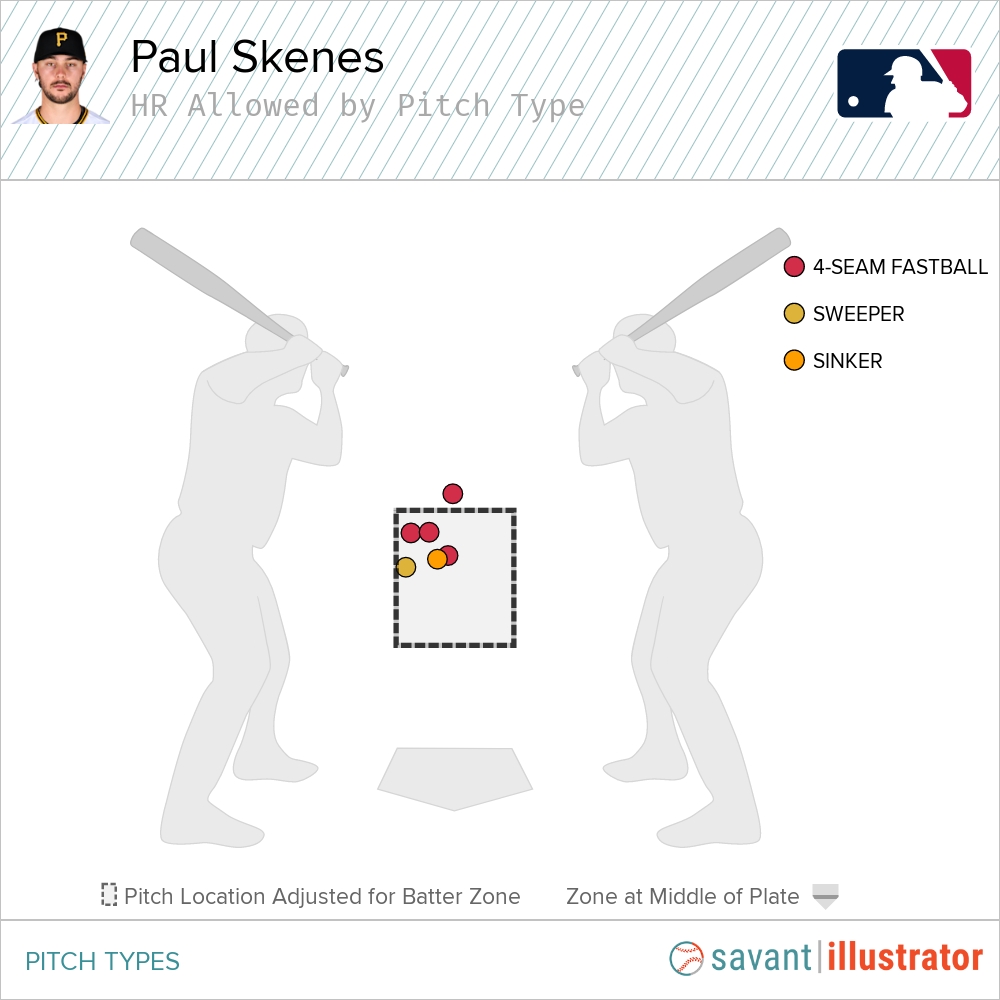
Because it’s still a relatively small sample, that only culminates in six total homers across 60 innings. Five of those homers were off of fastballs, four of which were four-seamers.
Skenes’ four-seamer had been discussed at length ahead of his debut, with the shape of the pitch bringing up questions that shouldn’t be asked at the velocity. The four-seam currently sits at 97.1 mph, but only gets 12.2 inches of induced vertical break. The lack of vert on the pitch made many think it wouldn’t be dominant in the big leagues, to which Skenes silenced those by running exceptional whiff rates.
Relative to his 25-degree arm angle, which is lower than 88% of starting pitchers, that 12.2 inches of iVB results in a 1.0 Height-Adjust Vertical Approach Angle (HAVAA). This is an average figure, meaning that the pitch isn’t entirely suited for whiffs at the top of the strike zone, which is where most fastball whiffs come from. Even if that’s where most whiffs come from, Skenes was seemingly cognizant that the pitch won’t perform great up in the zone, and spent his first two seasons keeping it lower in the zone with good results.
This year, Skenes has decided to elevate the fastball to all hitters.
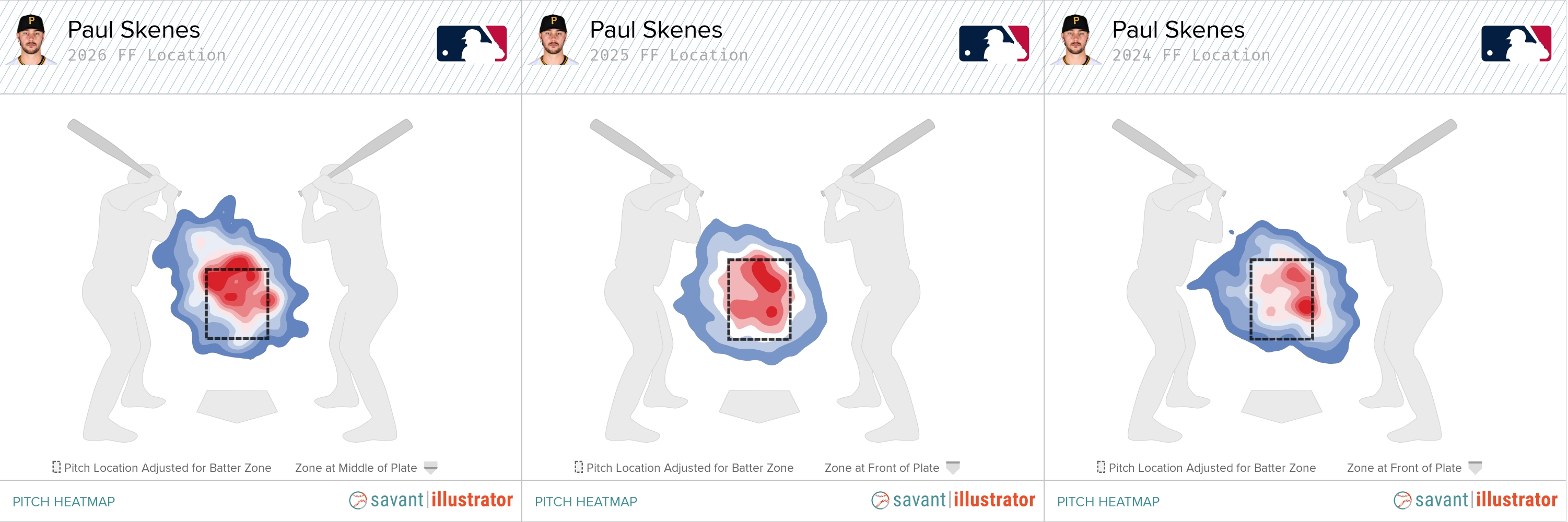
He’s throwing 20% more fastballs up in the zone compared to last year. This has come with a few tradeoffs, one of which is driving some that home run problem.
The zone rate on the pitch has dropped 10%, with now less than half of his four-seam fastballs in the zone. However, hitters are swinging more at the fastball than ever, giving the pitch a higher strike rate overall despite being in the zone less.
The simple math on more swings and less pitches in the zone is more chase. However, the change in location is leading to more contact in the zone and about the same amount of contact outside the zone. The whiff rate has maintained last year’s 29% (a 90th percentile figure), but simply more chases have led to an increase in swinging strike rate, now sitting at an incredible 17%.
Elevating the fastball has achieved its goal of getting more whiffs, but it’s also putting more pitches in places for hitters to do damage on. Just about everything Skenes throws is an exceptional pitch — there isn’t anything bad in the profile and it’s a wide arsenal. Hitters are going to want to hunt the fastball, and now elevating a fastball that isn’t necessarily equipped to do so will run into trouble.
It’s a smaller margin for error than at the edges, especially when dealing with premium velocity. On pitches 97 mph or harder in the outer parts of the shadow and chase areas of the zone, the league is hitting .167 with a .236 xSLG. On the middle third, that “balloons” to .198 and .326 figures, respectively.
Skenes throws the fastball 36% of the time overall, the most of any pitch. It’s also his most-used two-strike pitch, at almost 40% usage. It gives hitters familiarity with a pitch in a location they likely feel they can hit. Skenes can get the ball moving in just about any direction, and it’s easier to key on the fastball than anything else. When Skenes makes a mistake, hitters are more ready to pounce on it than they previously have, and it’s often in a better location.
Of the four home runs he’s given up this year on four-seam fastballs, three of them have been in two-strike counts.
This feels like it shouldn’t happen for a man of Skenes’ talent. He has four other offerings, and yet it appears he’s pigeon-holed himself into this issue with the fastball, despite all of its success. Transitioning the fastball/secondaries to a north-south approach can create a home run problem for anyone, even if it’s a muted version for Skenes.
The fastball location has also trickled to the sinker, which has seen a 26% increase from the 7% figure from his first two seasons. It’s still excelling at getting weak contact, but the whiff rate dropped from 10% to 3%. The sinker has faced a similar fate to the fastball, where a few mistakes end up center-cut and result in damage (but only one home run so far).
For a guy who seems so locked into his execution, this seems like a problem that could be solved easily. He appears to possess too much knowledge and skills to have this problem plague him for the rest of the season.
Skenes should turn to the offspeed pitches more against all hitters. The sweeper isn’t as good of a breaking pitch as one might think, only getting a 22% chase rate (31% is average) and 10% swinging strike rate (13% is average). The changeup and splinker are the two pitches that can get the swing and miss late in the count to putaway hitters.
The changeup works best for lefties, and the splinker works best for righties, leaving the sweeper as a periphery option.
This is all about a very minuscule problem. A 0.90 HR/9 is the least of anyone’s concerns, and Skenes is going to continue to be in the running for another Cy Young award. But if his ERA ends up a little higher than everything suggests, it’s likely because he’s become too trigger-happy on the four-seam fastball.
