





Playing for the Dodgers is a great thing for pretty much any baseball player. As one of the richest but also most savvy organizations in the sport, the Dodgers tend to provide their players the best platform to succeed and maximize their abilities. All of that being said, for one individual in particular, the road to the best fantasy production isn’t quite so clear, and he faces upsides and downsides from wearing the Dodger blue; his name is Will Smith.
In terms of pure hitting ability, Will Smith has a pretty strong case as the most talented catcher in the sport. Still, despite all that talent, his number of appearances isn’t up there with the top hitting catchers in the game because of situations beyond his control.
As we all know, Shohei Ohtani and Freddie Freeman are two key pieces of the Dodgers’ offense, and it just so happens they’re indisputably the top hitters at their respective positions, designated hitter and first baseman. Unlike the case with catchers such as William Contreras, Cal Raleigh, and Salvador Perez, to name a few, Will Smith is completely blocked off from part-time appearances at first or DH when he is not behind the plate.
Recently, another wrinkle has been added to this whole thing in the form of Dalton Rushing’s call-up. Smith is a great enough catcher that his job is not and can’t even be in jeopardy. However, it is plausible Rushing gets more playing time at the position than Austin Barnes ever did, given not only the difference in hitting quality between the two but also the goal to not completely stall out Rushing’s development. The Dodgers have already made it clear that they don’t plan on playing Rushing outside of the catcher position.
Taking all of this into consideration, it’s easy to understand the downside of rostering Smith over the other top-end catchers, which justifies the preference in ADP ahead of this year for the likes of Contreras, Raleigh, and company.
Before diving into what Smith is doing differently this season, and how that has led to this outstanding start, let’s assess the limitations of his current scenario. Raleigh is the only other catcher hitting as well as Smith right now, while William Contreras is on pace for the worst OPS of his career in a full season. Now, how do they compare in terms of non-rate fantasy production?
It’s just a massive challenge for Smith to keep up with those guys without the same level of PA. On the flip side, there is what at this point feels like a purely speculative potential benefit from this more limited exposure in comparison with other elite catchers. Given the most rest a stud catcher could get, Smith, who plays a pretty brutal position, has the best possible odds to reach the end of the season reasonably fresh, or not as beat up as other catchers.
Historically, Smith has been much more of a first-half hitter than a second-half one.
This makes sense for a catcher who, even in reasonably healthy years, is likely to decline in production due to the normal wear and tear of a season. Now, at the same time, Smith dealt with nagging injuries, derailing his second half in the last two seasons. There was the broken rib in 2023 and the ankle injury in 2024; both times, Smith didn’t produce at the same level after those injuries.
Smith may not be keeping up with Raleigh in counting stats, but there is no one in his atmosphere right now at the position when it comes to average and on-base percentage. He doesn’t just lead all catchers, but the entire National League in OBP (.457), and his batting average is also way up there at .336. This ties into the changes Smith has implemented early on, which have led to outstanding results.
The Dodgers’ catcher has decided he will no longer swing at baseballs outside the zone. After setting a career high in swing rate last season at 46.2%, Smith has dramatically decreased that number to 37.6%, which would put him in the overall second percentile in the bigs. Particularly in off-speed pitches, Smith has made the adjustment of going outside of the zone less often.
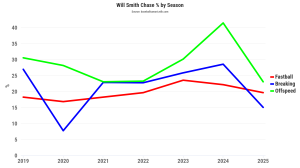
Smith’s chase rate on off-speed stuff was at a career high 41.5% last year, and it has gotten down all the way to 23.1% this year. Just on breaking balls, that number has gone from 28.6% to 15.1%.
Keeping one of the lowest O-swing rates in the big leagues, at 19.8%, Smith has been able to work a walk rate of 17.3%.
When it comes to the batting average, a line-drive percentage that went from consistently at 21% since 2021 to sitting above 27% is a primary cause for that .339 line. The last time Smith had a line-drive percentage this high was in 2020, when he hit .289, a career high mark. And not to mention a .404 BABIP for a hitter whose career mark is .282.
Being more selective about the pitches he swings at, Smith’s quality of contact is up across the board, and that’s clear when you look at an ICR of 51.0%. Sure, the barrel rate is up from 10.3% last year to 11.2%, but this massive jump in ICR doesn’t come just from that; Smith’s solid-contact rate (12.2%) and flares-and-burners rate (27.6%) would also easily be the best of his career.
The quality of contact has been such that Smith’s expected stats are right in line with his actual production after 40 games, with a .421 wOBA and .418 xwOBA. He has earned every single bit of this outstanding production.
Looking ahead, there is a lot to keep in mind. We’ve already discussed the wear and tear of the catcher position, but there is also the question of how pitchers will react to a more passive Smith at the plate. The zone rate of 48.1% would already be the highest mark in Smith’s career, and it stands to reason pitchers might be more aggressive facing the Dodgers’ catcher.
All in all, though, Smith is a relatively safe bet to be the best pure-hitting catcher this season, but when it comes to the top of the fantasy production list, that’s just an entirely different conversation. No one is complaining, though.
