





It’s not often we can look at a rookie pitcher and see a marked change in how they’re going about their business. Granted, Justin Wrobleski had a whole off-season to reinvent himself after his call-up and brief stint in the majors in 2024. He made the most of it, though. He was decidedly one-note with some interesting traits, but not much else to speak of last year. Let’s go over what he was doing then before we dive into why things are so much better for him now.
Last Year
Wrobleski stood out last season for two specific reasons. His comically low release extension and his good fastball, which he lived and died by. He had an exceptionally short stride, leading to just 5.3’ of extension, more than a full foot below league average. While I generally think the effects of release extension are overstated except at the extreme positive end, this was a bit concerning. It both lowered the perceived velocity of the pitch and steepened its attack angle slightly. These are the exact opposite of things you want for a rising four-seam fastball. He also threw the pitch way too much. A 95 mph fastball with 16.7” of iVB and 8.2” of run from a 5.7’ release height is a good base for a lefty, but it’s not a pitch he should’ve been throwing 58.6% of the time. Despite those factors, it still ran slightly above average whiff and swinging-strike rates. He was able to get called strikes with it as well. Getting above-average production out of a fastball thrown that often is a feat, even in a small sample, and it speaks to the quality of the pitch and how well he was using it.
After that, everything he threw was prospective. He had an 87.2 mph gyro slider with an excellent shape and not much ability to locate it. As such, it didn’t miss as many bats as it should, and got hit hard. He threw a low 80s curveball with a bit of movement that he was even worse at locating, and it got demolished. He also substantially changed his delivery to throw it, hurting his ability to sell it. As bad as the results were, the expected numbers were even worse. He flashed a really good sweeper at 84.5 mph with 13.1” of glove side break. This isn’t a pitch most pitchers with his four-seam quality can throw. It’s possible that it was just the result of a grip that worked well for him, but given the spin traits he’s shown this year, I think there’s a good chance he falls into the “spin doctor” archetype I wrote about a while back. Unfortunately, he wasn’t very good at locating this pitch either. I’m skipping ahead a little, but sadly, Wrobleski’s sweeper has not appeared at all this season.
The remaining two pitches included a changeup with decent stuff. It was 9.2 mph off of his fastball with 8” of iVB separation and solid spin deception with very similar direction and active spin percentage. As it’s gone with every pitch other than the four-seam, he wasn’t good at locating it. Lastly, he threw a handful of sinkers that did have good movement separation from his four-seam, but also came in 2 mph slower, and he dropped his arm slot to throw them. Would you care to guess as to his ability to locate this small sample of sinkers?
To summarize, Wrobleski had a good four-seamer that he leaned on heavily to get him through outings, and a cacophony of pitches with at least solid to really good shapes that he could not execute at all. It should come as no surprise that the 36 MLB innings he pitched in 2024 didn’t go particularly well for him. As ever, the most important thing when it comes to evaluating a pitcher’s potential is their traits, more so than their performance. Wrobleski spent time in the lab over the offseason and made several necessary adjustments to take the next step in his career.
This Year
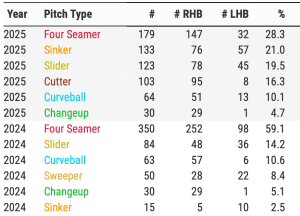
Before we discuss how his usage and pitch shapes changed, we need to address the modification that affects everything he throws. He reworked his delivery, lowering his arm slot and increasing his extension slightly. It has him throwing harder, and his pitch shapes largely got better with the change. Another thing that should be covered before we talk about how his pitches changed is the reordering of his pitch usage.
 (Image courtesy of BaseballSavant)
No longer a one-pitch wonder, Wrobleski attacks with a much more balanced arsenal, varying his pitches and allowing his four-seam to play up as hitters can’t sit on it anymore. Slashing his four-seam usage in half was a risky choice given the track record of his secondary pitches to this point, but his command also leaped forward, making the change viable.
As previously stated, his stuff got better this year, too. The four-seam is coming in with the same amount of iVB, but half a tick faster, from a marginally lower release with better extension. This led to a slight improvement in the pitch’s HAVAA, from +1.3 to +1.5. He’s cutting his fastball more, as its movement direction is further departed from its spin direction than it was last year. This is also visible in the lower spin activity, though the movement hasn’t suffered for it. The pitch that’s seen the most improvement, though, might have actually gotten slightly worse in regards to stuff.
His sinker, like everything else, is coming from a lower release. Despite this, he’s getting more iVB on it. It’s coming in at a much flatter angle than it was previously. However, he’s throwing it around the same speed as his four-seam now, on the same spin axis with the same release point and active spin percentage. This substantially increased the pitch’s deception. It looks exactly like the four-seam out of his hand. With how he’s using them against both handednesses of hitters, they have to guess which one they’re getting with nothing to give either one away. They’re separated enough in movement to make each other better, as the four-seam has an exceptional 30.9% whiff rate this year, and the sinker with the mediocre shape is forcing groundballs and uninspiring contact at excellent rates.
His slider is pretty similar to last season’s edition, though he’s gotten a steeper HAVAA despite the release point drop due to killing more iVB and improving the pitch’s depth. This is a comfortably plus pitch, even more so than the previous iteration, and while his command of it has improved, we’ll talk about that more later. The cutter is a new addition for Wrobleski this year. I think I like this pitch more in theory than I do in practice. He throws it hard, just 3.8 mph off of his four-seam, but gets over the horizontal zero-line with acceptable depth. This pitch’s performance is tied directly to how it’s used more so than the others, and just like the slider, we’ll talk about the execution of this pitch in a bit.
His curveball is close to last year’s. It’s a bit slower with slightly more movement. The changeup is the last really interesting thing he did in regard to his arsenal. This is a completely different pitch. It’s 3.5 mph faster, with 300 fewer RPM, substantially less active spin, and a ton of seam-shifted wake as opposed to the old one, which had very little. This adds up to a changeup with 8” less iVB. That is an enormous increase in depth and stuff. He hasn’t figured out how to locate it yet, as it misses the zone by too much, too often. Should he develop better command of it, this would be a dynamite pitch.
The Path to Further Growth
As great as the changes he’s made are, there are clear signs this is not his final form, nor should it be. I repeatedly stressed how poor the command of his secondaries was in 2024. It’s better this year, but in a way that will lead to some frustration. Wrobleski is running extremely high zone rates on every pitch, excluding his four-seam and changeup. Throwing a lot of strikes isn’t an inherently good or bad thing. I went over that in detail last week, talking about Skubal. The issue pitchers can run into is throwing too many bad strikes.
Wrobleski’s in-zone command leaves something to be desired. The cutter frequently finds itself in the zone on the inner third to righties, where it looks like a strike the whole way and isn’t getting far enough inside to consistently jam them. When the slider isn’t down and off the plate where it should be, it seems to land wherever in the zone. He hasn’t gotten burned on that yet, but it will come eventually if he doesn’t clean those up. The curveball command looks better; he’s hitting the edges of the zone with decent consistency. He does have this odd thing where he’s throwing them high a lot of the time. It’s a dangerous game to play, though it can nab him some called strikes if it catches a hitter off guard. His sinker command is much improved, regularly running it in on lefties and keeping it away from righties in spots that tunnel well with the high four-seam. It’s not perfect, but the intent is clear.
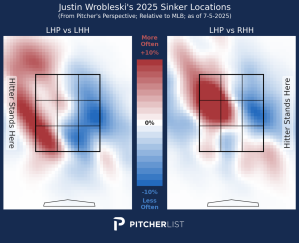
The command is a work in progress, but it’s certainly a substantial improvement from last season. Even still, it’s likely the biggest obstacle in the way of his success now. He already has a full arsenal of pitches; he doesn’t need to make any changes there. It would be fun if he could reincorporate the sweeper, but his current mix is so good that he probably doesn’t need to. Every step forward he makes now is likely tied to his ability to execute his pitches better. Given that he’s using a new delivery and still found a way to make improvements in that aspect this past off-season, I wouldn’t bet against him.
*Of course, as I’m writing this, the Dodgers sent Wrobleski down to AAA. I hope he’s back up soon.
**He’s pitched in Colorado a few times already in his brief MLB career, so all pitch shape data excluded those outings as they color the samples a bit, and are not representative of how he normally pitches.
