





Have you ever found yourself in a situation where you wanted to do everything available to you, but only had a limited amount of time or choices you could make? Maybe at a music festival, you had a few artists you wanted to see, but two of them performed on separate stages with the same start time. More relevant to baseball, maybe you created a player in a video game with maxed-out stats. A pitcher with an unhittable 4-seamer, a 90 mph sweeper that moved across the length of the screen at a mind-bending angle, a hammer of a curveball, and a sinker just for when you needed to roll a double play.
That specific pitcher probably only exists in video games, but the closest thing we get in real life is an archetype of pitcher I have dubbed the “spin doctor”. Spin doctors are unique in that, in a sense, they actually can have it all. This is not generally the case, most pitchers are born with a built-in amount of things they can do. As an example, think of when you see a pitcher go to a development camp and come back the next season with a devastating new pitch. It’s not that they magically added a new skill; it’s that they learned something that they had always been capable of.
No pitcher is exactly the same as another, but there are only so many molds they can be crafted from with some level of variation. This is due to how the molds work. They’re primarily built from natural physical biases and tendencies. The most important distinction that affects what a pitcher can make the baseball do is their pronation vs. supination bias.
A General Breakdown of Pronators and Supinators
For any readers unfamiliar with what those terms mean, I’d like to run through a quick exercise with you. Let your arms hang loose at your sides, then bring your hands forward by raising your forearms, so that your palms are facing each other out in front of you. Now, tilt your thumbs away from each other just by turning your forearms, and finish with your palms facing the ceiling. This is you supinating your forearm. The inverse, twisting your forearms so that your thumbs go toward each other and palms face down, is pronation of the forearm.
Everybody has their own built-in movement biases that make them more or less able to do those motions than others. For pitchers, these biases are what form the basis for their pitch arsenals. Pitchers with more aptitude for pronating tend to fall into similar buckets as each other. While he likely wasn’t the first to notice the trend, Tyler Zombro of Tread Athletics was one of the first people I saw explaining the “pronator’s triangle.”
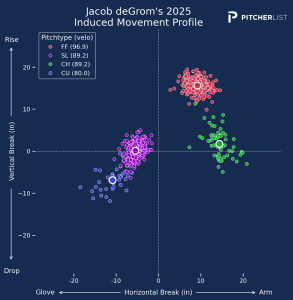
This is more or less what you can expect from a pronator. A 4-seam, changeup/splitter, and gyro slider forming a neat triangle is what they tend to do best. Granted, there are always some differences and variations. Some are better at turning over changeups than others, some can get better velocity on their gyro sliders through spiked grips, though if we start talking about the differences pitch grips can make, we’ll be here all day.
The important thing missing from the vast majority of pronators’ decks of cards is breaking balls with both power and significant movement. Some of them can pull it off if they throw all of their pitches with extreme velocity, think Paul Skenes. Now, consider that Brandon Pfaadt, who decidedly does not throw as hard as Skenes, throws a sweeper that is functionally almost identical.
Look at what pronators need to do to mimic a fraction of supinators’ power. This isn’t the only gift bestowed upon supinators that isn’t shared with pronators. Supinators generally have access to pitches with superior seam-shifted wake. This most commonly appears in sinkers and changeups, causing them to move in a way that is disaligned from their initial spin direction.
The advantages the average* supinator has, the ability to build a wider arsenal of strong pitches, and more aptitude for different pitch types do come with a caveat, however. They are generally not able to create the same excellent 4-seamers that pronators can. They struggle to reach the same levels of active spin percentage on 4-seamers, causing less of the total spin to contribute to movement.
What Makes “Spin Doctors” Special
Enter the spin doctors. They come in multiple forms, but they all share one thing in common that other pitchers do not. They can draw from the advantages of both spectrums.
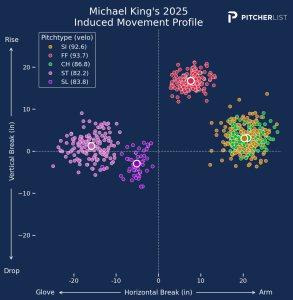
Do you see it? King has a strong pronator’s triangle between his 4-seamer, changeup, and gyro slider. Is that what you think of when you think about his pitching? Probably not, you think of his incredible east-west mix with his gorgeous sweeper and heavy sinker. This is what I mean when I say they’re capable of both. King has a decent 4-seamer, and also a sweeper with incredible movement that’s just 10 mph behind his fastballs. That is a rare combination, and it’s a big part of what makes him so great.
So, how does he do it? In what I would consider a trend among this archetype, King has a high-spin 4-seamer at 2375 RPM, with 84% spin efficiency. Pronators with high-moving fastballs tend to be 90+%, allowing them to maximize their spin that contributes to movement. King doesn’t have the most efficient spin, but the total spin makes up for it. This, combined with his strong shape compared to his arm slot, gives him a solid second fastball. This can be a tell for what pitchers like this are capable of, looking for guys who accomplish good 4-seam shapes with total spin rather than efficiency, who also have breaking balls with movement and less velocity separation. Marlins rookie Lake Bachar is the most extreme example in the league right now, with his nearly 2700 RPM 4-seam having 88% spin efficiency, giving it exceptional movement, while he also throws a beautiful high-80s sweeper.
Spin doctors come in multiple forms though, they don’t all look exactly like King as pitchers. Bryan Woo, another very successful example of this specific type, has a similar skill set but dominates with his 4-seam almost exclusively because he gets lower and creates a difficult attack angle for it.
Let’s look at someone who does it very differently. Cardinals reliever Kyle Leahy is one of my absolute favorite pitchers right now. He pitches from a higher slot than King or Woo, and like Bachar, he doesn’t use a sinker very much. Unlike Bachar, Leahy’s fastball is not as extreme. 94.8 mph with 17.1” of IVB and 3.2” of HB from a 5.9’ release height with elite extension is a perfectly fine cut-ride shape that will help him get by. It’s not a detriment, but it’s not his strong point either. The thing that makes Leahy special is his incredible mix of secondaries.
Leahy has a gyro slider that he throws very hard at 90.2 mph with 4.9” IVB and 5.1” HB. Nobody this season has thrown a harder slider with more HB on average, and only two pitchers (one of whom is aided in this by having Coors Field as a home park) have a harder slider with more depth this season. This is also somehow only Leahy’s second-best slider. His sweeper comes in at 86.2 mph on average, with an exceptional 14.9” of HB at that velocity. As you might imagine, no one has thrown a harder sweeper with more movement this year. The pitching nerds amongst you might have guessed Orion Kerkering, but he’s checked in at 86.5 mph with 14.3” so far.
You would expect that the hardest and most-moving breaking balls in the majors this year would come from a pitcher with exceptional velocity. As we’ve already established, that is not Leahy. Among pitchers with at least 50 fastballs thrown this season, Leahy’s fastball velocity ranks tied for 159th out of 440. We haven’t even gotten to his changeup or curveball, which are also excellent. His changeup, which has low spin efficiency and excellent seam effects, is likely thrown with a grip that’s better for supinators. His curveball is a hammer at 82.7 mph with -13.7” of IVB, and 9.7” of HB. While I wouldn’t mind seeing it be trimmed more towards the middle line horizontally, the real thing to note is the incredible spin mirror and deception he gets.
All of this is what makes spin doctors so special. The ability to build wide arsenals of great pitches, without being restricted to just throwing sinkers or bad 4-seamers for fastballs. A lot of them will take advantage of this by throwing both solid sinkers and 4-seams, like the aforementioned Woo and King. I’ve written about both of them before, and mentioned this unique ability of theirs, at the time not realizing that there were a lot more guys out there who were like them. Zack Wheeler follows a similar mold of excellent mid-80s % spin efficiency fastballs from a low arm slot as his base. Red Sox rookie Richard Fitts looked brilliant before getting hurt, he was actually going to be a big part of this article before that, given his uniqueness as a high-slot supinator with a 4-seam primary. Jax, Bubic, Rasmussen, PabLó, Casparius, Stewart, Warren, May, these guys are popping up more and more, and they’re going to take over the league.
What to Take (and Not Take) From This
After pure dominance in a pitch mix, the most coveted aspect for a pitcher is versatility. If you aren’t prime deGrom, tearing through hitters with two unhittable pitches, you need options for different situations. Rare is the pitcher who has a tool for every job. Now granted, throwing some of everything is difficult, sometimes you have to scale back the mix to make sure you’re commanding everything well enough (cough cough, Bryce Miller). I’m not advocating for everyone capable of it to throw every pitch under the sun, but the ability to pick and choose from almost every pitch you can think of is a gift.
Another thing to keep in mind, while I noted most pitchers of this archetype are in the 80-89% spin efficiency range with their fastballs, that is not a hard and fast rule, and also not a clear identifier on its own. There are pitchers in that range who are not capable of the same things as the guys I’ve mentioned so far. Some pitchers can do these things with fastballs in other ranges; the aforementioned López and Stewart are both in the mid-70s with their spin efficiency. The real tell comes down to analyzing the pitcher individually. If they have an effective 4-seam fastball, mixed with some supinator traits in the rest of their mix, there’s a decent chance they have the potential to do a lot of different things with their arsenal.
On very rare occasions, a pure pronator will come along who can imitate this ability not with elite overall velocity, but with pitch grips. The 4-seam with excellent spin activity and movement, paired with good, hard-thrown (relative to their fastball velocity) breaking pitches. These pitchers are difficult to predict the existence of until they’re already showing off their ability. If you’re trying to find a pitcher you think could grow their arsenal and become a more versatile arm, this is not the best way to look for them.
Back to the main topic, this type of pitcher is not inherently perfect. The ability to do many things as a pitcher does not necessarily make those options worthwhile additions. What makes them great is the fact that they theoretically can do those many things. That is not a trait afforded to everyone who picks up a baseball. So while this doesn’t automatically make them a budding star, it raises their potential floor and ceiling in a way that other pitchers can’t. It doesn’t make them better on its own, it allows them to grow in different ways not available to everyone. Like with any player, keep your expectations within reason with these pitchers.
That said, there’s likely something to be said about this type of arm being a way for savvy teams to gather more pitching talent. Identifying the potential this trait offers is probably a great strategy for building a group of talented pitchers, both for current rosters and prospect pools. As baseball and the analysis of it evolve, new trends and market inefficiencies arise. At the start of the Statcast era, the forward-thinking teams scrambled for pitchers with high-spin 4-seamers and low-spin sinkers. When pitch tracking was upgraded with Hawk-Eye systems, the obsession became seam-shifted wake. More recently, it was the explosion of attack angle-related metrics. Now, perhaps, it could be these guys.
*I didn’t include it in the main article because the section was getting lengthy as it was, but there are multiple archetypes of supinators, such as “super supinators” who have the inherent advantages and disadvantages of being a supinator bumped to the extreme. Shockingly low fastball active spin rate, breaking balls with crazy movement and speed, and stunning SSW capabilities. Think Sonny Gray and Clarke Schmidt
