





In the infinite equation of Major League Baseball, we have come to appreciate the constants. There are the flamethrowers with little control and sluggers struggling with swing-and-miss; soft-tossing innings eaters and slap hitters committed to keeping .300 batting averages alive.
Unless you’re Jacob Misiorowski, subscribing to a specialized archetype often blunts analysis. Kyle Schwarber isn’t going to stop whiffing anytime soon. Your favorite reliever’s walk rate is probably here to stay. In the words of the great Nick Saban, “I’m not going to, so quit asking.”
Tampa Bay Rays star Yandy Díaz might be the most consistent hitter on his side of the Mississippi, but a more lucrative hypothetical has always mirrored his production. What if he finally tried to optimize for fly balls?
In his age-34 season, Díaz isn’t radically changing his approach. He’s the same guy he’s always been, but in 2026, his 156 wRC+ has buoyed Tampa Bay’s offense and postponed worries about a mid-30s decline. Fortunately for the Rays, he’s not relying on extreme batted-ball luck or an unsustainable power surge. Rather, Díaz’s approach is shifting the odds slightly in his favor and amplifying his strengths.
Díaz Is a Known Quantity
Díaz has managed to become a fixture of Tampa Bay’s core without realizing his power potential. Instead, he has continuously won with elite bat-to-ball skills and impressive plate discipline. And as much as his power is unoptimized, he’s not selling out for contact and sacrificing exit velocity to save his strikeout rate.
None of this feels accidental. After all, Díaz has spent the last eight seasons in one of baseball’s most forward-thinking organizations.
His skill set is parsed out well by PLV, where his Decision Value+ (116), Contact+ (113), and Power+ (109) have resulted in a 126 Process+, good for 37th in MLB. Perhaps more emblematic is his 119 Whiff Avoid+, backed by 97th-percentile O-Con%. You can get Díaz to leave the zone, but he’s preternaturally good at getting better results than those swings would suggest.
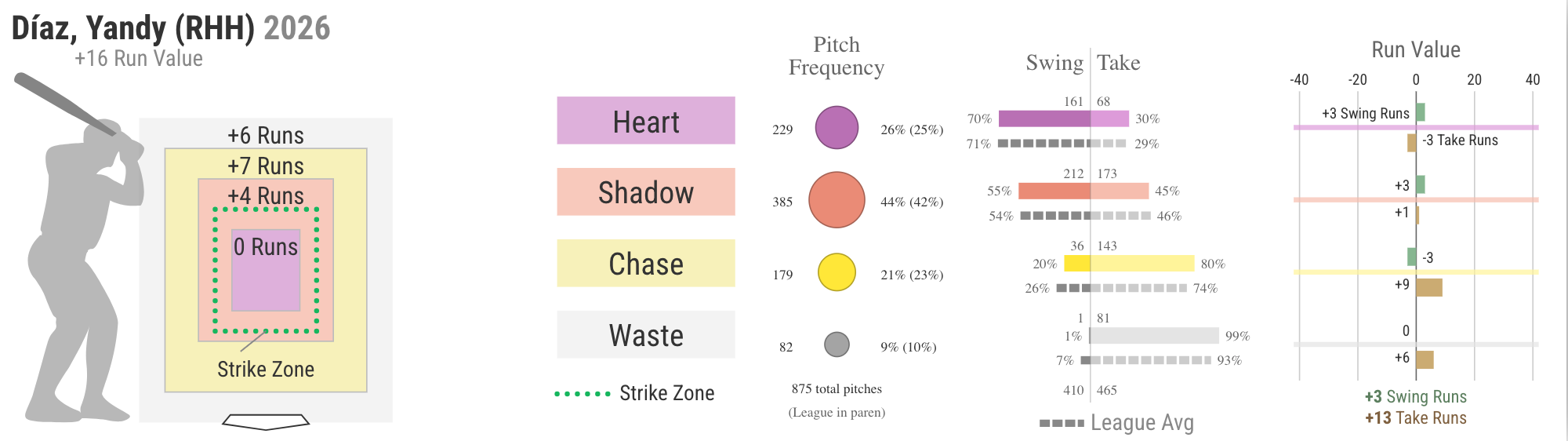
This season, Díaz is getting the most out of the shadow zone, explaining much of his improvement.
via Baseball Savant
It’s important to note that the shadow zone includes part of the strike zone, so not every shadow swing is necessarily considered a chase. Furthermore, not all chases are created equal. A swing in the chase or waste zone is almost guaranteed to produce poor contact or a whiff. In the shadow zone, though, there is still room for damage.
Here, Díaz has been exceptional, and these gains may have unlocked upside once left behind in his early 30s. In his first year with positive run value in the shadow zone, he has taken full advantage. Among 113 hitters with at least 100 qualifying plate appearances, Díaz ranks sixth in shadow zone run value. The five names above him—Yordan Alvarez, Ben Rice, Jordan Walker, Andy Pages, and Shohei Ohtani—are a collection of MVP candidates and breakout campaigns.
For comparison’s sake, Díaz has generated +4 run value in the shadow zone in 55 games. In 150 games last season, he created -7 run value.
I’ve come to think of this as a refinement of a strong, if imperfect, plan of attack. We know that Díaz can make contact out of the zone, and his all-encompassing chase rate (29.7%) is fairly pedestrian. That makes more sense if the pitches he is swinging at outside the zone aren’t that far away.
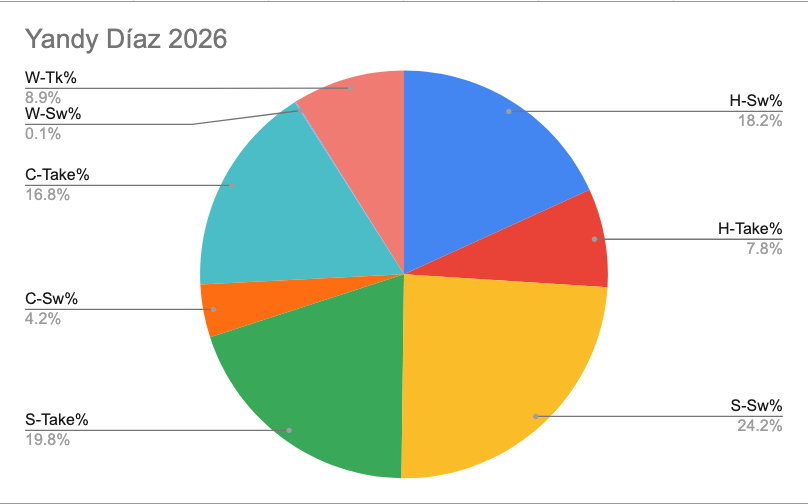
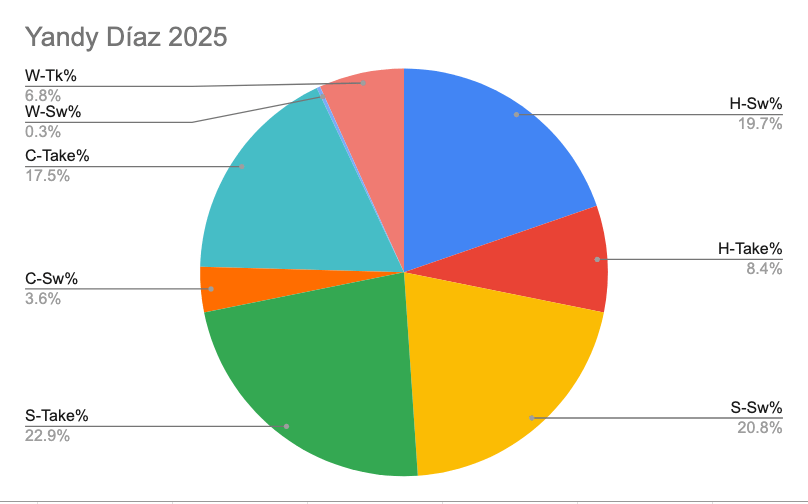
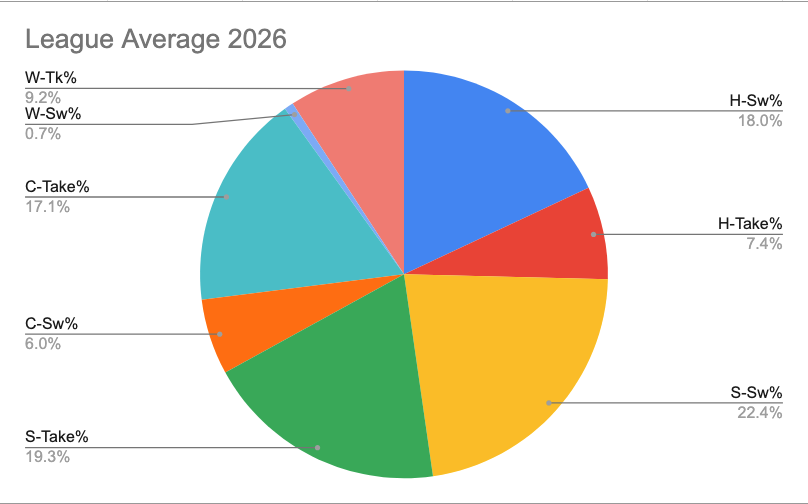
The biggest change in Díaz’s distribution is an uptick of swings in the shadow zone; a 3.56% increase from 2025. Given how much success he’s had on said swings, that seems like good process.
Likewise, Díaz’s chase zone yields promising results. He’s chasing a little more than last year, but compared to the league average, he is swinging at a smaller fraction of his chase-zone pitches and offering at a greater share from the shadow zone. The result is more competitive swings, made more productive by his natural bat-to-ball skills and an elite ability to retain high exit velocities on suboptimal pitches.
Diaz Is Dialing Up the Power
Another significant part of Díaz’s big year is an influx of power. Posting 11 home runs in his first 240 appearances, he’s going yard at the highest rate of his career and slugging .529 (93rd percentile) with an identical xSLG.
Díaz isn’t showing significant signs of aging, but his 90th-percentile EV is down almost two ticks. Nevertheless, his power has been present, even as his SEAGER (which measures swinging at damage-prone pitches, rather than just strikes) has plummeted. Again, it’s clear he isn’t optimizing for power—that hasn’t stopped him from clearing the fence.
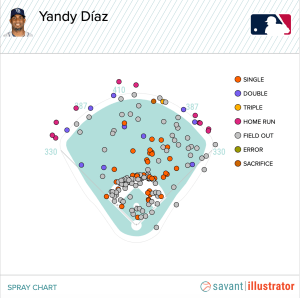
While Díaz will likely never be a pull-air aficionado, some of his power gains are in fact a result of pulled fly balls. Improving his pull-air% from 5.8% to 8.3% doesn’t get him out of the bottom decile, but tapping into pull-side power has added a couple of homers to his ledger. With Tampa Bay’s short porch in left, it’s a useful club to have in his bag.
Similarly, Díaz isn’t quite as grounded as years past. His 53.9% groundball rate is somehow his lowest mark since 2022. He’s hitting the ball in the air just a little more, improving his overall launch angle by 0.8° and increasing his fly-ball exit velocity by 1.8 mph. Paired with a similar HR/FB% to last season, his damage doesn’t feel like great fortune. Neither his HR/FB% nor BABIP is out of line with career norms, and he is only outperforming his xwOBA by 13 points.
This approach has its holes. Díaz’s 0 run value in the heart of the zone is a steep decline from last season (3 runs), and a downturn in exit velocity and SEAGER is still a negative signal for a potential power decline. It’s presumably more difficult to make a living in the shadows than in the middle of the plate, and there is obviously some level of power being left on the table by his proclivity for burning worms.
Even so, Díaz has a track record of plate discipline that suggests his swing decisions are intentional, and he has the bat-to-ball skills to pull it off. In the meantime, he’s accessing more power than ever before without sacrificing strikeouts, paving a path to his most productive season since 2023.
Adapted by Kurt Wasemiller (@kurt_player02 on Instagram & Threads
@kuwasemiller.bksy.social on BlueSky)
