





Things ain’t like they used to be. A decade ago, the average line of the top-25 first basemen in terms of offensive WAR was 84/28/98/.288, not surprising considering the 2009 bagmen pool included the prime years of guys such asAlbert Pujols, Mark Teixeira, Derrek Lee and Adrian Gonzalez.
For 2018, that same average first basemen has more in common with Aubrey Huff than Prince Fielder: 72/22/76/.259. While guys such asPaul Goldschmidt, Freddie Freeman, and Anthony Rizzo are trustworthy staples at the top of the first base pool, there are a lot of more guys with question marks around them that don’t inspire the same confidence. The players below are being overrated based on how the draft market is perceiving them. All of these guys should be owned, just not by you at their current ADPs.
Overrated
Cody Bellinger (Los Angeles Dodgers, ADP: 45): Bellinger’s appearance here is less a knock on his skills than it is a criticism of his fourth-round ADP. Last year at this time, he was going 26th overall in drafts. While he was serviceable in 2018, I’m sure his owners from this past season will tell you otherwise. If nothing else, his 25 long balls were a pretty massive disappointment after smacking 39 as a rookie in 2017.
What’s more concerning is the pedestrian quality of contact Bellinger made this past year, ranking 74th in 95-plus mph hits, 113th in barrel rate, and 85th in average exit velocity. Compare that with his rookie season, where he ranked 63rd, 26th, and 41st in those categories, respectively. The narrative at the end of 2017 was that pitchers had adjusted to him and he couldn’t hit breaking balls. While that didn’t really end up being the case this past year, at least in terms of his plate discipline metrics, it seems reasonable to assume Bellinger just isn’t able to get the bat on the ball in the same way he did in Year 1.
Also concerning is his overnight erosion against lefties. Despite not seeing much of a split in his 2017 season, Bellinger’s OPS against southpaws dropped from .903 to .681 this past year. He’s only 23 and just a year removed from a monster season, but there’s also not a lot to hang your hat on here to confidently say he’ll be better than he was last year. If he drops a round or two, I’d be happy to swing for him, but I want to have more confidence in my fourth-round pick than I do in Bellinger.
Jesus Aguilar (Milwaukee Brewers, ADP: 79): Something happened to Jesus Aguilar after the All-Star break. It’s not always fair to play the first-half/second-half game in making judgment calls on players, but I’m going to do it here anyway.
| HR | PA/HR | HR/FB% | GB% | FB% | AVG | ISO | |
| First half | 24 | 13.2 | 27% | 30.6% | 45.4% | .298 | .324 |
| Second half | 11 | 22.7 | 19% | 41.1% | 35.6% | .245 | .191 |
There’s clearly something going on, as Aguilar’s decreases in home runs, fly balls, and ISO point to more than just getting unlucky in the second half. Most troubling is that his ground-ball rate increased exactly as much as his fly-ball rate dropped. Not only were those extra grounders sapping his power, but when he did hit the ball in the air, it was less likely to clear the fence. Either Aguilar was hampered by a mechanical issue or he was facing a pitching adjustment. Let’s explore the latter below:
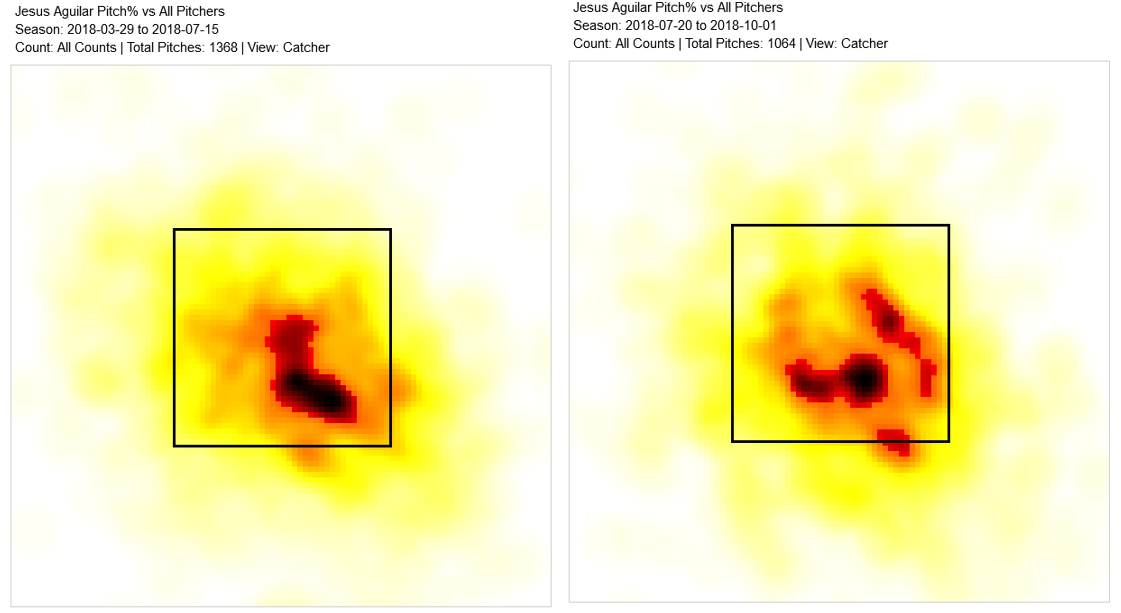
In the first half (the heat map on the left), opposing pitchers hammered the low-and-away part of the strike zone, and Aguilar returned the favor by hammering those pitches accordingly. The heat map on the right shows that pitchers took a more meticulous approach to finding holes in the right-handed slugger’s swing after the All-Star break. Heat maps for his ISO and SLG show similar splits.
The takeaway here is that he just wasn’t seeing his favorite pitches as the year went on. For a guy with only 900 career plate appearances, that potential league-adjustment has me a bit too concerned to invest at pick 79.
Ian Desmond (Colorado Rockies, ADP: 140): Since 2012, only two players have had five seasons of 20 homers and 20 stolen bases. One is Mike Trout, the best baseball player of his generation. The second is being drafted in the 11th round, which still might be too high. If I were forced at gunpoint to wager double-or-nothing on Desmond joining the 20/20 club for a sixth time in that span, I’d only ante-up things I’d be happy to get rid of: the overfilled waste bag in our Diaper Genie, the crate of empty paint cans in my garage the dump won’t accept, my crippling student loan debt — things like that.
Two key batted ball types jump out: his league-high 62% ground-ball rate, and his league top-five HR/FB%. The trouble with the grounders is self-evident in that he’s negating the positive park factors of Coors Field by putting nearly two-thirds of all batted balls into the ground. His dribbler rate of 38.4% was second-worst in the majors this past year, which points to some extremely weak contact.
The high HR/FB rate of 24.7% seems good on the surface, but it’s almost certainly not sustainable. Only four batters with more than 500 plate appearances performed better in that metric this past season: Christian Yelich, JD Martinez, Joey Gallo and Giancarlo Stanton. Of those players, Desmond had the lowest average launch angle (0) and weakest average exist velocity (89.2 mph). Given he’d never even hit more than 20% of his fly balls for home runs prior to this past season, it seems like there was a lot of luck involved. When you combine that with his propensity to swing and miss, you have an aging player with a low floor. No thanks.
Eric Hosmer (San Diego Padres, ADP: 170): Don’t take this as some sort of bold stand, but Hosmer seems to be a perennial resident of these types of do-not-draft lists. Thinking I was being edgy with this call would be the equivalent of making “Nickelback sucks lolz” memes in 2019 and patting myself on the back for originality. But still, I feel compelled to state the obvious in all caps because his ADP is somehow not lower: DON’T BE THE PERSON WHO DRAFTS HOSMER.
If my hand-wringing isn’t enough to convince you, try this: His -1.2 launch angle was worst in the league this past year among qualified batters (min. 300 plate appearances) and is the second-worst launch angle ever recorded in the Statcast era, which explains his 60% ground-ball rate. Not only that, but 38% of his batted balls qualified as dribblers, which was third-worst in the league. His strikeout rate rose to a career-worst 21%, a troubling trend supported by career-worsts in swinging-strike rate (12.1%) and contact rate (74.7%). Hosmer also struggled mightily against lefties last year, posting a career-worst OPS of .527 against southpaws.
He may bounce back, but Hosmer’s never had enough upside appeal to be worth betting on, even in the 14th round. At that stage in the draft, I’d rather wait a few rounds and chase higher-upside guys such as Luke Voit, CJ Cron or Justin Smoak.
Photo by Dan Sanger/Icon Sportswire
