





Andrew Painter has been on quite a journey since being drafted five years ago. The first-rounder quickly established himself in the Phillies farm system, becoming MLB’s sixth-ranked prospect overall and top pitching prospect by the end of his first full pro season in 2022. He climbed three levels up to AA while posting stellar results at each level as a 19-year-old, and the hype was off the charts. Scouts raved about his projected 70-grade fastball and his hyper-advanced ability to command his pitches. All signs pointed toward him being an ace sooner rather than later.
Blue Period
A sprained UCL diagnosis during 2023 spring training derailed the hype train at least for a while. After delaying for a few months, he got Tommy John surgery in July of that year. He went two full years between starts in a live game, returning to the mound in the Arizona Fall League in 2024. 2025 saw him open the year in A-ball for a few starts before being called up to AAA. He struggled through the season, with all of his stats exploding in the wrong direction from when we’d last seen him.
He made the Phillies roster out of spring training this season despite last year’s struggles, and he even had a strong debut. What followed was an unceremonious stretch of bad outings that led to him being sent down. After that, our own Will Orsland wrote an article discussing Painter’s struggles and the adjustments he needed to make. His miserable first half is better documented there, but here’s a brief overview:
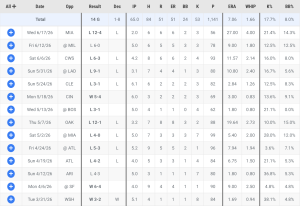
This wasn’t what anyone had in mind for him, and it was a far cry from what was expected before he got hurt. He spent a month in AAA and had a mixed bag of starts. When Painter was called back up in late July, as if he had trained in an atelier, he had clearly modified his approach. The ideas offered in Will’s article were on the right track; a usage change was exactly what Painter needed. In practice, Painter’s course correction looked slightly different than what Will had outlined. No one could’ve predicted he’d come back a month later with a brand new pitch he was so confident in that he’d spend the next month and a half throwing it more than any secondary he had used up to that point.
Acrylics, Watercolors, and Oils
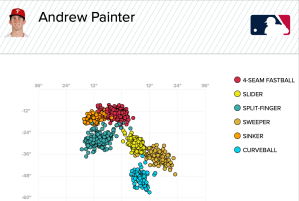
A lot of his pitches have fluctuated/changed over the season; I’ll cover that after this section, as not all of those changes have stuck. Before we break down said alterations, we should quickly cover what he actually had to work with and remix.
Painter’s primary fastball, lauded as it was when he was a top prospect, is a league-average pitch by stuff standards. It hasn’t performed like one so far, but we’ll get there. His uniquely high release point and upper-end velocity are bonuses, but its cut-ride shape from such a high slot leaves something to be desired. It has below-average vertical movement, though by cutting it, it’s well removed from the expected dead zone given his arm angle. The lack of horizontal movement plays somewhat to its advantage.
Painter’s first slider is a plus pitch, though not a particularly interesting one. He throws it hard, with solid depth that is further aided by the high release, giving it a steeper VAA. It also has good horizontal break for its velocity.
His sweeper is interesting in that he significantly drops his arm slot to throw it. This makes sense; sweepers are difficult pitches to throw from higher slots, though this drop can sometimes be identifiable for hitters. That aside, this pitch is also a plus breaker, with a ton of horizontal movement and decent power in the low-mid 80s.
Painter’s splitter is an odd pitch, with substantially less depth than most splitters, even accounting for his higher arm slot. This lack of depth may add some deception, as it comes out with a similar VRA to his fastball, and it maintains a steep VAA due to his high release point. It’s an odd pitch, but a decent one.
The version of his sinker we saw in the first half was not good. This pitch is likely doomed to never have good stuff grades due to his naturally high spin direction relative to his arm angle. You generally want more than the two inches of vertical separation he was achieving on his fastballs. The horizontal separation is nice, but it can only do so much. He made changes that helped, and the steeper VAA his high release creates should get this pitch some ground balls, even if it may never have great depth.
For a high-slot supinator like Painter presumably is, he has a surprisingly mundane curveball. It’s not a bad pitch; he throws it with slightly higher-than-league-average velocity with a slurvy shape and somewhat limited break. Curveballs that reside in the back of the arsenal like Painter’s can get away with mediocre stuff quality considering the role they play, so it’s not the end of the world that this pitch is just okay from a stuff perspective.
From Portrait To Landscape
Now that we’ve established the offerings that were at Painter’s disposal, we can better understand what the change in his process looks like and does for him.
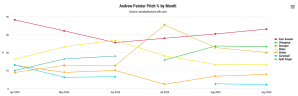
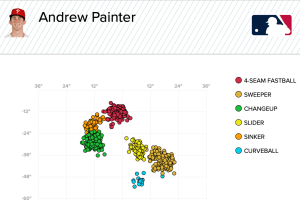
Some things immediately stand out. His splitter is gone, and the changeup has replaced it completely. He’s also reversed his slider usage, opting for more sweepers instead of gyros. His sinker took a back seat as he tinkered with it, and the curve has been demoted to an afterthought. What does this mean, and why did he do it? I think, at least in part, he wanted to space out his arsenal. He had a very tight cluster of movement, and working in pitches that create a wider horizontal and vertical spread gives hitters more to think about.
(Images courtesy of BaseballSavant)
Let’s start with the biggest change. Upon returning to the majors in July, Painter’s new changeup had taken the role of offspeed pitch, and the splitter was shelved. He hasn’t thrown that pitch since, and the changeup has become a massive part of his mix. It’s not hard to see why: the pitch has superior depth and fade, and he seems to command it better too. Lance Brozdowski documented the new pitch and its differences back in August.
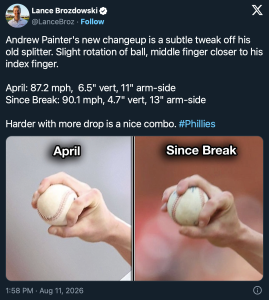
The new changeup achieves this shape with incredible seam effects while also having more active spin and a lower initial spin direction than his splitter did. It’s an excellent offering, with good movement separation from his fastball and strong depth aided by his high release. The numbers this pitch has returned, given it’s completely new to him, are extremely impressive. But considering how good the stuff is and the feel he has for it, they may not be that surprising.
His sweeper has also stood up well to the increased usage, giving his fastball a reprieve as his primary pitch against righties. While his fastball improved, it’s still not the kind of pitch you want shouldering the load. His sweeper, on the other hand, has done a good job in its new, more demanding role.
The little things add up to significant change across his arsenal as well. His 4-seam was coming out straighter, gaining rise and having even less horizontal movement, with higher spin rates from a slightly lower arm angle. It’s starting to revert to something a bit closer to what it was before he was sent down, but the extra inch of rise it had for a bit was probably good for a half step up on the 20-80 scale. Dropping his arm slot on his slider a bit seemed to help him get around it better, creating more depth in July and August, though it seems to be trending back toward its original shape in his last few outings. He also dropped his arm slot on the sinker, further eschewing uniformity across his delivery in pursuit of higher stuff quality.
All these modifications have reshaped what Painter looks like on the mound. They’ve been the catalyst for his first real success at the major league level after his miserable first half.
Broad Strokes
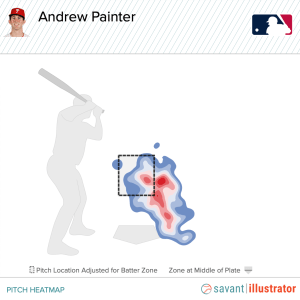
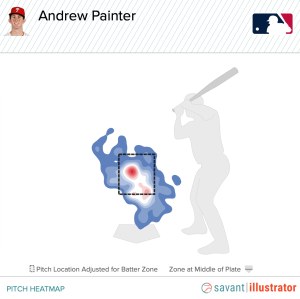
So what’s next for the Phillies’ promising young starter? He’s got a ways to go before he’s a finished product; there will likely be more headaches along the path to him reaching his potential. While he’s seen success managing contact against lefties in the second half, I’d like to see him strike them out more consistently. He’s been leaning more and more on his 4-seam and changeup against them, and I’m not convinced that’s going to work forever. He’s been using his slider against them less often as the season has gone on, and I think that’s a result of how it has played against them. This performance is a product of his ability to command it against lefties, which is stunningly different from how he wields it against righties.
Slider Locations Since Return
(Images courtesy of BaseballSavant)
If he could find a way to throw the slider to lefties as he does to righties, that would do wonders for his ability to handle them, especially when he needs a strikeout. His PAR% against them in the second half is only 15.0%; he could really use another pitch as a finishing blow when he gets to a 2-strike count. Even if that’s not the slider, using more pitches than just the 4-seam and changeup could open the change to more whiffs with two strikes.
Beyond this, most of what’s left for Painter to work on is consistency. He loses the zone sometimes and can get too predictable, filling the bottom of it even when he has his handle. He could also benefit from lessening his dependency on his 4-seam. Even with the changes he’s made that should help it play closer to its quality, I don’t love how often he’s using what I believe to be a fairly hittable pitch. The way he’s using it is protecting it, zoning it just 37.6% of the time since his return. This kind of process for a fastball that’s being thrown 30% of the time, and 36% against lefties, can put him in bad counts more often than you’d like. Despite this, he’s managing counts at a league-average rate right now, in large part due to his extreme aggression with the sweeper and changeup.
It hasn’t always been pretty, but he’s made noticeable progress. He’s earned every bit of his improvement, and I’m impressed by how quickly he adapted to his ill-fated first run in the majors. It speaks well of his intelligence and mindset as an athlete that he got in the lab with coaches after being sent down, having realized that what he was doing wasn’t working, and looked to fix it. He didn’t become a top prospect by accident, and he didn’t bounce back by accident either. I love what I’ve seen from Painter in the second half, both the changes he’s made and his desire and willingness to pursue them. He’s not done yet, but it seems like he’s well on his way to finding his best form.
Photos by Icon Sports Wire and Adobe Stock | Graphic by Carlos Leano
