





Much has been said about the injuries to the Dodgers’ starting rotation. Although no one may have projected a situation as dire as they currently face, injury concerns were evident before a regular-season game was played. There were real question marks about the ability of any of those starters to stay healthy through a full year, with some having never done that in their big league careers.
The bullpen, on the other hand, was a different story, even while accounting for the injuries before the season got underway. Surely, an already strong unit that added Kirby Yates and Tanner Scott would get by just fine. That unit has gotten by, but not in the way you’d expect, and with contributions from unlikely names.
If you look up the fWAR leaderboard on the Dodgers’ pitching staff, at numbers two and three right after Yoshinobu Yamamoto, you’ll find the names of Ben Casparius and Jack Dreyer, a couple of arms pretty much buried on this depth chart ahead of the 2025 campaign.
Before diving into what it is that these two are doing to make them such crucial pieces to the Dodgers’ pitching staff, it’s important to note a very murky outlook for this unit moving forward, both concerning injury woes and general struggles.
One of the healthy names from the Opening Day bullpen, Scott’s saving grace this season is that he is not walking anybody (3.8% walk rate). Still, not walking people doesn’t mean much if you’re allowing a .442 SLG as a closer. The underlying numbers show Scott is dealing with some tough luck, and while his level of production moving forward is in question, he should bounce back. The series against the Mets was already very promising. But the point is that beyond him, Los Angeles doesn’t have much in terms of proven healthy commodities.
Evan Phillips is out for the year. Michael Kopech, Kirby Yates, and Blake Treinen have all missed significant time. Not to mention the fact that righty hitters are performing like MVP candidates against Alex Vesia. Given the injuries of all of these high-profile relievers, Los Angeles will likely often err on the side of caution, eyeing another deep October run.
Primarily a starter through the minors, Casparius falls in that group of valuable relievers who can routinely give you more than three outs. In fact, the 39 innings Casparius has pitched so far in 2025 put him near the top of the leaderboard for relievers. He pitched 2.2 innings as a starter in the one time this year he filled that role, holding the Cubs scoreless in Wrigley shortly after a disastrous outing against them at home.
Jack Dreyer, on the other hand, has been a reliever since joining the organization. Although his exposure is somewhat limited, as he has yet to reach 60 innings as a pro, the Dodgers haven’t been shy about riding him this season. In fact, if Dreyer keeps up this pace, he’ll blow through his career high for innings as a pro in a calendar year, currently at 32.2.
There has been quite a bit of clamoring for Los Angeles to turn Ben Casparius into a starter. That’s the case because, unlike most relievers, he has three plus-pitches in his mix, plus a curveball that gets decent results against left-handers.
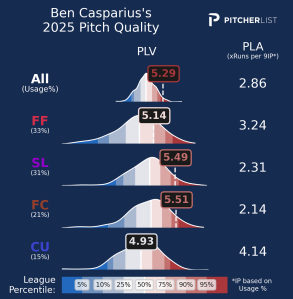
Last year’s sample size was very small at just 8.1 innings, but it’s important to note that Casparius decreased the fastball usage by a decent chunk and started throwing a lot more cutters this year. As a pitcher who relies on overpowering batters, Casparius doesn’t really pound the zone with his fastball, throwing it in the zone at only a 53.2% clip, instead relying heavily on swing and miss action on the pitch. The primary characteristic of it to help in that department is an induced vertical break of 18.0 inches that puts him in the 92nd percentile among all relievers.
As an arm with a deep arsenal for a high-leverage reliever, Casparius works that to his advantage by having two separate approaches against righties and lefties, which ties into a significant enough splits difference, as the right-hander is unhittable against righties.
The slider, which Baseball Savant qualifies as a sweeper, is primarily reserved against right-handed hitters, thrown against them at a slightly-under-50% clip. With a spin rate of 3056 RPM, which puts Casparius in the 99th percentile, and elite horizontal movement, hitters simply don’t make good contact on the pitch. Despite using the pitch half the time he faces right-handed batters, they only have one extra-base hit off it the whole season.
Against left-handers, Casparius relies on a pretty even split of cutters and curves to complement the fastball, both thrown at a slightly above 25% clip. The fastball and curve induce whiff rates of roughly 40%. When he has gotten in a bit of trouble, it has been with the cutter. Way more than on any of his other pitches, batters tend to swing a lot and rarely miss against the cutter. Lefties are hitting .286 off that pitch, but the good thing is that he’s been able to keep it in the park, which can be said for all of his pitches.
Another formidable Dodger reliever who throws a sweeper-esque breaker, this one actually classified as a sweeper, is Evan Phillips. Unlike Casparius, Phillips still relies on that sweeper against lefties, even if at a smaller clip than he does versus righties. One can contemplate if that’s a skill Casparius might develop over time, or if he’ll stick with this current approach, one that mostly shelves his best pitch against opposite-handed batters.
Much like Casparius, Jack Dreyer is having a great season, fueled by absolutely outstanding numbers against same-handed batters, with lefties hitting .125 off him.
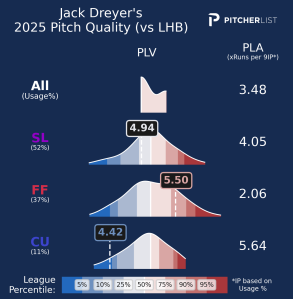
Dave Roberts has done a good job of maximizing the skill set of Dreyer, considering he has faced lefties in 51 plate appearances and righties in 77 plate appearances. This is especially impressive when you account for the fact that Dreyer didn’t open up the year as a leverage arm, and more so as one of the guys who ate up innings in the back of the bullpen.
Despite using that slider over half the time against lefties, Dreyer has yet to allow a barrel on the pitch and only one extra-base hit. The breaking ball is only half the story, as Dreyer’s four-seamer, with its elite induced vertical movement, is very tough to square up.
As is the case with Casparius, it’s not as if Dreyer has been bad against opposing-side batters; it’s just that he’s been so dominant to the same side that you can’t help but highlight those numbers.
Whether it is by merit or necessity, Los Angeles has not been shy about handing these two the reins in key spots. Casparius has already caught on with our reliever team, ranking him highly in SV-Holds leagues, and Dreyer might be next.
Dreyer currently has only five holds this season, but if we look at his usage, three of those have come over his last six appearances, with the other three appearances coming in games Los Angeles was trailing only by two.
The one thing that might work against them in terms of accumulating holds on top of the looming return of some big names is their ability to pitch multiple innings. The Dodgers have just played a pair of close games against the Mets, and in neither did their starter go very deep. Needing to cover a lot of innings, Roberts turned to Casparius and Dreyer for a combined 14 outs to keep these two games close, finding a way to split them.
