





Sometimes, things happen during the baseball season that make you reconsider everything about what you thought was possible to see in this game. Here’s one going on right now:
The Pittsburgh Pirates have one of the best offenses in Major League Baseball.
After a decade in the wilderness, the Pirates are back after a 50-47 first half that has them 2 games back of the final NL wild card spot. Their lineup, painfully futile in recent years, is tied for the MLB lead in runs scored. Their collective 111 wRC+ is second only to the Dodgers. They still strike out a lot, but they lead the sport in batting average and sit inside the top 10 in home runs and walk rate.
If you travelled back in time and told an invested Pirates fan on the morning of Opening Day, hours before Oneil Cruz’s adventurous day in center field and Paul Skenes’s nightmarish start at Citi Field, that this would all come to fruition by mid-July, they’d reasonably assume the offseason additions would be the catalysts. After all, Pittsburgh was unexpectedly active over the winter. They acquired Brandon Lowe, Marcell Ozuna, and Ryan O’Hearn to bolster the offense. Ownership finally seemed to care a little bit. In reality, that’s only part of the answer. O’Hearn, Lowe, and Jake Mangum have all produced either in line with or more than what was expected of them, but Ozuna has been decidedly below replacement level.
The team leader in fWAR and wRC+ among qualified hitters is none other than Bryan Reynolds, the franchise icon who had the worst 162-game season of his career in 2025. At age 30, it seemed a little too soon to speculate on physical decline, and the evidence agrees. His bat speed had marginally increased. His foot speed was unchanged. His swing-and-miss percentage was identical to 2024 when he recorded a .791 OPS. He underperformed his xwOBA by 23 points. Still, it was a tad demoralizing for both player and team, considering he signed an 8-year extension in 2023. For a franchise that rarely pursues long-term contracts, the prospect of Reynolds falling from grace might have discouraged them even further from trying to do the same in the future. If he was going down, the Pirates were going down with him.
Turns out, that goes both ways. A year later, Reynolds hasn’t looked this good since his all-star 2021 campaign, the 6-WAR season that put him on the map. At .283/.400/.477, he’s within striking distance of the coveted .300/.400/.500 slash line, and in fact, his 143 wRC+ would be a lifetime best. Last season saw him post career-worsts in almost every offensive category: Home runs, K%, all 3 triple slash categories, and wRC+. He just barely managed to slug .400. Now, everything looks better across the board.
Except, the more you look, the more you realize that isn’t actually the case. On May 23, he set a new career-high max EV with a 113.7-MPH single, another reassuring sign he isn’t yet declining physically. Beyond that, just about all of his batted ball metrics are strikingly similar to 2025.
| Year | xwOBACON | Hard Hit% | LA | Barrel% | GB% | FB% | Pull Air% |
|---|---|---|---|---|---|---|---|
| 2025 | 0.424 | 46.0% | 7.3° | 10.1% | 47.2% | 23.5% | 15.3% |
| 2026 | 0.415 | 47.3% | 6.9° | 10.1% | 48.4% | 25.2% | 14.7% |
He’s not hitting the ball harder, higher, or to different places than he was during his down year. Yet, his ISO is at its highest since 2023, he’s on pace to exceed 20 home runs again, and his wRC+ has never been higher. He is running a .348 BABIP, which has also never been higher; it was .345 in his breakout 2021 campaign, but has never been below .304 in a given season either. Reynolds’s launch and spray angle distributions have always been pretty close to league-average, and he’s a decently fast runner with gap-to-gap power, so he’s not someone who’s going to experience crazy BABIP fluctuations year over year. Sure, this is probably the high end of what we can expect from him, but his resurgence doesn’t come with a ton of red flags.
So, what has changed about his plate skills? His zone contact rate is 83.8%, a level not seen since 2022, but he’s sat between 80% and 85% his whole career. As a result, his strikeout rate is down to 22.3%, better than last year but right in line with personal norms. What he is doing is taking walks at a much higher rate than usual. I’d like to imagine he was doom-scrolling social media at the start of spring training and came across the Idris Elba “Learn to sit back and observe. Not everything needs a reaction” meme and decided to make that his personal mantra.
He’s now walking more frequently than 95% of hitters in MLB thanks to a career-low chase rate. Relatively speaking, he didn’t shave nearly as much off his chase rate this year as he did last year. In 2024, it was all the way up to 30%. I can respect the fact that he doubled down on this patient approach even though it didn’t bear fruit in 2025. The fact that his contact rate on pitches out of the zone is also at a career-low perfectly demonstrates how swing decisions and power output interact. Extreme bat-to-ball guys are trying to make contact with everything because they can’t make pitchers pay for mistakes as much as power hitters can. For most hitters in the league, though, a lower chase contact rate is better, because it’s harder to do damage on anything out of the zone. Reynolds is swinging at bad pitches, and making contact with them less often. If a hitter wants to increase their slugging percentage by 75 points as he has without wholesale mechanical adjustments, that’s a simple and effective place to start.
Intuitively, though, a ~3% reduction in chase rate shouldn’t lead to this big a bump in walk rate. Reynolds is swinging at the first pitch at a frequency almost identical to last year, which signals that it’s the changes he’s making when ahead in the count that are making the biggest difference.
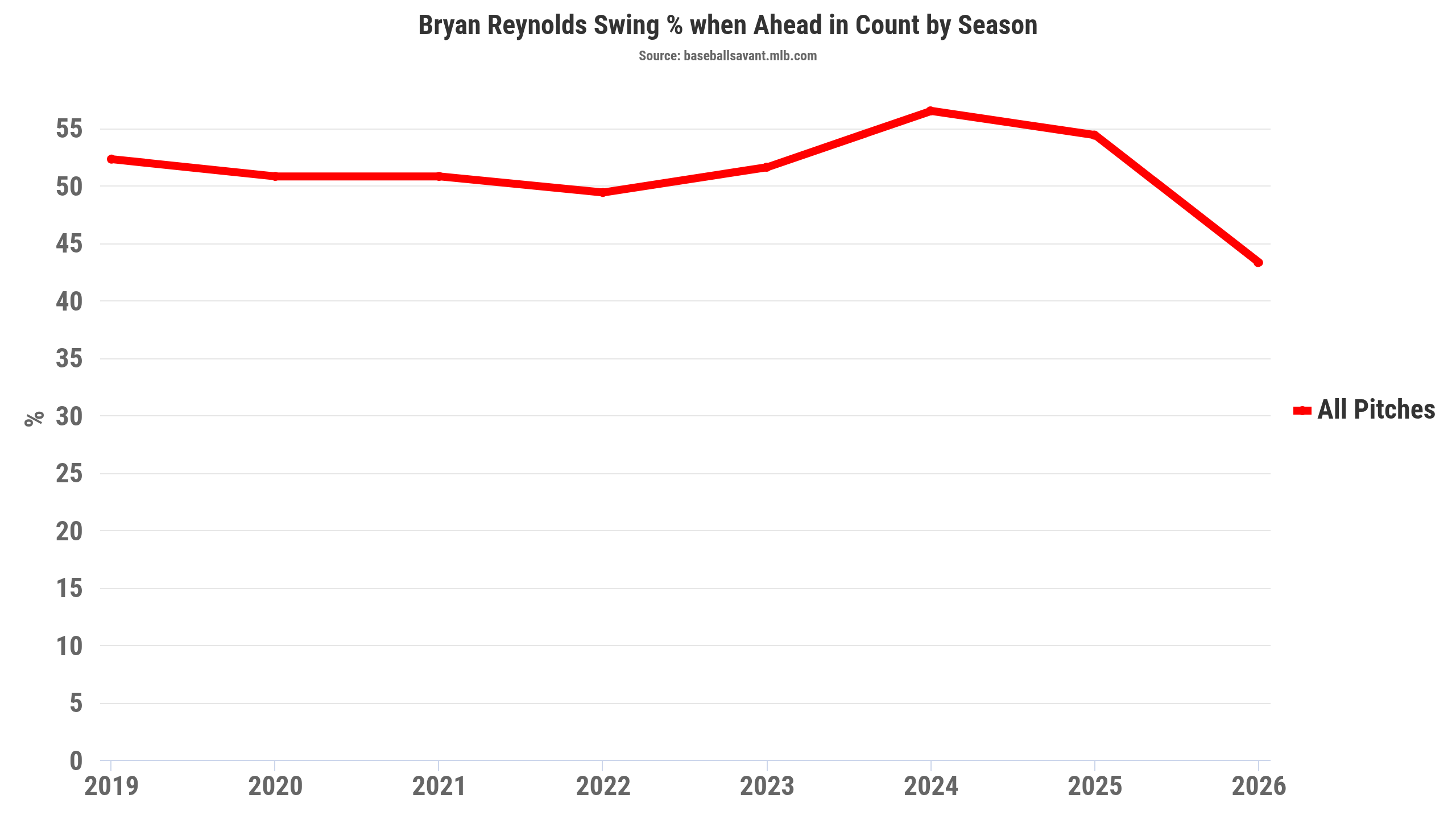
This chart alone captures the essence of how Reynolds is getting on base so much, but it’s also worth getting a little more granular:
In a recent interview with MLB.com’s Aiden Stepansky, Reynolds stated that he doesn’t think about walking, and that when it happens, it’s more of a byproduct of him seeing the ball well. I think breaking things down by count illuminates what “seeing the ball well” means for him. The count is an all-powerful bit of context that is a chief determinant of strategy for both pitchers and hitters. When hitters find themselves in good counts, it’s imperative they don’t stray from their plan and allow the pitcher to tightrope out of trouble. In 3-ball counts, Reynolds has cut his swing rate by more than 20%. Even in 3-2 situations, the most pressure-packed count state there is, he’s showing heightened selectivity. In favorable scenarios, he has been at his most cautious in terms of deciding what to swing at. That’s a skill that makes any hitter a tough out, and it tells us a lot about why he’s at the center of what’s going on in Pittsburgh this year.
While we’re here, I should point out a delightful wrinkle in Reynolds’s career trajectory: He has become a true Swiss army knife when it comes to switch-hitting. He’s long been a capable switch hitter, with a career 122 wRC+ from the left side and a 114 wRC+ from the right side. He usually walks a little less and strikes out a little more as a righty. The past few years, though, have been a beautiful act of symmetry. During that wonderful 2021 season, he was a 140 wRC+ bat from both sides of the plate. There was no such thing as a platoon advantage. The next few years, he was better as a lefty, but that trend reversed in 2025. That brings us to this year, where he is currently laying waste to left-handed pitching.
A tip of the cap is warranted for the season Phillies outfielder Brandon Marsh is having (.297/.335/.484, 121 wRC+, 15 HR, 1.5 fWAR). It’s not surprising that he won the fan vote to start the All-Star Game in front of the Philadelphia faithful at Citizens Bank Park this year, given the circumstances, but Reynolds absolutely deserved to be there instead. Much like 5 years ago, I am imploring the masses to take note that Bryan Reynolds is better than you thought he was. Sure, part of his bounce-back can be chalked up to positive regression, but he knew that to do his part, he didn’t have to reinvent the wheel: The small changes he made to his approach have had far-reaching effects. A strong group of wild-card contenders in the National League means the Pirates have plenty of work to do if they’re going to make the playoffs, but if they do, it’s sure to mean the most to Reynolds, who is going above and beyond to take them there after witnessing the lean years firsthand.
All stats entering July 17, 2026.
