





Despite flying under the radar in his early minor league days, even going unranked by MLB Pipeline as recently as 2024, Cam Schlittler is poised to secure a postseason rotation spot for the Yankees after an excellent half-season of work.
In 13 starts, Schlittler has a 3.27 ERA/3.95 FIP over 66.0 innings, and has a 2.61 ERA over his last eight starts. A mid-July Tommy John surgery for Clarke Schmidt led to a last-minute call-up for Schlittler, who opened his season with a strong 5.1 innings against the Mariners and hasn’t looked back since.
Schlittler’s season started far earlier than July, however. After opening the season in AA Somerset, Schlittler made 9 starts/10 appearances with a 2.38 ERA before climbing to AAA, making just five starts and joining the Yankees soon after.
So what led to such a quick ascent to the Majors? Schlittler had been solid in the minors for two years before taking a dramatic step forward in 2025, led by a few driving factors: velocity and stuff.
Current Pitch Mix
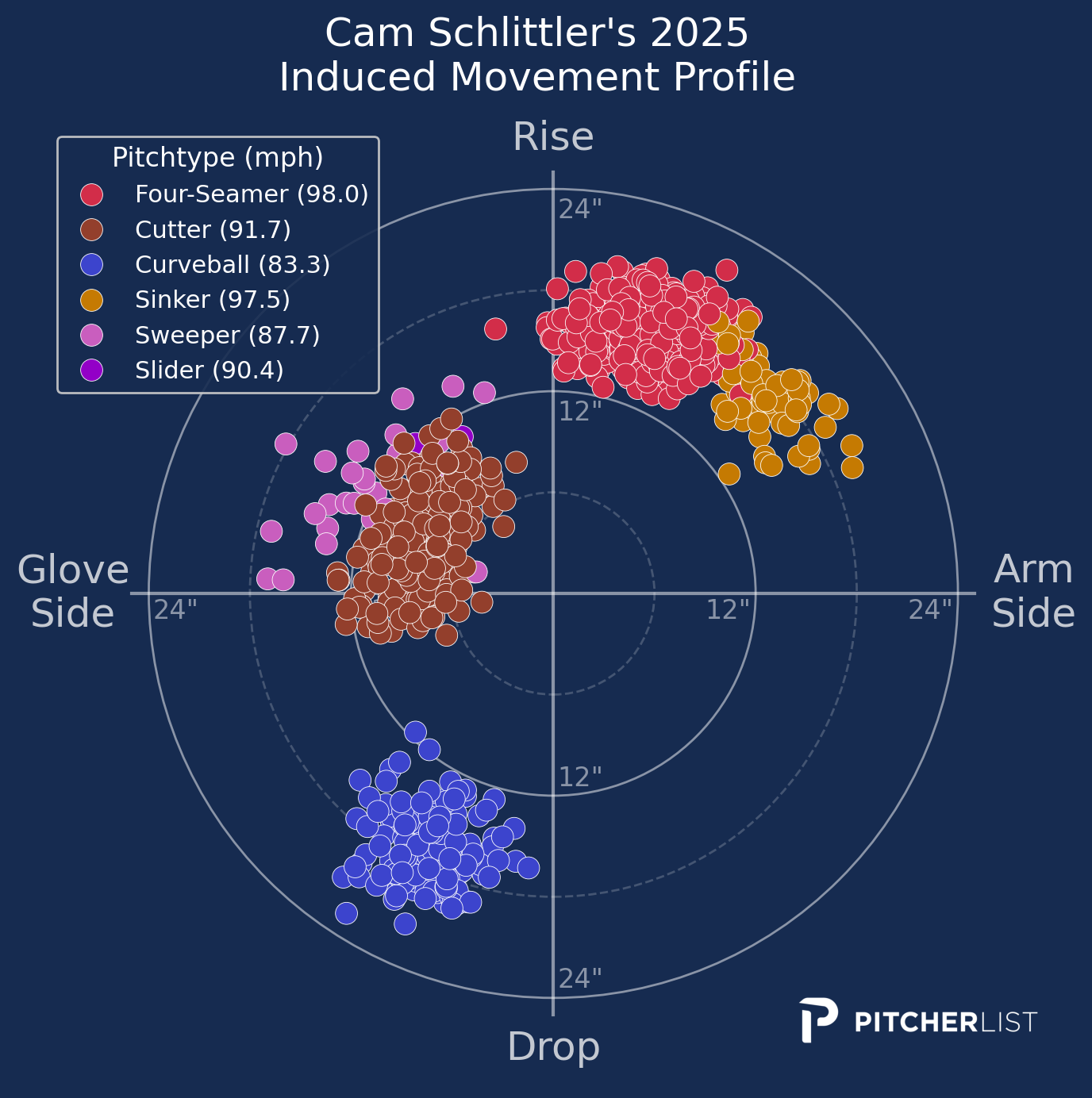
In what’s been dubbed the “year of the pitch mix,” Schlittler has climbed three levels with a fairly simple arsenal. While floating a sweeper occasionally and gradually adding a two-seam/sinker, Schlitter has been four-seam heavy with a hard slider/cutter and curveball as secondaries.
Each of his pitches has a strong combination of poor batted-ball metrics and solid whiff rates, so far, thanks to his elite velocity overall and great movement on breaking pitches. Even with his glove-side heavy movement profile, his new sinker, combined with high-grading stuff overall, has helped keep splits fairly neutral.
The big neutralizer, however, has been his four-seam. After averaging ~93 in the minors in 2024 and adding two ticks in 2024, Schlittler has sat 98 in the Majors, getting all the way up to 100.6 mph in an August start vs. the Mariners. This velocity development is far from common and likely a product of intentional development by Schlittler to fill out his 6’6 frame.
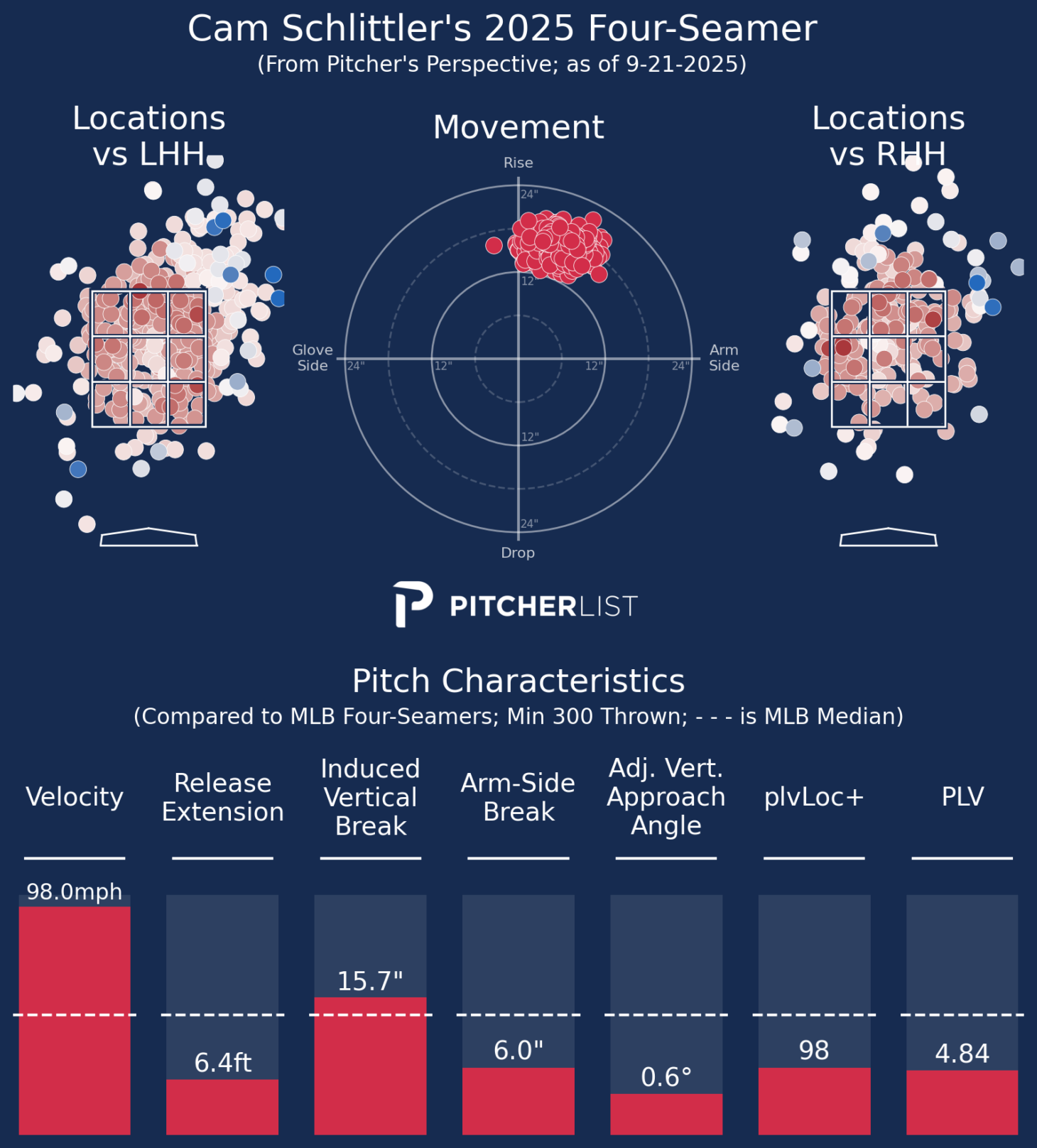
Without this added velocity, Schlittler’s four-seam would be a far more average pitch. Regardless, its elite velocity and decent command turn it into an impressive offering capable of being thrown 55% of the time with a .182 BAA.
Schlittler’s secondaries are more of an interesting story. While Schlittler boasts high velocity on his cutter/slider, it still gets an elite 8 inches of glove-side break at nearly 92 mph. His curveball also has an average of -13 inches of induced vertical break at 83 mph, a solid offering that’s been key to generating ground balls vs. lefties.
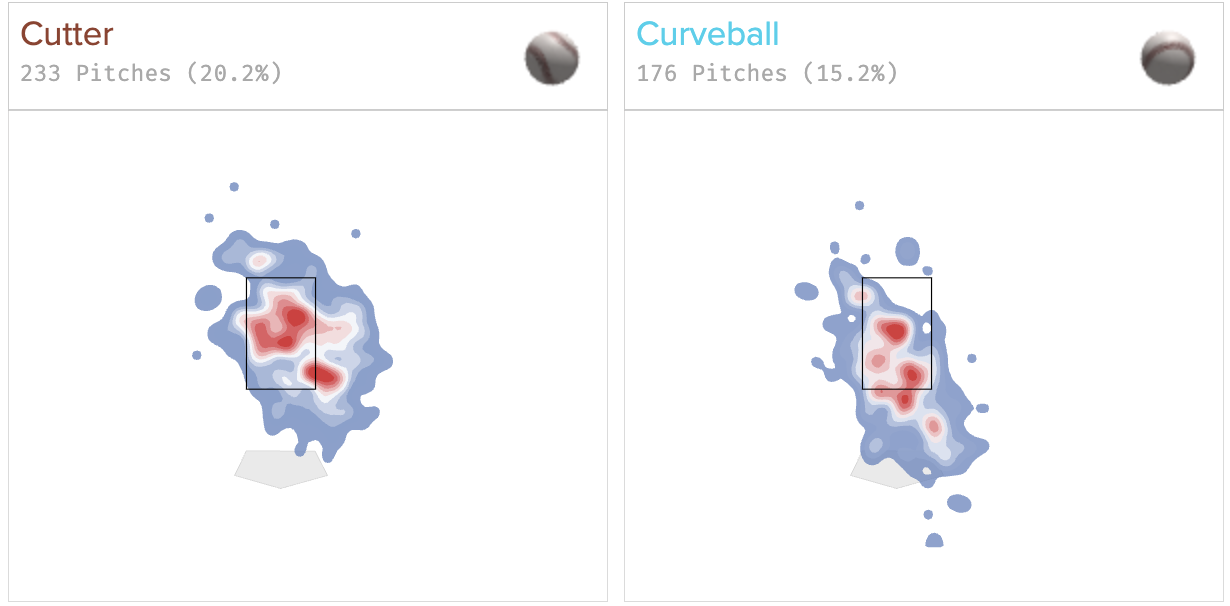
Data via Baseball Savant
Command of these secondaries, however, has been a challenge. Too many mistakes over the plate have prevented his cutter and curveball from consistently generating whiffs, while their batted ball results have taken a similar hit.
Overall, Schlittler’s current offerings have the stuff of a front-end starter. Improvements to his command are gonna be key to unlocking his best pitches, but there are still other options to consider that could be just as important.
Future Pitch Mix
Schlittler’s induced movement profile suggests a lack of arm-side offerings with depth, outside of a steadily improving two-seam. According to David Laurila of Fangraphs, Schlittler had worked on a splitter in spring training, but ditched it after struggling with execution.
As a heavy supinator, adding an offspeed pitch with consistency has likely already been a known challenge for Schlittler. However, he has reportedly yet to try a kick-change, a newly popularized version of the changeup with more drop and high application for natural supinators like Schlitter. If a version of the kick-change were to click with Schlittler, it could boost whiffs against lefties and ground balls against righties, an improvement from his already solid splits.
The number one priority for Schlittler will be continuing to develop command. Walk rates are already too high, and without improvements to his breaking ball locations, adding another pitch will only further complicate execution. Still, this doesn’t mean it would be impossible.
If a kick-change or similar offering were to feel comfortable, Schlittler could have some of the best stuff for a starter in the league. Such a development could be the difference between Schlittler developing into a solid, middle-of-the-rotation arm with high-octane stuff and becoming a star in the Yankees’ rotation.
Regardless, Schlittler has the potential of a frontline starter. Three plus-to-elite pitches is an impressive trait for a 24-year-old starter, and by continuing to develop at the Major League level, Schlittler could have a bright future ahead.
